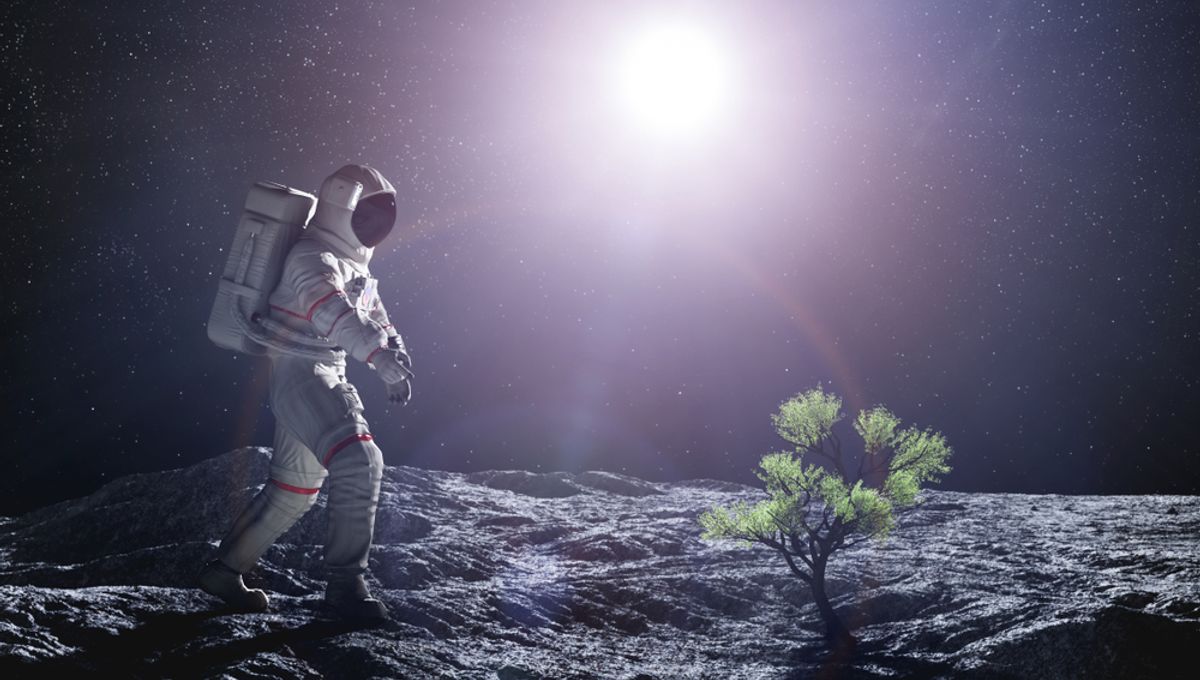
Plants are not just able to survive in low gravity such as on the Moon, two new papers suggest – they may prefer it, at least based on the only species to sprout.
When Chang’e 4 landed on the Moon in January 2019 it carried with it a payload that could dictate the future of space exploration: seeds of four plant species it sought to grow on the lunar surface. The germination of a single cotton seed attracted plenty of attention at the time, but there’s more to growth than just sprouting. If crops grown on the Moon are less productive or more fragile than those on Earth, it’s going to be a big problem.
It’s taken more than four years, but important results from the experiment have been released in 2023 and they suggest that for all the obstacles to establishing colonies on the Moon and Mars, growing food might not be one. Then again, it’s still very early days.
It’s important to note that Chang’e 4 did not try to grow the seeds in lunar soil. Other experiments have shown that is possible, albeit difficult. Instead, the test was only of whether the Moon’s low gravity and high radiation would prove a problem for plants. Gravity is the most important part of this question. After all, if the Sun’s radiation, unfiltered by an atmosphere, turns out to damage plants we can always find ways to tint the roofs of domes on other worlds. Altering the downward force leaves and stems experience would be more of a challenge.
Fortunately, however, it seems like that won’t be necessary. In fact, low gravity may help offset some of the other difficulties to be faced beyond Earth’s embrace.
The first results comparing the plants on the lunar surface with those on Earth were released by a team from Chongqing University in June 2023, and more details is now available. While Chang’e 4 was doing its thing on the Moon the authors placed matching seeds in a facility with identical soil kept to the same temperature, humidity, and air pressure.
“We discovered that the 1/6 g moon gravity speeds up seed germination,” the researchers announced in one of the papers.
Only one of the cotton seeds, and none of the other plants, sprouted on the Moon, in contradiction to reports at the time. On Earth some canola plants geminated, along with cotton seeds.
The greatest threat the lunar seedling faced was the long night, which started nine Earthly days after landing. Temperatures inside the lunar compartment dropped to -52°C (-61°F), so the Earthly control was cooled to match. Warmth did not return for around 18 Earthly days.
Astonishingly, the lunar seedling was still green and upright when the light returned. The Earthly equivalents, however, were dead and black-yellow in color. The plucky Moon-seedling survived the second lunar day although its growth stalled, which the researchers attribute to the compartment running out of oxygen.
The researchers suspect the low gravity triggered a freezing resistance some polar plants have developed, but which has long since been deregulated for warm-climate plants like cotton. Sadly, however, the cotton seedling appears to have died during the second lunar night, and over five lunar days none of the other seeds germinated.
The authors attribute the failure of the other three plant species to sprout to temperatures having exceeded their comfort zone over the first five days.
Besides the obstacles, lunar farming has some potential advantages. Like the underwater agriculture described in this episode of our podcast The Big Questions, it should be free from pests and weeds, and therefore the chemicals used to control them.
Experiments on the International Space Station have demonstrated plants don’t need gravity to grow and even bear fruit. However, these plants have generally been mollycoddled with optimum conditions in every other way. The fact that low-gravity cotton is able to overcome the cold is a revelation that could prove very significant.
The ability to farm will be even more important for Martian bases than their lunar counterparts. Bringing food from Earth to the Moon will be expensive, but not nearly as prohibitive as to Mars. With roughly twice the lunar gravity, it’s to be hoped Mars will have a similar effect on plants.
The two studies from 2023 are published in Microgravity Science and Technology and Acta Astronautica.
An earlier version of this article was published in November 2023.

Source Link: Groundbreaking "Lunar Farm" Shows Plants Can Grow On the Moon
