• Email Us: [email protected]
  • Contact Us: +1 718 874 1545
  • Skip to main content
  • Skip to primary sidebar

Medical Market Report

  • Home
  • All Reports
  • About Us
  • Contact Us

“Guest Star” Last Seen 840 Years Ago Finally Found Again, And It Looks Weird

January 17, 2023 by Deborah Bloomfield

In the year 1181 CE, astronomers in China and Japan observed a new bright object appearing in the constellation of Cassiopea. These observers called it a “Guest Star”. The most likely culprit was a supernova – but for 840 years, this object was lost. The object was seen again in 2013, but it was only in 2021 that the connection to the ancient event was made. Now, new follow-up observations reveal something absolutely peculiar.

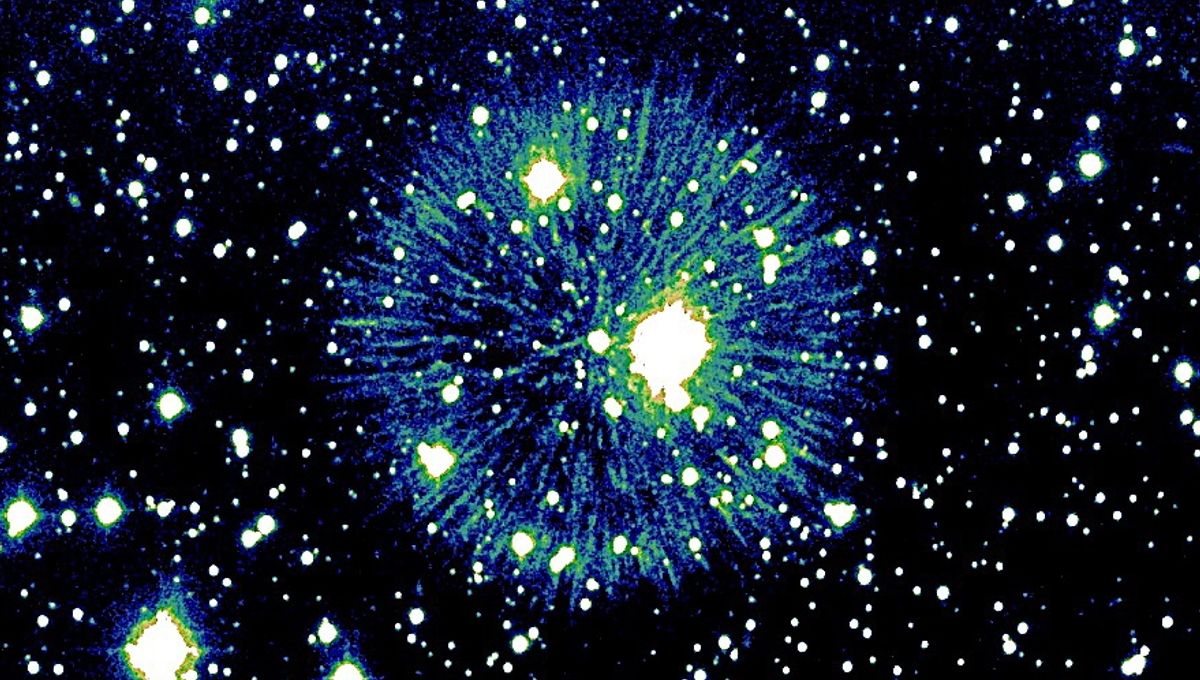
The supernova remnant, the usually illuminated nebula that surrounds the remains of an exploded star, looks like a firework. Thin strands of material are seen radiating from a highly unusual star. The object, called Pa 30, does not look like your usual supernova.

Advertisement

“I have never seen any object—and certainly no supernova remnant in the Milky Way galaxy—that looks quite like this, and neither have any of my colleagues,” lead author Professor Robert Fesen, from Dartmouth College, said in a statement. “This remnant will allow astronomers to study a particularly interesting type of supernova that up to now they could only investigate from theoretical models and examples in distant galaxies.”

Models suggest that it is the result of a collision between two white dwarfs. This stellar merger creates a subclass of supernovae called Type Iax (pronounced One-a-x). The team reported that the structures contain little hydrogen and helium, but are rich in sulfur and argon.

“Our deeper images show that Pa 30 is not only beautiful, but now that we can see the nebula’s true structure, we can investigate its chemical makeup and how the central star generated its remarkable appearance, then compare these properties to predictions from specific models of rare white dwarf mergers,” Fesen said.

Advertisement

Previous work couldn’t characterize the object in such detail, but could estimate that it was around 1,000 years old and its location fit observations conducted by Asian astronomers in the 12th century. Thanks to the new observations, the team determined that the supernova took place around 850 years ago.

“Our new observations put a much tighter constraint on the object as having an expansion age of around 850 years, which is perfect for it to be the remains of the 1181 guest star,” Fesen said.

When it exploded, the star would have been as bright as Vega. 

Advertisement

The new work is accepted for publication in The Astrophysical Journal Letters and presented at the 241st Meeting of the American Astronomical Society. 

Deborah Bloomfield
Deborah Bloomfield

Related posts:

  1. Norway coalition talks start, with climate and oil in focus
  2. Indonesian fintech Xendit is now a unicorn, with $150M in fresh funding led by Tiger Global
  3. U.S. Senator Cruz vows to block new Democratic debt ceiling ploy
  4. Yellen says U.S. may exhaust cash by Oct 18 barring debt ceiling rise

Source Link: "Guest Star" Last Seen 840 Years Ago Finally Found Again, And It Looks Weird

Filed Under: News

Primary Sidebar

  • Astronomers Catch Incredible First Direct Images Of Objects Colliding In Another Star System
  • Billionaire Jared Isaacman Finally Confirmed As Head Of NASA, As Agency Faces Uncertain Future
  • Something Just Crashed Into The Moon – And Astronomers Captured The Whole Event
  • These “Living Rocks” Are Among The Oldest Surviving Life And Are Champion Carbon Dioxide Absorbers
  • Ambitious Iguana “Love Island” For Near-Extinct Reptiles Becomes Epic Conservation Success Story
  • Sol 1,540: NASA Releases Video Of Perseverance Rover’s Record-Breaking Drive On Mars
  • Why Carl Sagan Was Way Ahead Of His Time And The Legacy He Left Behind
  • Why Were Pompeii Victims All Wearing Thick Woolly Cloaks In August?
  • We May Finally Know What Causes These Bizarre Bright Blue Cosmic Flashes
  • What’s The Biggest Rock In The World?
  • There Is A Very Simple Test To See If You Have Aphantasia
  • Bringing Extinct Animals To Life: Is Artificial Intelligence Helping Or Harming Palaeoart?
  • This Brilliant Map Has 3D Models Of Nearly Every Single Building In The World – All 2.75 Billion Of Them
  • These Hognose Snakes Have The Most Dramatic Defense Technique You’ve Ever Seen
  • Titan, Saturn’s Biggest Moon, Might Not Have A Secret Ocean After All
  • The World’s Oldest Individual Animal Was Born In 1499 CE. In 2006, Humans Accidentally Killed It.
  • What Is Glaze Ice? The Strange (And Deadly) Frozen Phenomenon That Locks Plants Inside Icicles
  • Has Anyone Ever Actually Been Swallowed By A Whale?
  • First-Known Instance Of Bees Laying Eggs In Fossilized Tooth Sockets Discovered In 20,000-Year-Old Bones
  • Polar Bear Mom Adopts Cub – Only The 13th Known Case Of Adoption In 45 Years Of Study At Hudson Bay
  • Business
  • Health
  • News
  • Science
  • Technology
  • +1 718 874 1545
  • +91 78878 22626
  • [email protected]
Office Address
Prudour Pvt. Ltd. 420 Lexington Avenue Suite 300 New York City, NY 10170.

Powered by Prudour Network

Copyrights © 2025 · Medical Market Report. All Rights Reserved.

Go to mobile version