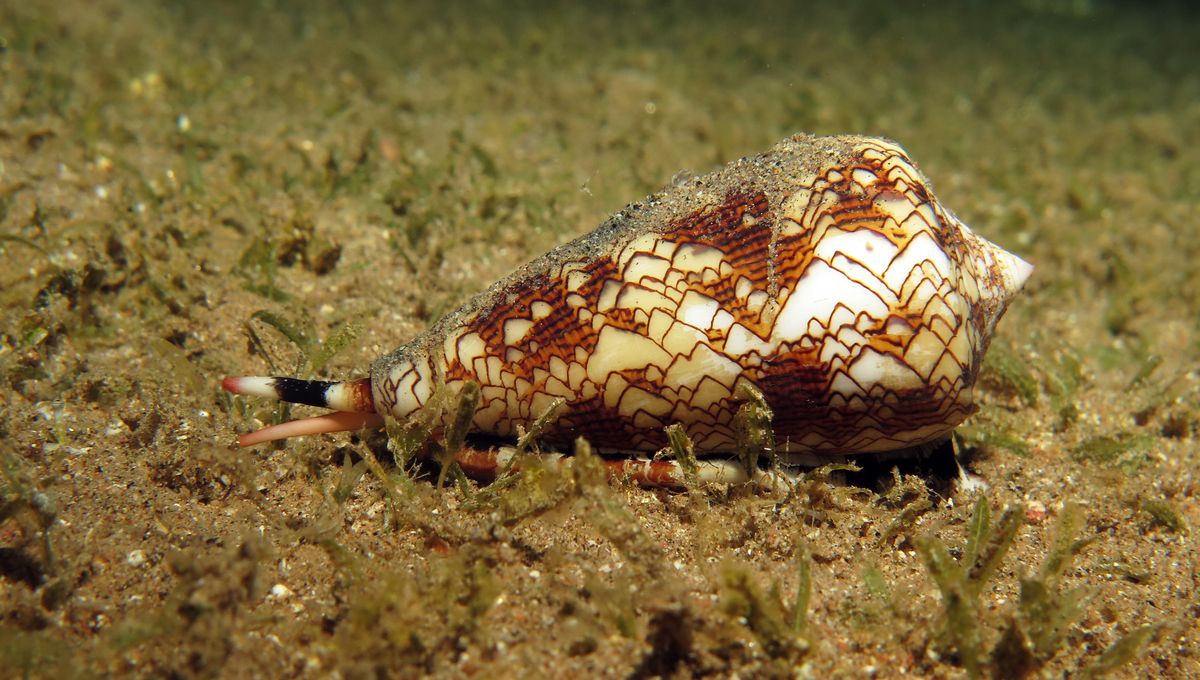
A snorkeler had a dangerously close call after picking up a stunning seashell, unaware that it was potentially home to one of the ocean’s most venomous sea snails.
ADVERTISEMENT
An anonymous Redditor recently shared a photo of a seashell in his hand on r/AnimalID, a subreddit dedicated to identifying animal species from pics and video, explaining that he found it while snorkeling in Egypt’s Red Sea.
“I thought I just found a very pretty seashell and was thinking about taking it home as a souvenir, but I noticed it’s still alive, feeling some weight and movement inside, so I decided to at least take some pictures of it. Only months later I was told handling it like this might have been a very bad idea. Could you help me ID exactly what it was and what kind of danger I was really in?,” his posts reads.
He added: “Was it realistically a threat to my life?”
The short answer was yes – that pretty little shell in his hand was likely home to a very dangerous snail.
ADVERTISEMENT
Many Reddit users quickly recognized the shell as belonging to a venomous cone snail. In particular, some speculated whether it was a textile cone snail, a member of the cone snail family that can deliver an especially nasty sting to humans.
“You’re lucky and you’re also foolish,” one user commented.
“Op, don’t ever touch living creatures underwater. For your safety and that of the creatures down there,” another commented.
“If it’s a cone, leave it alone,” said one wise soul.
ADVERTISEMENT
“If you ever come to Australia, please don’t touch ANYTHING, on land or in the water,” quipped another user.
Cone snails are marine mollusks equipped with a specialized tooth, or “radula,” which functions like a spear to inject a potent cocktail of conotoxins for defense and hunting.
There are hundreds of species of cone snails, all of which are venomous. However, some are more potent than others. Most will deliver a mild sting, but at least two species – the textile cone (Conus textile) and the geography cone (Conus geographus) – can inject venom that’s capable of killing a human.
Fatality estimates vary, but the Carnegie Museum of Natural History claims there have been fewer than 100 deaths from cone snails. A 2004 Nature News article put the figure closer to 30 deaths.
ADVERTISEMENT
Either way, that fatality rate should be more than enough to convince you to steer clear of these shelled fellas, no matter how great they’d look in your vacation Instagram post.
Unsurprisingly, this lucky snorkeler isn’t the first to have a close call with a cone snail. In 2023, another person on Reddit shared an incredibly similar story of someone unearthing a textile cone snail from a sandy beach, coincidentally also in Egypt. Fortunately, they too managed to avoid a sting, but it just goes to show that these creatures are best left undisturbed despite their good looks.
As a rule of thumb, it’s best to leave nature untouched – both for your safety and the wellbeing of the ecosystem around you. Likewise, leave the habitat exactly as you found it (don’t, for instance, leave a bag of Cheetos in a vulnerable, sealed-off environment).

Source Link: Guy Picks Up A Stunning Sea Shell, Unaware He Was Extremely Close To Danger
