• Email Us: [email protected]
  • Contact Us: +1 718 874 1545
  • Skip to main content
  • Skip to primary sidebar

Medical Market Report

  • Home
  • All Reports
  • About Us
  • Contact Us

Habitable Rocky Super-Earth Discovered Orbiting Star Just 100 Light-Years Away

September 9, 2022 by Deborah Bloomfield

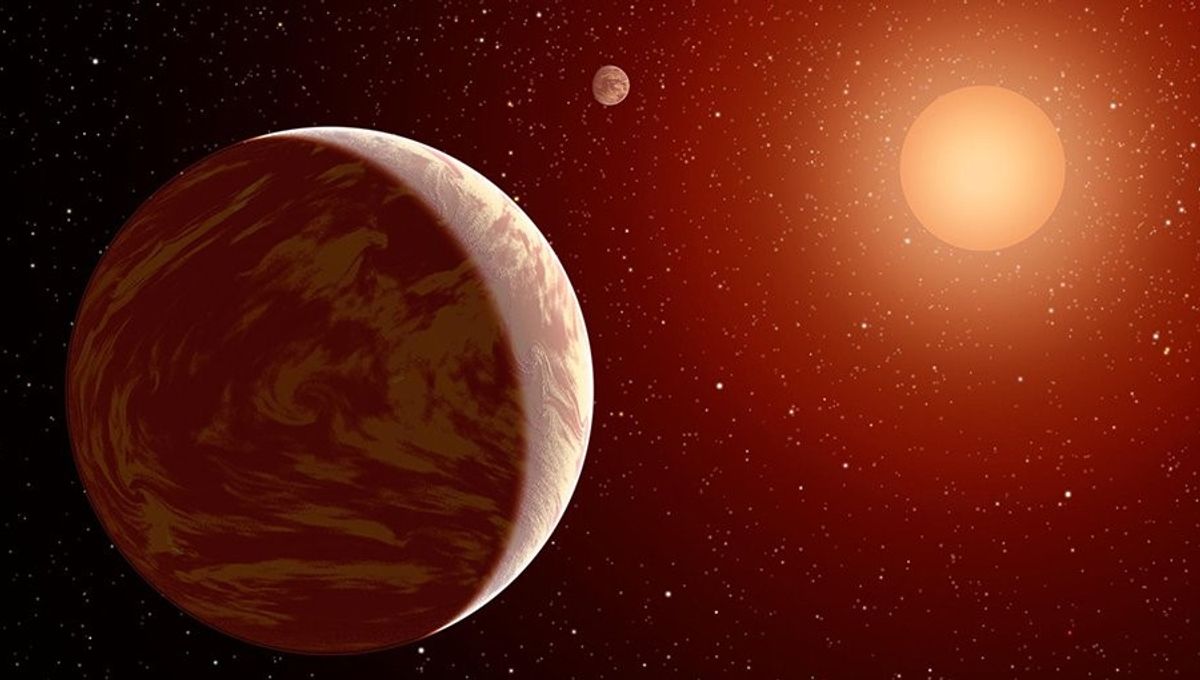
Two new rocky super-Earths can be added to the now long list of known exoplanets, worlds that orbit stars outside the Solar System. This finding is exciting for multiple reasons. They orbit an ultra-cool star, they are relatively close to Earth – about 100 light-years away – and one of them is in the habitable zone, the region where a planet gets enough starlight for water to be liquid.

As reported in the journal Astronomy & Astrophysics, the team set out to confirm the detection of one of the exoplanets by NASA’s planet-hunting space telescope, TESS. The planet is orbiting star TOI-4306, which has a temperature less than half as hot as the Sun. While there, they found another.

Advertisement

Exoplanets can only be confirmed when observed with two different techniques, so this follow-up was necessary.

“This follow-up is particularly important in the case of relatively cold stars, such as TOI-4306, which emit most of their light in the near-infrared and for which TESS has a rather limited sensitivity,” lead author Dr Laetitia Delrez, from the University of Liège, explained.

This follow-up actually led to a new discovery, one-upping what TESS was able to spot.

Advertisement

“Using the combined near-infrared sensitive ground-based telescopes of the SPECULOOS consortium – including the Bern led SAINT-EX telescope in Mexico – we were not only able to confirm and characterize the candidate planet that TESS had detected, but also discovered a rather special second, previously unknown planet,” co-author Brice-Olivier Demory, from the University of Bern, added.

The team estimates that both planets are made of rocky material and they are between 30 to 40 percent larger than Earth, bigger but not vastly different. They orbit the star respectively in 2.7 days and 8.5 days. But the star is smaller and cooler than the Sun, so the second planet is in the habitable zone, just like our own.  

“This second planet receives about the same amount of stellar radiation as our Earth receives from the Sun and could therefore potentially have liquid water on its surface,” said co-author Dr. Robert Wells from the University of Bern.

Advertisement

“But we should not get ahead of ourselves. Being in the right spot does not guarantee a palm beach. Our neighbor planet Venus, which is, so to speak, a CO2-rich, near 500°C pressure cooker, is also near this so-called habitable zone around the Sun.”

JWST may be able to study this planet’s atmosphere and determine if it has the right ingredients to be Earth-like or if it is a different kind of world altogether.

Deborah Bloomfield
Deborah Bloomfield

Related posts:

  1. U.S. Ex-Presidents Bush, Clinton, Obama band together to aid Afghan refugees
  2. Twitter re-opens its account verification process after another pause
  3. Review: The Surface Pro 8 with Windows 11 is fast and fresh
  4. Sure raises $100M at a $550M valuation to help companies launch insurance products with its ‘flexible’ APIs

Source Link: Habitable Rocky Super-Earth Discovered Orbiting Star Just 100 Light-Years Away

Filed Under: News

Primary Sidebar

  • Could This Weirdly Moving Comet Have Been The Real “Star Of Bethlehem”?
  • How Monogamous Are Humans Vs. Other Mammals? Somewhere Between Beavers And Meerkats, Apparently
  • A 4,900-Year-Old Tree Called Prometheus Was Once The World’s Oldest. Then, A Scientist Cut It Down
  • Descartes Thought The Pineal Gland Was “The Seat Of The Soul” – And Some People Still Do
  • Want To Know What The Last 2 Minutes Before Being Swallowed By A Volcanic Eruption Look Like? Now You Can
  • The Three Norths Are Moving On: A Once-In-A-Lifetime Alignment Shifts This Weekend
  • Spectacular Photo Captures Two Rare Atmospheric Phenomena At The Same Time
  • How America’s Aerospace Defense Came To Track Santa Claus For 70 Years
  • 3200 Phaethon: Parent Body Of Geminids Meteor Shower Is One Of The Strangest Objects We Know Of
  • Does Sleeping On A Problem Actually Help? Yes – It’s Science-Approved
  • Scientists Find A “Unique Group” Of Polar Bears Evolving To Survive The Modern World
  • Politics May Have Just Killed Our Chances To See A Tom Cruise Movie Actually Shot In Space
  • Why Is The Head On Beer Often White, When Beer Itself Isn’t?
  • Fabric Painted With Dye Made From Bacteria Could Protect Astronauts From Radiation On Moon
  • There Used To Be 27 Letters In The English Alphabet, Until One Mysteriously Vanished
  • Why You Need To Stop Chucking That “Liquid Gold” Down Your Kitchen Sink
  • Youngest Mammoth Fossils Ever Found Turn Out To Be Whales… 400 Kilometers From The Coast
  • The First Wheelchair User To Travel To Space Is About To Make History
  • “It Was Bigger Than A Killer Whale”: 66 Million-Year-Old Tooth Suggests Mosasaurs Were Hunting In Rivers, Not Just Seas
  • Killer Whales And Dolphins Team Up In First-Ever Footage Of Cooperative Hunting
  • Business
  • Health
  • News
  • Science
  • Technology
  • +1 718 874 1545
  • +91 78878 22626
  • [email protected]
Office Address
Prudour Pvt. Ltd. 420 Lexington Avenue Suite 300 New York City, NY 10170.

Powered by Prudour Network

Copyrights © 2025 · Medical Market Report. All Rights Reserved.

Go to mobile version