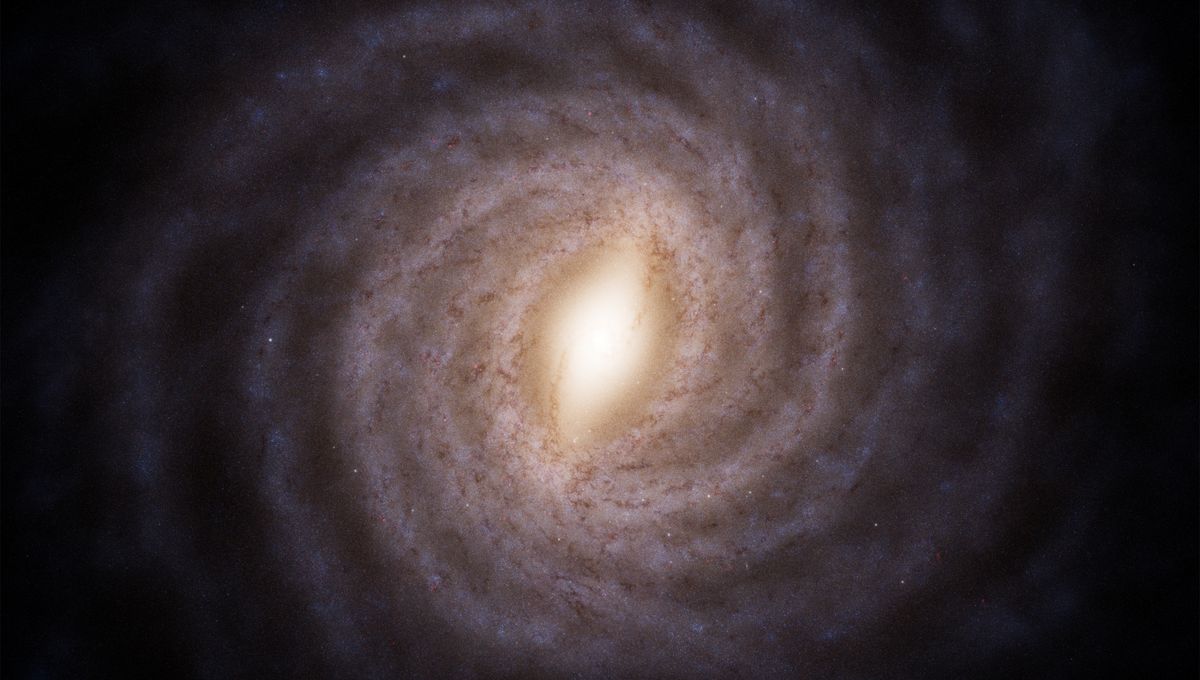
Our galaxy, the Milky Way, is a beautiful barred spiral galaxy, but we will never see what it looks like from the outside. It is too big, and we are too deeply inside it. This limitation results in some large uncertainties about the detailed structure of our place in the universe. A new method to map our galaxy “from the inside out” aims to fill these gaps.
The current best map of the Milky Way was produced by the European Space Agency’s Gaia observatory, which was retired earlier this year. Its full data set is still being analyzed, and the best is clearly yet to come. The new work uses a combination of the third data release and spectroscopic analysis from the European Southern Observatory survey, which added chemical abundances to the Gaia map.
In the new study, the team tracked the “chemical fingerprints” of stars – what they are made of rather than where they are – in a way that enabled them to study a portion of the Scutum and Sagittarius spiral arms, located towards the center of the Milky Way, in a new way. Not only that, they even detected a spur connecting the two arms, a structure that was unknown before.
The outer spiral arms of the Milky Way are well studied, but it gets harder the closer in we get. As we are viewing them from inside – we are located in the Orion arm – we cannot see the whole galaxy, nor can we see through the dust that hides the inner arms in the region between the Sun and the galactic center, which means the exact number and shape of the arms have yet to be determined.
“Dense clouds of dust obscure our view of the Galactic centre, and traditional methods such as stellar density or gas distribution provide only part of the picture,” lead author Dr Carlos Viscasillas Vázquez, from Vilnius University, said in a statement seen by IFLScience.
The team wanted to explore whether they could map the spiral arms by studying the chemical elements of the stars instead. They used stellar spectroscopy to determine the chemical makeup of stars by analyzing their light.
“It was only very few examples of this type of research before we did it. We didn’t know whether it was going to work with a different dataset, but it did. We were even able to see the spirals from another perspective for the first time – in a vertical view,” said Dr Viscasillas Vázquez.
This new chemical method allowed them to see patterns that would have remained hidden otherwise, like the spur linking the Scutum and Sagittarius spiral arms. “By applying a technique that allows us to see even small differences in chemical abundances, the arms clearly emerged,” said Dr Laura Magrini at the Arcetri Observatory in Italy.
The team found that the spiral arms influence the star formation, and while stars can travel in and out of the overdensities we call spiral arms, there are clear chemical signatures left behind. The team praised the work of Dr Elisa Poggio and her team, who recently showed the presence of a vast wave traveling across the Milky Way.
“Observing the Galaxy is like standing in the middle of a brightly lit city at night. If you look toward the outskirts, the view is clearer – you can make out individual streets, scattered houses, and the distinct glow of streetlights and cars in motion,” Dr Viscasillas Vázquez explained.
“But when you turn towards the city centre, everything becomes a blur of overlapping lights, dense buildings, and constant movement – making it hard to separate one structure from another. The same happens when we observe the Milky Way, looking outward, we see more clearly, looking inward, toward the Galactic centre, we face a crowded, complex scene.”
Thanks to Gaia and the combination of other observatories, our understanding of our galaxy has changed significantly, even though some limitations persist. A successor for Gaia has been proposed, which could reveal and measure billions more stars. For now, this new mapping method allows us to see more details of the galaxy, a step forward in understanding what our island of stars in the universe is really like.
The study is published in Astronomy & Astrophysics.

Source Link: Hidden Features In Our Galaxy Discovered By Studying The Milky Way From The Inside Out
