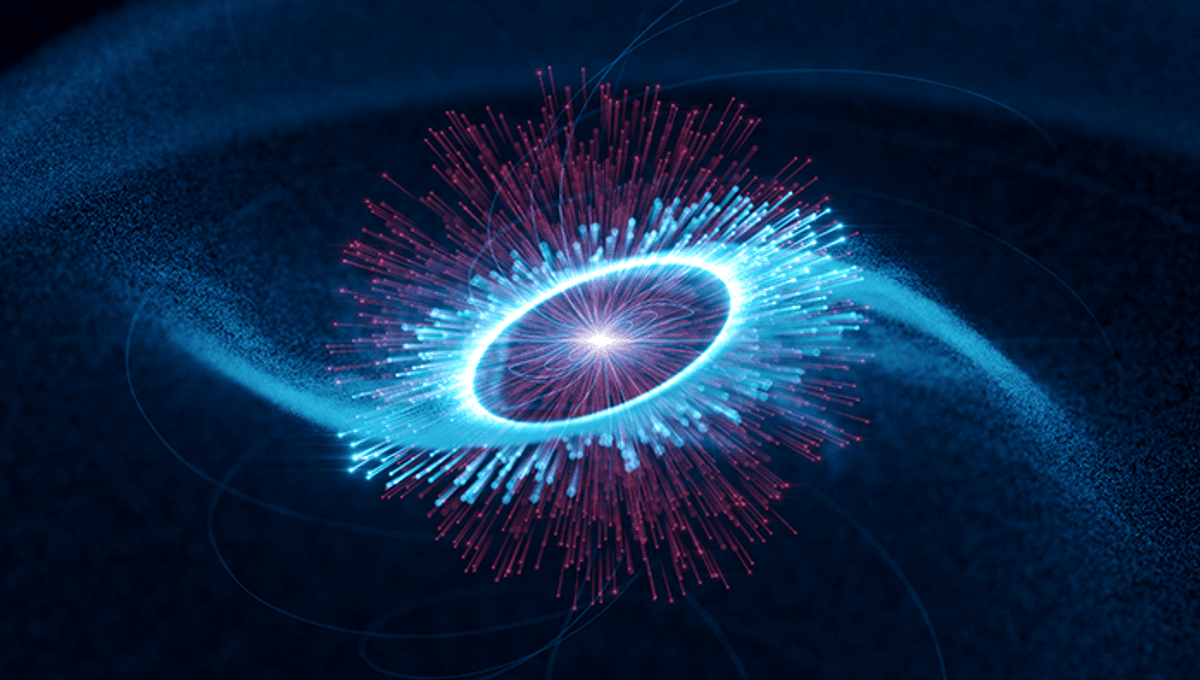
Scientists have observed some incredibly energetic light coming from a nearby pulsar, the highest-ever from this type of star and close to the highest-ever seen from a cosmic source. Each photon had an energy of 20 TeV which is roughly 20 times the kinetic energy of a flying mosquito – and that comes from a single photon, a single particle of light.
What is even more peculiar about this ultra-energetic light is that it is separate from the other gamma-ray emissions, suggesting that the higher-energy photons are not caused by the mechanisms that produce the previously detected gamma rays from Vela.
“We have discovered gamma-ray photons reaching 20 TeV from the Vela pulsar,” the corresponding author for this research Dr Arache Djannati-Ataï, from the French National Centre for Scientific Research, told IFLScience. “The spectrum of the second bump is distinct from the lower energy emission, which is seen by satellites. These highest energy gamma rays, we can only catch them from the ground because they are so rare that you need very large observatories.”
The photons were observed by H.E.S.S. (High Energy Stereoscopic System), but not directly. These photons have such high energy that when they hit the atmosphere they generate a shower of particles. By following them, the system can work out the original energy of the photon and where it originated from – in this case, in a pulsar located around 960 light-years from Earth.
A pulsar is a special type of neutron star. When a massive star goes supernova, but it is not too heavy, its core will collapse into a neutron star. These objects can have incredible magnetic fields, spin very fast, and emit radiation out of their magnetic poles.
Gamma rays around pulsars are produced by accelerating particles, usually electrons. The faster the acceleration, the higher the energy. There are two scenarios for the acceleration of particles to end up producing gamma rays; either through electric fields where there are no other particles (so no bumping around), or where the opposite polarity magnetic field lines are forced to join together.
Both scenarios can accelerate particles, and those particles can then produce gamma rays. But not as energetic as the ones seen in this study, and the researchers believe that something slightly different is taking place: a phenomenon called inverse Compton scattering.
Whether the electrons are accelerated by electric or magnetic fields, some of them will hit some of the photons emitted by the star in the infrared and visible range. They have much lower energy than the very fast-moving electrons. In a game of particle billiards, during the collision, the photons steal energy from the electrons and it is changed into a very-high energy source.
“The electrons basically give all their energy to the photons,” Dr Djannati-Ataï told IFLScience. “This is what we imagined because you need particles with sufficient energy to do these collisions with the photons to boost them in the TeV range”
The team also noted that the gamma rays, despite their different energies, are in phase, arriving at the same time. This indicates that despite being different, the processes that produce them are connected.
A research paper about this work is published in the journal Nature Astronomy.

Source Link: Highest-Energy Light Ever From A Pulsar Is Coming From One Of The Closest To Earth
