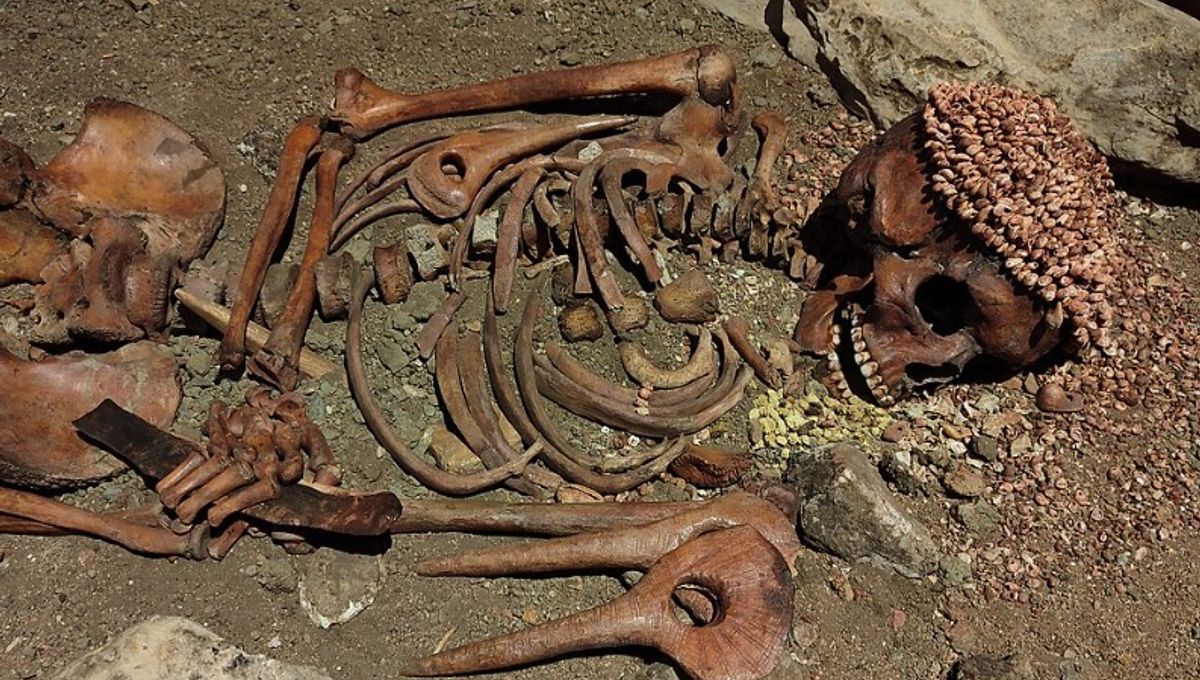
The occupant of one of the most lavish Paleolithic burials ever discovered may have died one of the most agonizing deaths in all of human history. Nicknamed “Il Principe” (“The Prince”), the teenage boy found inside the grave died a few days after having his face and chest ripped apart by a large predator, which researchers suspect was probably a bear.
Originally discovered in 1942 in the Arene Candide Cave in northern Italy, the burial has been dated to between 27,900 and 27,300 years ago, placing it in the Gravettian period of the Upper Paleolithic. Alongside the mangled skeleton, archaeologists found an array of opulent grave goods, including hundreds of pierced shells, carved antlers, mammoth ivory pendants, and a flint blade that researchers believe was a symbol of prestige.
Ranking among the most ornate burials of the Gravettian era, the grave was initially interpreted as a sign of high social status, earning its adolescent inhabitant his royal nickname. However, just as striking as these material offerings were the boy’s injuries, which included a smashed collarbone and a gaping hole in his jaw.
Reanalyzing the skeleton, the authors of a new study reveal that The Prince also suffered various fractures to his skull, teeth, and neck, as well as a punctured fibula. “The overall traumatic pattern observed in this individual resembles injuries typically documented in modern motor vehicle accidents, but in the prehistoric context examined here is more plausibly attributed to a large animal mauling, likely by a bear,” write the researchers.
Ruling out a series of other possible explanations, the authors explain that Il Principe lacks the kind of arm and leg fractures that would be expected if he had fallen from a height, while interpersonal violence would unlikely have wiped out so much of the bone in his jaw and shoulder. Given all the hazards faced by prehistoric hunter-gatherers, therefore, an animal attack seems by far the most likely cause of these shocking injuries.
Based on the fauna that occupied northern Italy at the time, the researchers suggest that the lesions may have been the work of a brown bear, a cave bear, a leopard, or a cave lion. And while they can’t say with any certainty which of these animals was the culprit, they note that the pattern of the injuries does appear more consistent with a bear mauling than a feline attack.
Amazingly, however, the bones show early signs of healing, indicating that The Prince lived for another two to three days following the encounter. This suggests that the furry assailant somehow failed to sever the boy’s jugular vein or carotid or subclavian arteries, which would have caused him to rapidly bleed to death.
Instead, Il Principe was probably left writhing in agony until he eventually expired from organ failure, internal hemorrhaging, or severe brain injuries.
Given the impact this disturbing scene would have made on The Prince’s community, the study authors suggest that the exceptional grave goods found alongside the body may in fact represent a “ritual sanctioning” of this scarring episode rather than royal rank. In other words, the teenager may not have held a high social status after all, but may have received an over-the-top burial as part of an attempt to somehow bring an end to the horrific ordeal.
According to the researchers, this theory is supported by the fact that all of the most lavish burials from the Gravettian period involve people displaying unusual injuries or disfigurements.
“This pattern has led to the hypothesis that formal burial was afforded based on the necessity to ritually contain and sanction these ‘exceptional events and exceptional people’,” they write.
The study is published in the Journal of Anthropological Sciences.

Source Link: Horrifically Disfigured Skeleton Known As “The Prince” Was Likely Mauled To Death By A Bear 27,000 Years Ago
