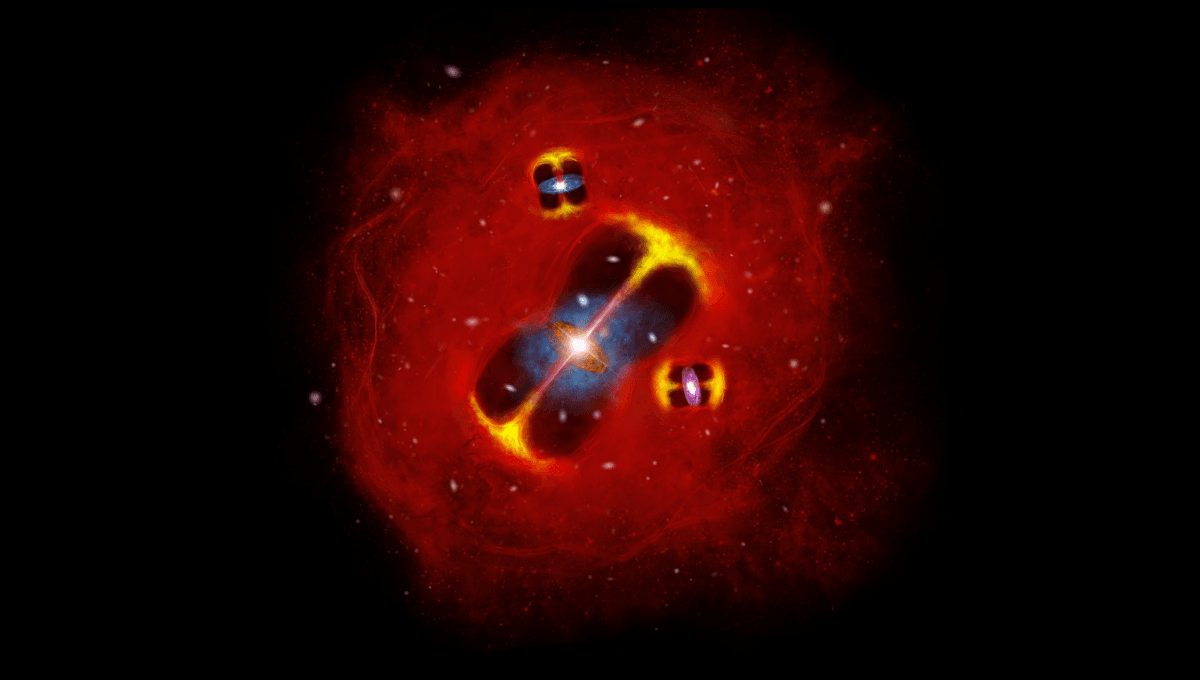
It seems that in the last few years, we have been collecting a lot of objects, phenomena, and events that challenge our best understanding of how the universe and galaxies in it have evolved. Thanks to new telescopes coming online, we are seeing with more accuracy into the past, and this means new insight. Insights that can challenge what we thought we knew. The latest one is a galaxy cluster with gas that shouldn’t be as hot as it is.
The rest of this article is behind a paywall. Please sign in or subscribe to access the full content.
The system in question is called SPT2349-56. It is a baby cluster whose light comes to us from 12 billion years ago. It contains more than 30 active galaxies, and it is forming stars at a rate 5,000 times faster than our galaxy is today. All of that is pumping a lot of energy into the gas that is spread among the galaxies in the cluster, and it has been heated to a level that is not expected so early in the universe.
“We didn’t expect to see such a hot cluster atmosphere so early in cosmic history,” lead author Dazhi Zhou, from the University of British Columbia, said in a statement. “In fact, at first I was skeptical about the signal as it was too strong to be real. But after months of verification, we’ve confirmed this gas is at least five times hotter than predicted, and even hotter and more energetic than what we find in many present-day clusters.
Recent observations have found galaxies and the supermassive black holes at their core to be more active and more massive than expected. If that is indeed the case, galaxy clusters, too, can be hotter and more active.
“This tells us that something in the early universe, likely three recently discovered supermassive black holes in the cluster, were already pumping huge amounts of energy into the surroundings and shaping the young cluster, much earlier and more strongly than we thought,” added co-author Dr Scott Chapman, a professor at Dalhousie University who conducted the research while at the National Research Council of Canada (NRC).
The team is planning more work on SPT2349-56 to understand how the different components fit together. The core of this cluster is tiny, at just 500,000 light-years across. That’s about five galaxies like the Milky Way put side by side. Yet, what goes on inside it must be very powerful.
“We want to figure out how the intense star formation, the active black holes and this overheated atmosphere interact, and what it tells us about how present galaxy clusters were built,” said Zhou. “How can all of this be happening at once in such a young, compact system?”
The biggest galaxies in the universe sit at the core of galaxy clusters. Understanding them, especially in their formative years, is key to unlocking further insights into these galactic behemoths.
The study is published in the journal Nature.

Source Link: Hottest And Earliest Intergalactic Gas Ever Found In A Galaxy Cluster Challenges Our Models
