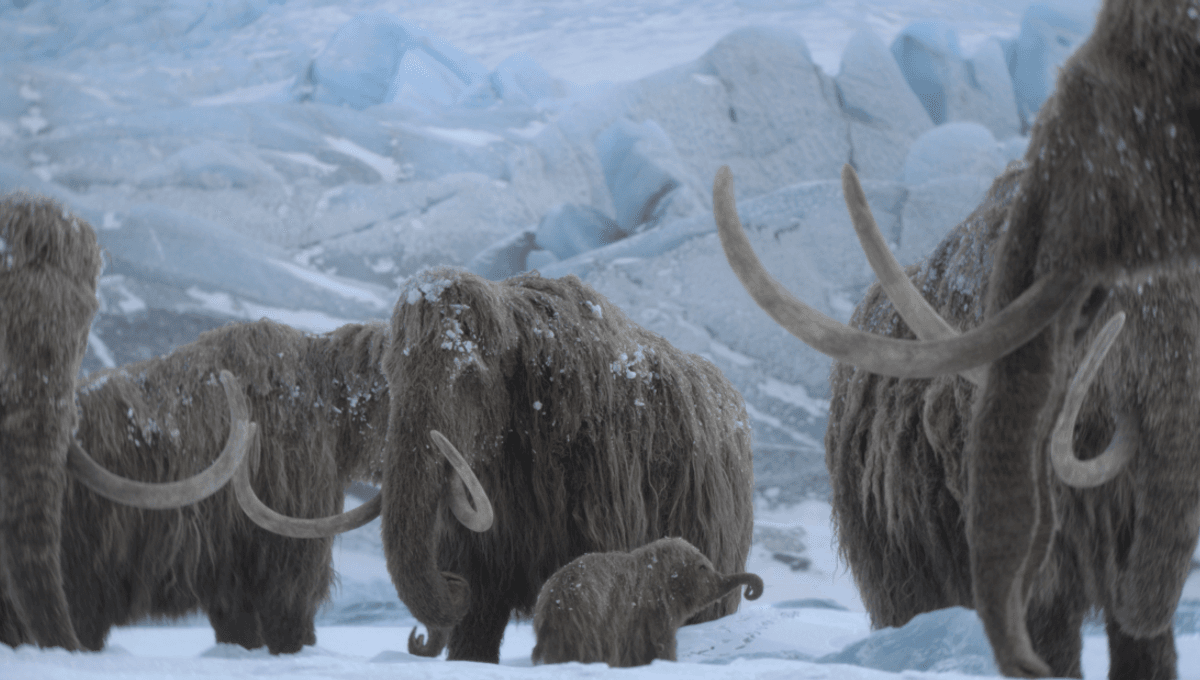
Have you ever noticed how life during the Ice Age just seemed to be much, much bigger? As Apple TV’s new series Prehistoric Planet: Ice Age demonstrates, everything from bears to sloths, birds, and armadillos was far bigger than anything we’ve seen since, but might I point you to one small fact that might’ve escaped your knowledge: woolly mammoths had tiny ears.
Yep. If you were today years old when it occurred to you that you’ve never seen a mammoth’s ears, fear not, you aren’t alone. Surprising though, isn’t it, when we know that their closest living relatives, the elephants, are walking around with giant sails on either side of their heads.
The African elephant (Loxodonta africana) is the world’s biggest land mammal and has the largest ears of modern-day elephants. They’re so big, in fact, that they account for 20 percent of their overall surface area. This adaptation all comes down to the fact that they are living in a very different climate from woolly mammoths.
Why did woolly mammoths have tiny ears?
Giant ears mean lots of blood vessels that are encountering a thinner area of skin, making it easier for them to offload heat. An ear that’s very large but also thin means it’s got a bigger surface area, presenting more opportunities to dissipate heat. It’s estimated that African elephants can circulate around 12 liters (3.2 gallons) of blood through their ears per minute; that’s some decent cooling potential.
For a woolly mammoth, that kind of heat loss would’ve been a disaster. A 2023 study that asked the question ‘When did the woolly mammoth get so woolly?’ concluded that the earliest mammoths probably had less fur and larger ears, gradually getting fluffier with smaller ears as time went by.
So, did that mean they had lousy hearing? Not necessarily, as like modern-day elephants, woolly mammoths were able to listen for a kind of sound that’s inaudible to the human ear: infrasound.
You can see the superpower in action in this exclusive clip from Apple TV’s upcoming series Prehistoric Planet: Ice Age.
What is infrasound?
Infrasound is sound with a frequency below the normal limit of human hearing at about 20 Hertz (that is, a noise made by 20 vibrations per second). Elephants can use it as a way to communicate by producing sounds that are as loud as a chainsaw and travel for kilometers – and yet to our ears, it doesn’t seem like they’re making any noise at all.
Something that is a major plus point [about this series] – but that also makes it especially difficult – is the fact that so many of the Ice Age megafauna are really closely related to living species.
Dr Darren Naish
These low-frequency calls create vibrations that travel through the ground and along its surface, and as a result, they’ve evolved to have pressure-sensitive nerve endings in their feet. We’ve even found evidence that when African elephants detect ground vibrations caused by human activity, they retreat in a kind of risk-avoidance strategy. This is why we can safely suggest that mammoths, which family-tree-wise sat in the middle between African and Asian elephants, could do the same.
Were mammoths like elephants?
“Something that is a major plus point [about this series] – but that also makes it especially difficult – is the fact that so many of the Ice Age megafauna are really closely related to living species,” Prehistoric Planet: Ice Age scientific advisor Dr Darren Naish told IFLScience. “That’s good because it means that if we want to know something about a fossil cat, it’s still a cat. It doesn’t belong to an entirely different group of animals. If we know a lot about cats and how they move and what their fur is like and what sounds they make, you can apply all that to the extinct animal that you’re reconstructing.”
“The downside to it is that if you do a dinosaur with a weird run, only a few people are going to notice, but if you get a cat’s movement cycle wrong, it’s obvious to a huge chunk of humanity.”
“Woolly mammoths are a kind of elephant. That means that they’re not like a separate thing. So, everything that’s true for living elephants was true for woolly mammoths,” Dr Naish said.
[Infrasound] is a specific thing that’s known to be true for elephants. It’s totally safe, in that case, to apply it to woolly mammoths, even though the fossil record is never going to show us that behaviour
Dr Darren Naish
“As a consequence, we looked at the studies that have been done on elephant language. They make specific noises that mean specific things. We applied that to woolly mammoths and started asking: What were their senses like? What were their abilities like in terms of sensing their environment and listening to things?”
“That’s where [this sequence] comes from. [Infrasound] is a specific thing that’s known to be true for elephants. It’s totally safe, in that case, to apply it to woolly mammoths, even though the fossil record is never going to show us that behaviour – that they could listen to things with their feet and detect infrasound to their feet.”
The five-part series Prehistoric Planet Ice Age will be available on Apple TV on November 26, 2025.

Source Link: How Could Woolly Mammoths Sense When A Storm Was Coming? By Listening With Their Feet
