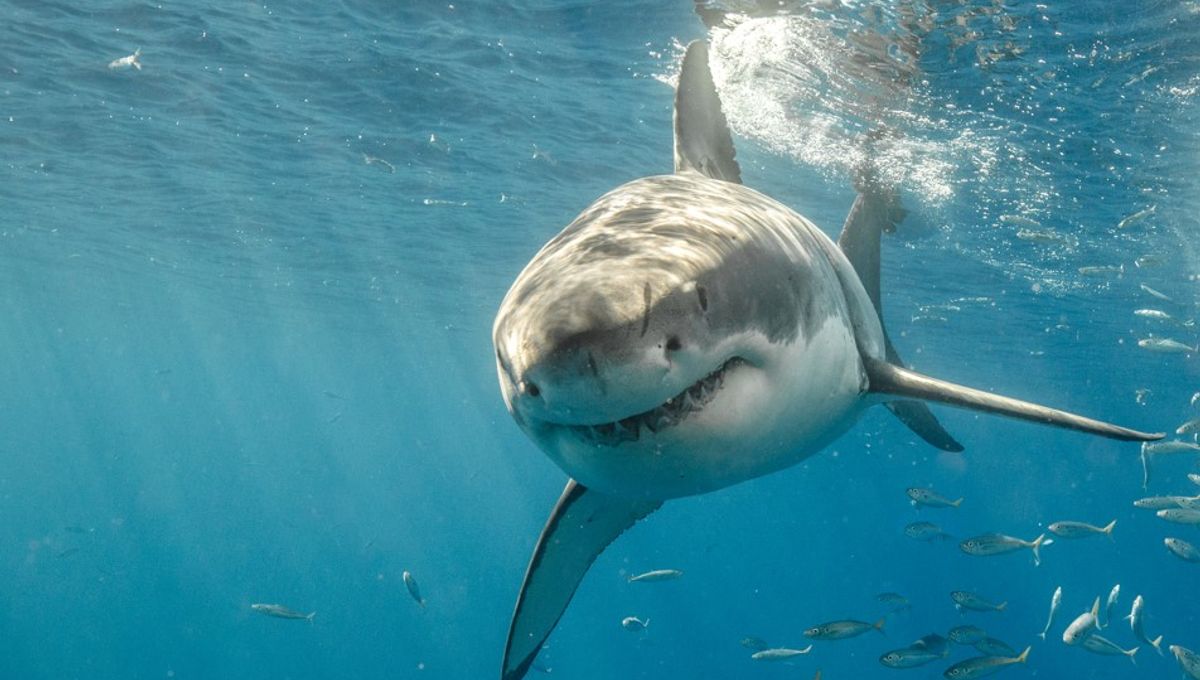
Sharks are sometimes referred to as “swimming noses” in honor of their spectacular olfaction. Yet with no air under the ocean to carry scent particles, the super smellers rely on some ingenious apparatus to help them pick up the stench of their prey from vast distances away.
How Sharks Smell
Like us, sharks have two nasal cavities at the front of their heads – although unlike human schnozzes, these nostrils are not used for breathing. Instead, they act as openings for seawater to flow in one end and out the other carrying with it dissolved scent particles.
Inside is a structure called the olfactory rosette, which is made up of folds of skin covered in sensory cells called lamellae that send signals to the olfactory bulb in the shark’s brain. It’s here that the signals get decoded, telling the animal what stinky stuff is in the water.
In that sense, sharks’ olfactory system isn’t all that different to our own – it’s just that their noses are designed to detect scents in the water, while ours pick up smells in the air.
Can A Shark Really Smell Blood From A Mile Away?
We’ve all heard the old myth that sharks can smell a single drop of blood from a mile away, but it doesn’t take a genius to work out that this is incredibly unlikely. After all, sharks can’t smell anything until it reaches their noses, and blood spilled in the water would take a while to travel a whole mile to its target, especially depending on the speed and direction of the current.
However, it’s true that sharks are incredibly well adapted to trace the source of scents that enter their noses. This is because they smell “in stereo“, whereby they are able to detect tiny delays in the time it takes a scent to reach one nostril compared to the other. It’s this lag that informs sharks which direction a smell is coming from, allowing them to home in on the scent’s origin with speed and precision.
Ultimately, different shark species have different levels of smell sensitivity, with some reported to be able to detect a drop of blood per million parts of seawater.
Which Shark Has The Best Sense Of Smell?
The longer noses of hammerheads could mean they have a sharper sense of smell than other sharks. However, our best indication of the relative sensitivity of different types of shark comes from a paper published in 2014, which compared the size of the olfactory bulb in 58 species of cartilaginous fishes.
Overall, the great white, gray nurse, and tiger sharks were found to have the largest smelling apparatus, suggesting they are probably the best sniffers. In contrast, the sharptooth lemon, whitetip reef, and bigeye thresher sharks had the smallest olfactory bulbs.
According to the study authors, larger olfactory bulbs were generally seen in shark species that hunt smelly animals like seals and scavenge on stinky whale carcasses. They therefore suspect that species like the great white shark developed a razor sharp sense of smell in order to detect distant odors in ocean currents.
Fortunately, however, the apex predator mostly uses this extraordinary power to sniff out blubbery prey and bony fish, and isn’t particularly fond of the smell of humans – which may explain why shark attacks on people are so rare.
All “explainer” articles are confirmed by fact checkers to be correct at time of publishing. Text, images, and links may be edited, removed, or added to at a later date to keep information current.

Source Link: How Do Sharks Smell Blood Underwater?
