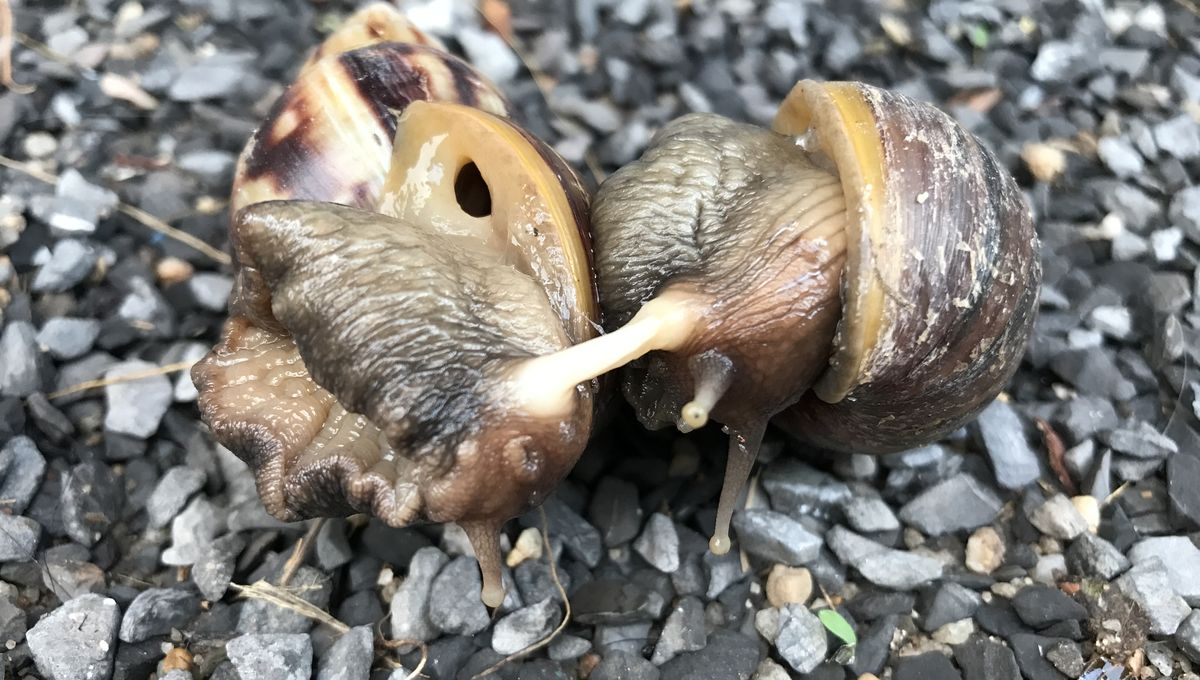
Here at IFLScience, we like to answer all manner of questions about the world around us. Sometimes that means tackling the big stuff, and other times it means violating the purity of our internet history to find out how snails have sex. You’re welcome.
Finding a partner
The vast majority of land snails are hermaphroditic, which means they have both male and female reproductive organs. That’s good news when it comes to their chances of finding a partner, as they can mate with any other member of the species.
That’s about the only good news though – pretty much everything else about finding a partner is hard. Snails have terrible vision and also no thumbs, so swiping through some sort of snail dating app to see who’s got the shiniest shell isn’t exactly an option.
Instead, it’s thought that they make use of something they have plenty of: slime. As snails move around, they leave a trail of it, and it may contain pheromones that attract a partner.
Sometimes, however, the straits are so dire that humans have to step in. That’s what happened to poor Jeremy the left-coiled garden snail, whose genitals were on the opposite side compared to right-coiled snails, which are in the majority.
A successful public appeal was launched to find him a fellow lefty partner. If snails were capable of being embarrassed, then Jeremy may well have been a bit red in the cheeks, but it did end up working for him.
Courtship
The trouble with both snail partners being hermaphroditic is that, from an evolutionary and energy-expense standpoint, both want to have the best chance of passing on their genes, while also putting in the least effort.
“Courtship is how they sort that out,” Barry Roth, a former collections manager at the California Academy of Sciences, now an independent snail and slug consultant and researcher, told KQED. “Who’s going to be male? Who’s going to be female? Or is it going to be shared?”
In some species, that decision is ultimately made by a drawn-out swordfight.
Okay, there aren’t actual swords involved, and neither are we using a euphemistic term for a penis; many land snails produce “love darts”, sword-like structures made out of calcium carbonate and covered in mucus. Either one or both snails will try to stab the other with this dart and whoever manages to do so first is more likely to successfully inseminate the other.
Why? Not to assert some sort of dominance, but because the mucus covering contains hormones that make it easier for sperm to make it out of the snail’s copulatory canal, reducing the chances of it being digested and increasing the likelihood of it reaching the point of fertilization.
For the snail that gets darted, it’s not good news; a 2015 study of the land snail species Bradybaena pellucida found that the loser of the swordfight not only ends up with reduced fertility, but also winds up dying earlier than usual. All is not fair in love and war, it turns out.
Doing the deed
If you thought a pre-sex swordfight was the only insane part of this process, wait until you hear about the actual point of copulation.
During the final stage of mating, a penis will pop out from the side of both snails’ heads (yes, you read that correctly), and simultaneously enter into the other’s vaginal duct. The snails then form and transfer spermatophores – a sort of capsule filled with sperm – after which, they separate.
That sounds simple, but the whole thing can take several hours.
We need a lie down just thinking about it.

Source Link: How Do Snails Have Sex?
