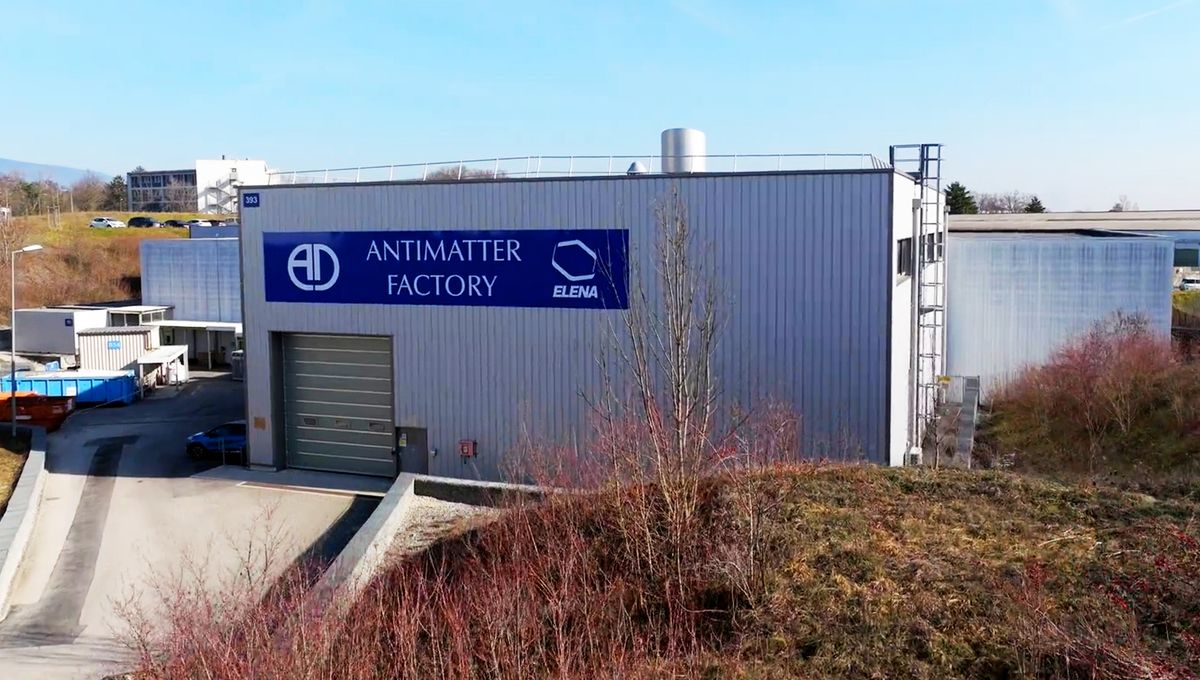
Everything we see in the universe and everything we interact with is made of matter. At a fundamental level, though, the particles that make us have twins of the same mass but with opposite charge. This is antimatter. We do not know why the universe is made of matter and not antimatter, but there must be a reason. Scientists at CERN are looking for an answer in a facility called the Antimatter Factory. With a name like this, we could not resist going there for a visit to learn how it works.
Atoms are made of three particles: protons, neutrons, and electrons. Most hydrogen is even simpler, made just of the positively charged protons and negatively charged electrons. Their counterparts are antiprotons and positrons. If protons and antiprotons interact or if electrons and positrons interact, they annihilate, turning into pure energy.
Positrons are easy to form. If you have bananas in your kitchen, due to the small amount of radioactive potassium they contain, you will get positrons. We have not found any behavior in positrons that could explain why the universe is made of matter, so scientists have started looking at the properties of antiprotons. And the antimatter factory can produce them in sufficient quantities.
All different kinds of techniques are used here to directly study antimatter.
Dr Virginia Marshall
“This is where we produce antimatter directly,” Dr Virginia Marshall, ALPHA Collaboration, CERN, told us in our tour of the facility, “and we study it by doing gravitational measurements, and spectroscopy experiments with lasers, and microwaves, and magnets, and all different kinds of techniques are used here to directly study antimatter.”
Before you study it, one has to produce it. Protons are accelerated close to the speed of light and slammed into a block of metal. This collision creates a lot of particles, including antiprotons, at high speed. The factory features an Antiproton Decelerator (AD), which significantly slows down the antimatter particle using electric and magnetic fields.
A second decelerator ring called ELENA (Extra Low ENergy Antiproton), slows them even more, including using electrons to do that. While matter and antimatter annihilate when they interact, it needs to be pairs of the same particles; otherwise, they are happy coexisting.
Once the antiprotons are suitably slowed down, they can be sent to experiments. AD and ELENA serve several experiments that study the properties of antimatter in different ways. Dr Marshall works for the ALPHA collaboration, which focuses on the creation of antihydrogen to see if it behaves differently from regular hydrogen.
“The ALPHA collaboration where I work, we trap the antimatter in a magnetic trap and then we study it directly with lasers or we drop the antimatter to see whether it has the same gravitational effect as normal matter,” Dr Marshall explained.
There are experiments like the BASE collaboration, which is actually planning to transport some antiprotons to another facility with tests that are happening this year. The cargo will travel by van in a specially designed magnetic trap. There are also AEgIS and ASACUSA that focus on the properties of antihydrogen in a different way from ALPHA. And there’s GBAR that produces antihydrogen with an extra positron to work out if antimatter behaves the same in freefall. There is a lot of interest in antimatter and gravity.
“We did an experiment called ALPHAG, which is where we trap antihydrogen in a magnetic field, and then we release the magnetic field, and we see whether the antihydrogen goes up or goes down. And what we want to know is, we want to see whether it interacts the same way with gravity as normal matter does,” Dr Marshall explained.
The Antimatter Factory has produced results that no other facility has produced, but it did not find that antimatter defies gravity. The properties of matter and antimatter continue to be similar, but antimatter is not understood with the same precision as matter, and the difference might be hiding in those details.
Despite the revolutionary ability to produce antimatter at CERN, every year the lab produces something around a billionth of a gram. A lot of people worry about the explosive nature of this substance, because half a gram would wipe out a city. CERN would need 500 million years to produce that quantity.
One billionth of a gram is a minuscule quantity, but it takes a lot to create. And in that fraction, there might be the answer to how the universe is the way it is.

Source Link: How Does CERN’s Antimatter Factory Work? We Visited To Find Out
