• Email Us: [email protected]
  • Contact Us: +1 718 874 1545
  • Skip to main content
  • Skip to primary sidebar

Medical Market Report

  • Home
  • All Reports
  • About Us
  • Contact Us

How Does NASA’s Supersonic Airplane Avoid The Sonic Boom?

January 15, 2024 by Deborah Bloomfield

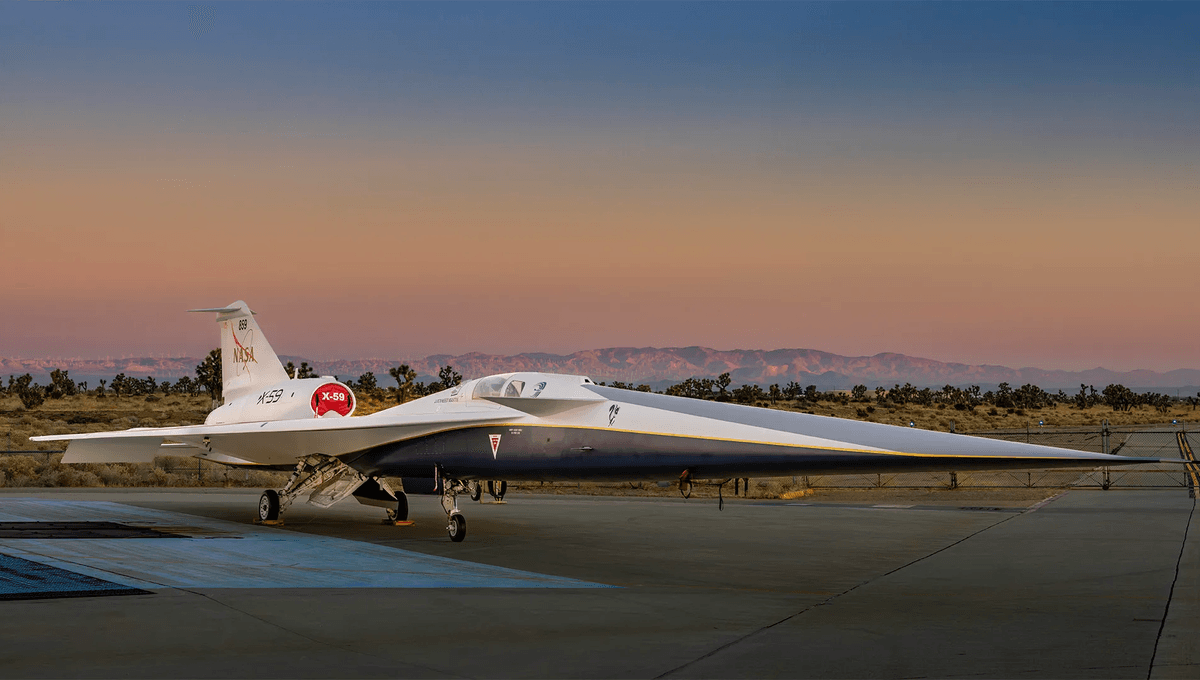
Supersonic air travel holds the promise to get us across the world faster, but it comes with a big and loud drawback: Sonic booms. Supersonic planes are not allowed to travel over land because the boom they create is loud and disruptive. NASA has been working for decades to design an aircraft that can avoid that while still traveling at incredible speeds. The result is the X-59.

Developed with Lockheed Martin, the experimental aircraft is expected to reach 1.4 times the speed of sound in air, or about 1,490 kilometers (925 miles) per hour – and it does that while staying very quiet. It was unveiled last Friday and it will be tested in actual flight later this year.

Advertisement

What Is A Sonic Boom And How Is It Created?

A sonic boom is a thunderclap-like sound released by an object moving through air (in this case) faster than the speed of sound. It’s a big release of sound energy, and for this reason, it is loud. 

It’s not just special planes that can crack one. The characteristic crack of a bullwhip is an example of a sonic boom. Just a small one, since the tip of a bullwhip hasn’t got the same moment of a jet.

Any object moving through a fluid would create pressure waves in front and behind itself. The waves travel at the speed of sound. As the speed of the aircraft increases, these waves are squished together, and when the aircraft reaches the speed of sound they merge into a single shockwave. Boom!

As an aircraft moves faster than the speed of sound it constantly creates sonic booms, releasing these pressure waves. But as you can imagine, it might get pretty loud and annoying if you were to live under the path of a supersonic plane.

How Does The X-59 Avoid A Sonic Boom?

Avoiding the sonic boom is a matter of breaking those pressure waves – something easier said than done. The X-59 is designed to do just that. The plane has a length of 30.3 meters (99.7 feet), but one-third of it is for its thin tapered nose. This is its secret. The nose is designed to break the pressure waves, creating a vehicle that can fly faster than sound without loud bangs.

This experimental plane is not the blueprint for future passenger supersonic vehicles, but such a design will inform the supersonic plane of the future, like the Bell X-1 rocket engine-powered aircraft later informed the development of Concorde.

All “explainer” articles are confirmed by fact checkers to be correct at time of publishing. Text, images, and links may be edited, removed, or added to at a later date to keep information current.

Deborah Bloomfield
Deborah Bloomfield

Related posts:

  1. Tennis-‘Experienced’ Medvedev the last hurdle in Djokovic’s pursuit of history
  2. Bulk of S&P 500 embraces sustainable accounting standard, foundation says
  3. PideDirecto bags $5.25M; aims to be ‘Shopify with 30-minute deliveries’
  4. A Spy Creature Gets Its Shell Home Stolen In BBC’s New “Spy In The Ocean”

Source Link: How Does NASA’s Supersonic Airplane Avoid The Sonic Boom?

Filed Under: News

Primary Sidebar

  • The Man Who Fell From Space: These Are The Last Words Of Cosmonaut Vladimir Komarov
  • How Long Can A Bird Can Fly Without Landing?
  • Earliest Evidence Of Making Fire Has Been Discovered, X-Rays Of 3I/ATLAS Reveal Signature Unseen In Other Interstellar Objects, And Much More This Week
  • Could This Weirdly Moving Comet Have Been The Real “Star Of Bethlehem”?
  • How Monogamous Are Humans Vs. Other Mammals? Somewhere Between Beavers And Meerkats, Apparently
  • A 4,900-Year-Old Tree Called Prometheus Was Once The World’s Oldest. Then, A Scientist Cut It Down
  • Descartes Thought The Pineal Gland Was “The Seat Of The Soul” – And Some People Still Do
  • Want To Know What The Last 2 Minutes Before Being Swallowed By A Volcanic Eruption Look Like? Now You Can
  • The Three Norths Are Moving On: A Once-In-A-Lifetime Alignment Shifts This Weekend
  • Spectacular Photo Captures Two Rare Atmospheric Phenomena At The Same Time
  • How America’s Aerospace Defense Came To Track Santa Claus For 70 Years
  • 3200 Phaethon: Parent Body Of Geminids Meteor Shower Is One Of The Strangest Objects We Know Of
  • Does Sleeping On A Problem Actually Help? Yes – It’s Science-Approved
  • Scientists Find A “Unique Group” Of Polar Bears Evolving To Survive The Modern World
  • Politics May Have Just Killed Our Chances To See A Tom Cruise Movie Actually Shot In Space
  • Why Is The Head On Beer Often White, When Beer Itself Isn’t?
  • Fabric Painted With Dye Made From Bacteria Could Protect Astronauts From Radiation On Moon
  • There Used To Be 27 Letters In The English Alphabet, Until One Mysteriously Vanished
  • Why You Need To Stop Chucking That “Liquid Gold” Down Your Kitchen Sink
  • Youngest Mammoth Fossils Ever Found Turn Out To Be Whales… 400 Kilometers From The Coast
  • Business
  • Health
  • News
  • Science
  • Technology
  • +1 718 874 1545
  • +91 78878 22626
  • [email protected]
Office Address
Prudour Pvt. Ltd. 420 Lexington Avenue Suite 300 New York City, NY 10170.

Powered by Prudour Network

Copyrights © 2025 · Medical Market Report. All Rights Reserved.

Go to mobile version