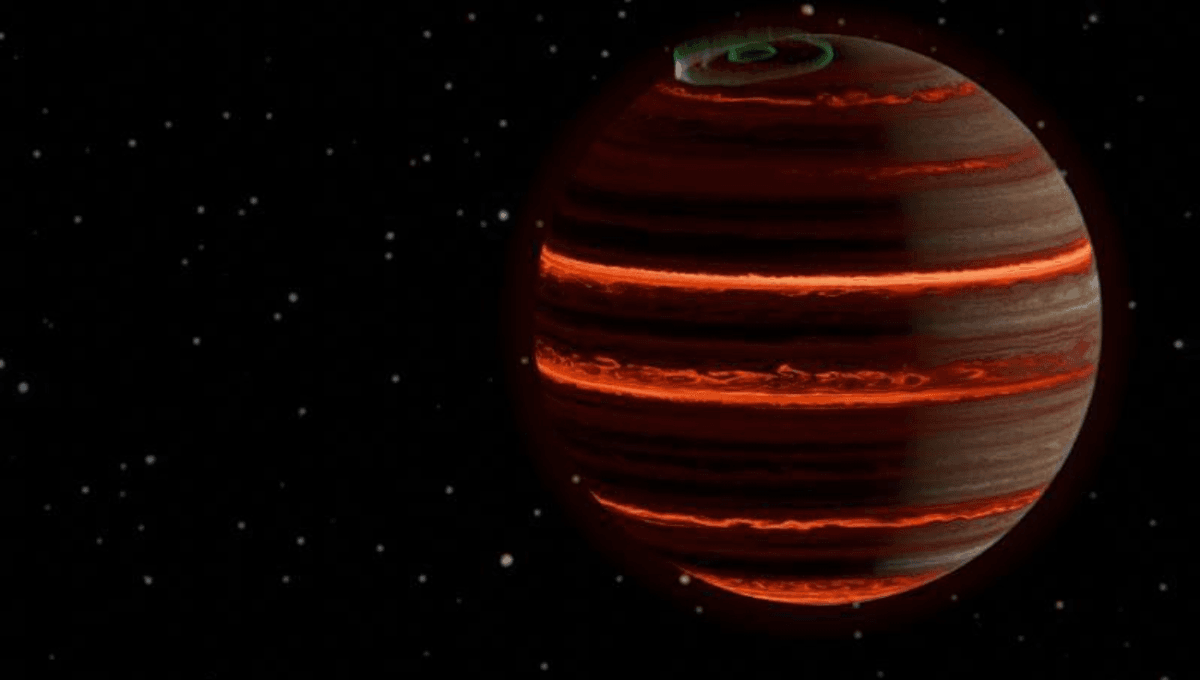
The JWST has found evidence of auroras and clouds in the atmosphere of the giant rogue planet SIMP-0136, but the causes must be very different from anything we see within the Solar System.
When SIMP-0136 was first discovered, it was classified as a brown dwarf and thought to be one of the closest to Earth at 21 light-years away. Subsequent evidence cast doubt on whether SIMP-0136 is fusing deuterium in its core, the defining feature of brown dwarfs, and some consider it to be a “rogue planet”, ie one without an accompanying star.
There are probably a great many rogue planets closer to Earth than that, but without a star to light them up or be swayed by their gravity, they’re very hard to find. Consequently, SIMP-0136 remains a major target for astronomers, as possibly the closest known member of whichever category it falls into. Even before the JWST was launched, it was marked as a priority target for study.
Now that this has happened, astronomers report they were able to observe the planet in such detail that they could track the shifting cloud patterns as it rotates every 2.4 hours. More remarkably, they can even detect signs of an aurora heating SIMP-0136’s atmosphere, upper atmosphere, just as happens on Jupiter.
“These are some of the most precise measurements of the atmosphere of any extra-solar object to date, and the first time that changes in the atmospheric properties have been directly measured,” said Dr Evert Nasadekin of Trinity College Dublin in a statement. “And at over 1,500°C (2,700°F), SIMP-0136 makes this summer’s heat wave look mild.”
Not having a nearby star to provide warmth, it might seem puzzling that SIMP-0136’s temperature is so high, but planets all start out hot because the gravitational potential energy of the material they form from is converted to heat as they coalesce. With a planet as enormous as SIMP-0136, 15 times the mass of Jupiter, that’s a lot of heat that takes a long time to dissipate, and at an estimated age of 200 million years, SIMP-0136 has plenty left.
“The precise observations we made meant we could accurately record temperature changes smaller than 5 °C (9 °F). These changes in temperature were related to subtle changes in the chemical composition of this free-floating planet, which is suggestive of storms—similar to Jupiter’s Great Red Spot—rotating into view,” Nasedekin said.
These clouds are made of silicate (like sand) rather than water, given the enormous temperatures. The surprising thing in this regard was how little the clouds varied while the JWST watched, suggesting an even distribution of clear and cloudy. That may not seem odd to outsiders, but astronomers who modeled the spectra obtained from brown dwarfs couldn’t match the average observations of SIMP-0136 unless there were patchy silicate clouds.
That consistency didn’t stop Nasedkin and co-authors from learning a lot from the JWST data. “Different wavelengths of light are related to different atmospheric features. Similar to observing the changes in color over the surface of Earth, the changes in the color of SIMP-0136 are driven by changes in the atmospheric properties,” Nasedkin explained. “So by using cutting-edge models, we could infer the temperature of the atmosphere, the chemical composition, and the position of the clouds.”
The forthcoming Extremely Large Telescope will add to what we can learn about SIMP-0136 and worlds far closer to Earth’s size. Team leader Professor Johanna Vos also expressed hopes for the proposed Habitable Worlds Observatory, but the chances of that gaining funding from the US Congress is considered slim at this point.
Meanwhile, the work also revealed evidence of auroras near SIMP-0136’s poles powerful enough to invert the usual temperature relationship between troposphere and stratosphere. We see a similar phenomenon on Jupiter creating pulses of heat through much of the planet. However, like Earth’s auroras, Jupiter’s are a product of charged particles from the solar wind being funneled to the planet’s poles by the magnetic field.
The power of Jupiter’s field is so great that the auroras are bright, but the field still needs the Sun’s particles to work with. A rogue planet lacks that source of charged particles, but auroras had already been proposed as the source of pulsed radio waves previously detected from SIMP-0136.
Auroras are yet to be absolutely confirmed through UV radiation or other tell-tale signs, but Nasedkin and co-authors think they’re the most likely explanation for a stratosphere warmer than SIMP-0136’s lower atmosphere. The authors attribute the auroras to SIMP-0136’s magnetic field being vastly more powerful than Jupiter’s (750 times stronger according to a previous study). Electrons (presumably stripped from atoms by internal processes) would flow with the field and hit atmospheric molecules fast enough to make them glow, they conclude.
The study is open access in Astronomy and Astrophysics.

Source Link: How Does Rogue Planet SIMP-0136 Have Auroras When It Has No Stellar Wind?
