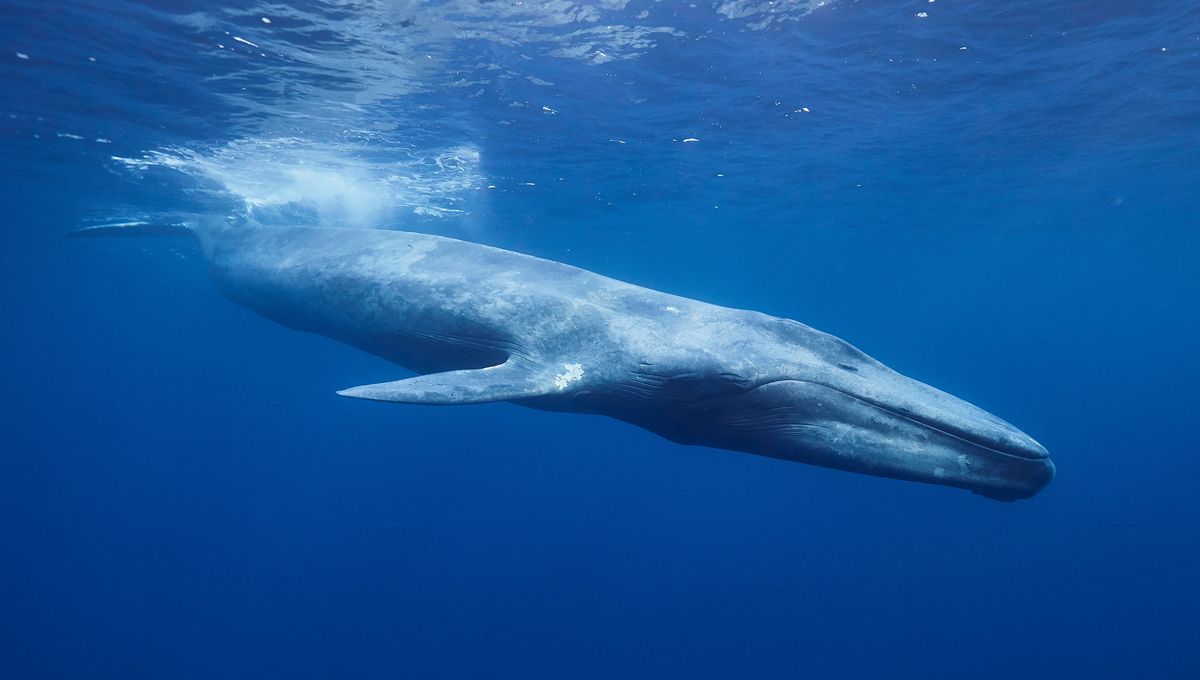
Being able to see underwater can prove to be tricky, so for creatures such as the blue whale, using sound to get about and communicate is far handier. But just how far can these marine giants hear?
Blue whales are generally pretty solitary creatures. However, they need to chinwag with others eventually, particularly when it comes to finding a group to migrate with, or a mate to make massive babies with.
Sadly, whales can’t use Tinder (actually, they’re probably better off when it comes to this one) or a telephone, so they’ve got to have more than a decent level of hearing in order to be able to chat with one another across vast expanses of ocean.
It turns out that “more than a decent level” doesn’t even cut it; blue whales can hear sounds emitted by other whales up to 1,000 miles (1,600 kilometers) away in good conditions. If we compare that to humans, that’s roughly the same as if you were in St Louis, Missouri, and could hear your pal shouting at you from New York.
Of course, sound does travel faster and further in water than in air, but it probably helps that blue whales are also among the loudest animals, if not the loudest. Some sources say that title belongs to sperm whales, but they make their 230-decibel sounds in short bursts, so not everyone counts it. Blue whales, on the other hand, can reach 188 decibels – that’s even louder than a jet engine at take-off, which is typically between 125 to 155 decibels.
If you’re worried about ending up in the unlikely situation of being nearby when a blue whale makes such a sound, you can put your concerns aside. It might sound like a contradiction for one of the loudest sounds, but we can’t actually hear it. Blue whale sounds are made in the infrasonic range, which is too low for humans to hear.
A recent study found that baleen whales – a group of 16 species to which blue whales belong – have evolved unique structures in order to make such low frequency and complex vocalizations.
In the human larynx, the vocal cords are attached to a pair of tiny, pyramid-shaped cartilages called the arytenoids, which allow the cords to move. However, in baleen whales, these have changed into a pair of elongated cylinders that fuse together to form a U-shape, spanning nearly the entire length of the larynx.
“This is probably to keep a rigid open airway when they have to move huge amounts of air in and out during explosive surface breathing,” explained study author Professor Tecumseh Fitch in a statement.
“We found that this U-shaped structure pushes against a big fatty cushion on the inside of the larynx. When the whales push air from their lungs past this cushion, it starts to vibrate and this generates very low frequency underwater sounds,” added fellow author Professor Coen Elemans.
It’s not just their vocal and hearing abilities that make blue whales impressive though – they’ve recently taken back the crown as the heaviest animal ever to live on Earth.
All “explainer” articles are confirmed by fact checkers to be correct at time of publishing. Text, images, and links may be edited, removed, or added to at a later date to keep information current.

Source Link: How Far Can Blue Whales Hear?
