Imagine you were able to stand on the surface of Mars, Venus, or even Titan without the need for protective gear. Now, imagine you were speaking. Do you think you’d sound the same as on Earth? The answer is no. Sound is a mechanical wave, which means that it doesn’t travel through a pure vacuum, it needs a medium. The properties of said medium affect the speed of the waves, and the atmospheres of terrestrial worlds are not at all the same.
There are four worlds in the Solar System that we could (sort of) stand on and with dense enough atmospheres for sounds to move in our audible range: Earth, Venus, Mars, and Titan, the largest moon of Saturn. We know, Venus has a temperature that can melt lead and a pressure that would turn an astronaut into a pancake in seconds, but for the sake of our thought experiment, we’ll make it count. After all, we’ve had landers on all those worlds.
When we hear a voice from Venus, we think the speaker is small, but with a deep bass voice. On Venus, humans sound like bass Smurfs.
Professor Tim Leighton
For starters, on Earth, the speed of sound is around 340 meters (1,100 feet) per second, depending on altitude and temperature.
In the early 1980s, two Soviet-era missions, Venera 13 and 14, measured sound waves on Venus, producing a measurement of wind speed on the planet. The speed of sound at ground level on Venus is around 410 meters ( 1,345 feet) per second, so faster than on Earth.
Scientists a decade ago tried to picture what a voice would sound like on Venus, and it is certainly a trip, because the denser atmosphere but faster speed of sound actually work against each other.
“On Venus, the pitch of your voice would become much deeper. That is because the planet’s dense atmosphere means that the vocal cords vibrate more slowly through this ‘gassy soup’. However, the speed of sound in the atmosphere on Venus is much faster than it is on Earth, and this tricks the way our brain interprets the size of a speaker (presumably an evolutionary trait that allowed our ancestors to work out whether an animal call in the night was something small enough to eat or so big as to be dangerous),” Professor Tim Leighton explained in 2012.
“When we hear a voice from Venus, we think the speaker is small, but with a deep bass voice. On Venus, humans sound like bass Smurfs.”
The Cassini mission landed the Huygens probe on Titan in 2005, which took measurements of the atmospheric properties of the distant moon. The atmosphere of Titan is denser than Earth’s own, but also much colder. On that moon, sound moves more slowly than on Earth, just over 200 meters (660 feet) per second. Based on Prof Leighton’s comment about Venus above, the voice I’m picturing is like a Jack and the Beanstalk-style giant – fee-fi-fo-fum, indeed!
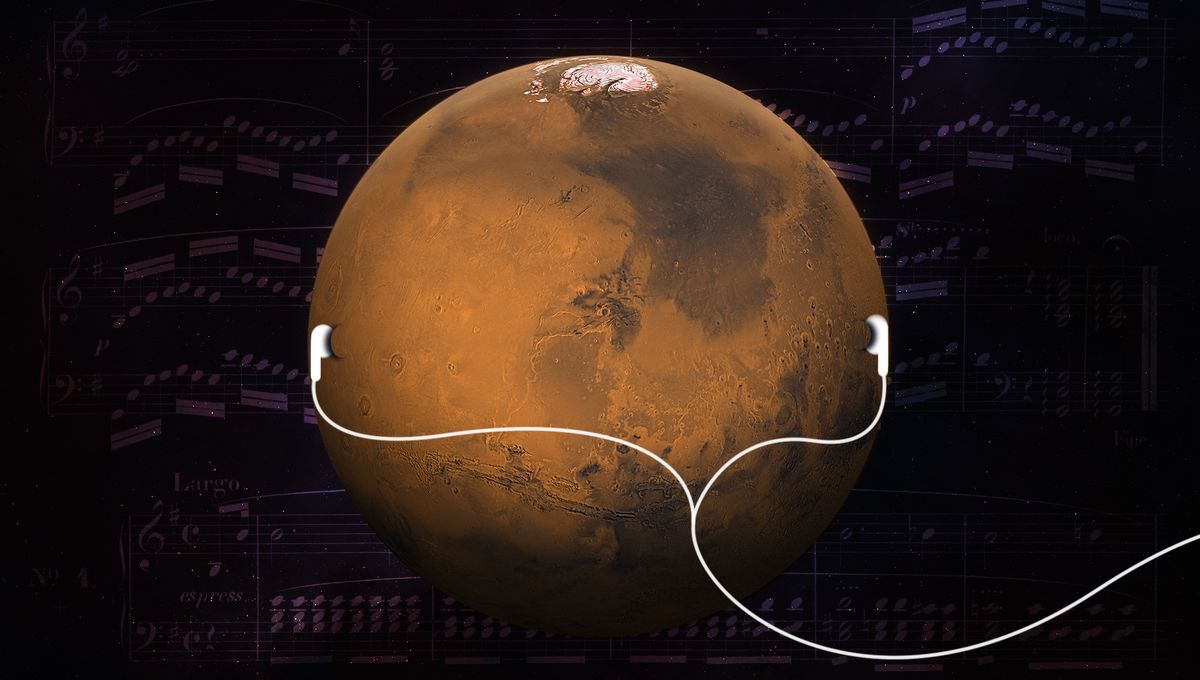
And what about Mars? Other than Earth, the Red Planet is the place in the Solar System where we might have a more sophisticated understanding of the speed of sound. NASA’s Perseverance Mars rover is the first rover to carry a microphone. This has allowed us to record the sound of its lasers and even the first-ever sound of a dust devil (and thus its properties) on another world. It was also used to prove the existence of lightning on Mars!
In 2022, Perseverance measured the speed of sound on Mars, which is slightly lower on average than on Earth, at about 240 meters (787 feet) per second. But there is a peculiar effect taking place on Mars. With the Martian atmosphere being 1 percent of the Earth’s own when it comes to density, we are probably thinking high-pitched dinosaurs in terms of experience.
What about other worlds? As we said, sound varies due to the properties of the atmosphere. Among the clouds of Venus won’t be the same as its surface. The gas giant planets, Saturn and Jupiter, have vast atmospheres surrounding dense cores. As the density and pressure increase, the speed of sound will increase. So what’s the highest possible value? For Jupiter, it might be the very theoretical limit of the speed of sound.
The core of Jupiter is believed to be in an extreme state called metallic hydrogen. It is possible that here, the speed of sound reaches near the theoretical maximum, which is 36 kilometers (22 miles) per second. That’s twice as much as the speed of sound in diamonds and over 100 times the speed of sound through air.
So, in plenty of locations in space, people can, in fact, hear you scream… just don’t go through Jupiter!

Source Link: How Fast Does Sound Travel Across The Worlds Of The Solar System?
