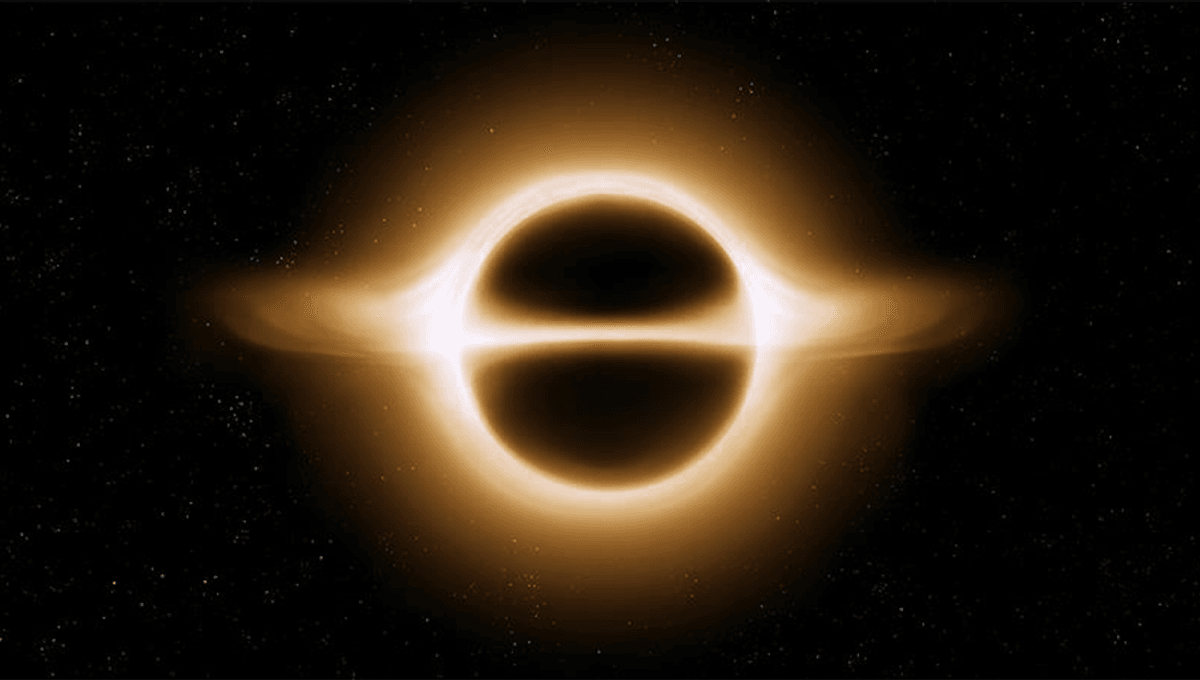
A team looking into dark energy and the holographic principle have modeled what the end of the universe may look like, assuming that the universe is a hologram after all.
As with a lot of the stranger hypotheses about the universe, the holographic principle has its roots in the theoretical study of black holes. Tackling the black hole information paradox, Dutch physicist Gerard ‘t Hooft showed that the total degrees of freedom contained inside a black hole is defined in proportion to the surface area of its horizon, rather than its volume. This allows for looking at the entropy of a black hole.
“From the point of view of information, each bit in the form of a 0 or a 1 corresponds to four Planck areas, which allows one to find the Bekenstein–Hawking formula for entropy,” French astrophysicist Jean-Pierre Luminet explained in a 2016 review on the topic. “For an external observer, information about the entropy of the black hole, once borne by the three-dimensional structure of the objects that have crossed the event horizon, seems lost. But on this view, the information is encoded on the two-dimensional surface of a black hole, like a hologram. Therefore, ’t Hooft concluded, the information swallowed by a black hole could be completely restored during the process of quantum evaporation.”
While this is reassuring in one way (black holes do not violate the second law of thermodynamics, yay) it led to a pretty out-there idea that the physics of a three-dimensional volume can be described at its two-dimensional boundary. String theorists suggested that the whole universe itself could be thought of as encoded at a two-dimensional boundary, giving rise to the three-dimensional (plus time) universe that we perceive.
Though a fun idea, it would have to do a lot more to be considered a viable model of the universe, including explaining our observations of the universe better than the standard model, and making a few more correct predictions to boot.
Dark energy is one area of physics that would need to be explained by the holographic principle. By observing the universe from the cosmic microwave background to our nearest galaxies, we know that our universe is expanding. Weirder (and subject to further observations and analysis) the expansion appears to have sped up, beginning around 5-6 billion years ago.
There are a few models of how dark energy could work, with one similar explanation to ideas proposed by the standard model involving quantum fluctuations, though in the holographic principle these are constrained to (and by) the event horizon of the universe.
Now, researchers have attempted to model the effect that holographic dark energy would have on the universe. In the standard model, the currently favored idea is that dark energy will push the universe apart, leading to the eventual heat death of the universe. But other options are available, including the idea that it could continue to increase in strength and eventually rip the universe apart.
In the holographic principle, so far theoretical physicists have found that a big rip scenario is more likely. But in a new paper exploring the math of holographic dark energy, which has not yet been peer reviewed, a team of two physicists found that the rip was not inevitable, but stabilized depending on time.
“The asymptotic evolution in this case is quite interesting,” the team explains in their paper. “As t → ∞, the Hubble parameter, the energy density, and the pressure all vanish, while the scale factor goes to a constant,” they add, suggesting a long freeze scenario may arise naturally from holographic dark energy. “It is interesting to note that in some of these long freeze models, the long freeze can be preceded by a period of exponential expansion.”
While a fun idea, and always good to know how the universe would end under various scenarios, the holographic principle is still a fringe idea with plenty of problems. There is no direct evidence that we are living in a holographic universe, and it may not even be testable, so we probably wouldn’t worry about the fate of a universe we probably aren’t in, billions of years in the future.
The paper is posted to preprint server arXiv.

Source Link: How Holographic Dark Energy Could Lead To The End Of The Universe
