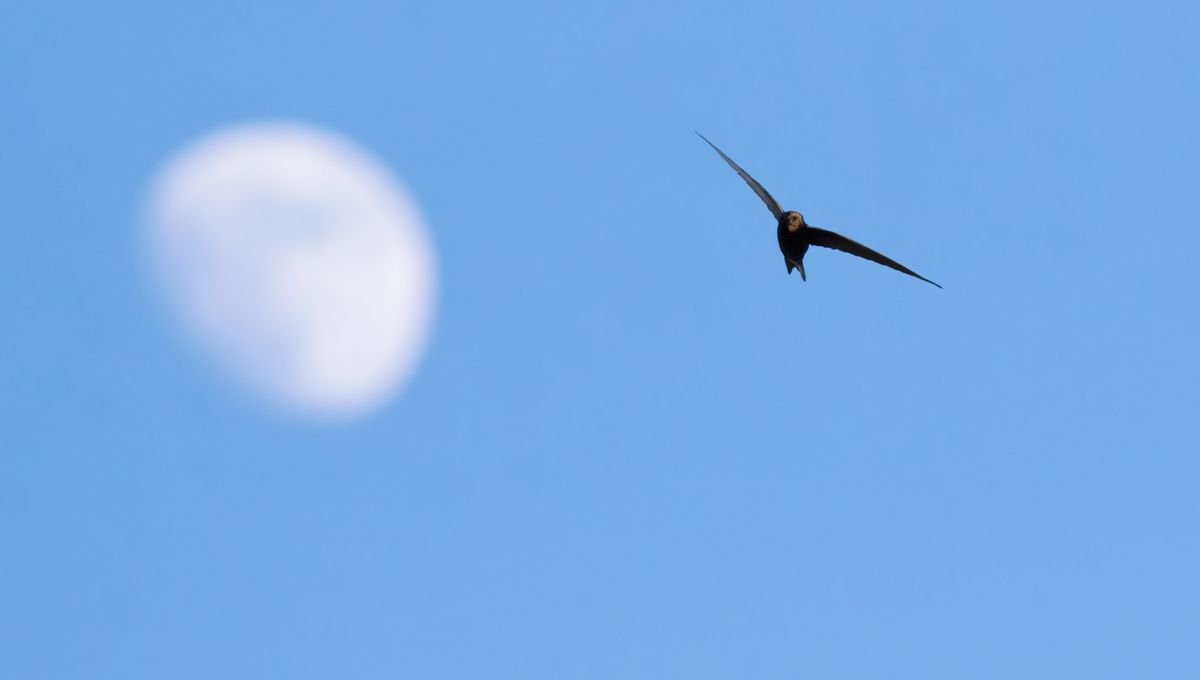
Trekking nearly a whole day by plane to Australia might seem like a long-haul flight, but that’s got nothing on what the common swift is capable of.
Lots of us get pretty restless after just a few hours, and we’re just sat on our asses. Imagine having to hold your arms out to the side for 10 straight months in order to stay in the air – that’s how long the record-breaking common swift can fly for without landing.
Though Welsh ornithologist Ronald Lockley had suggested that common swifts might be capable of such a feat back in the 1970s, it wasn’t until 2016 that a group of researchers from Lund University in Sweden were able to confirm this theory.
To do so, the team followed 13 adult common swifts, tagging the birds with tiny data loggers set with accelerometers to record their flight activity, and light-level sensors for locating them. Some of the birds were tracked for multiple years as they migrated from Sweden to the south of the Sahara in the winter and back again.
The results showed what had been long suspected – common swifts spend much of their time in the air. The tracked birds stayed consistently on land for only two months of the year, settling down to breed. Though some birds occasionally landed for short periods in the remaining 10 months, they still spent more than 99.5 percent of their time flying.
Three of the swifts were up in the air for the whole 10 months of their migration, a particularly impressive achievement when you consider that these are pretty small birds, weighing only around 40 grams (1.4 ounces).
The researchers suggest that the difference between the long-haulers and those who landed might be in their feathers; the birds that landed had not molted their wing feathers, whereas those who stayed in the air the entire time had molted and gained new flight feathers.
“Whether they moult or not could indicate small differences in their general condition or burden of parasites, and explain the flight behaviour of individual birds within the species,” explained study author Anders Hedenström in a statement released at the time.
But how on Earth do they manage to stay up in the air for so long? Physical activity costs energy, after all, but common swifts have adapted to use relatively little during their extended flights.
“Common swifts have evolved to be very efficient flyers, with streamlined body shapes and long and narrow wings, generating lift force at low cost,” Hedenström told Nature. This helps them to use less energy, though they can get a quick boost from insects that are also up in the air.
Alongside in-flight snacks, us humans might have a nap to recharge our batteries whilst flying, but whether common swifts do the same remains unanswered. “They might do as the frigate bird and sleep while gliding,” said Hedenström in the Lund statement. “Every day, at dusk and dawn, the common swift rises up to an altitude of about two–three kilometres [1.2–1.9 miles]. Perhaps they sleep during a declining glide, but we’re not sure.”
What we can be sure of is that flying non-stop for 10 months is no mean feat – call us common swifties, because these birds have just gained some dedicated fans.
The study is published in Current Biology in 2016.
An earlier version of this story was first published in March 2024.

Source Link: How Long Can A Bird Can Fly Without Landing?
