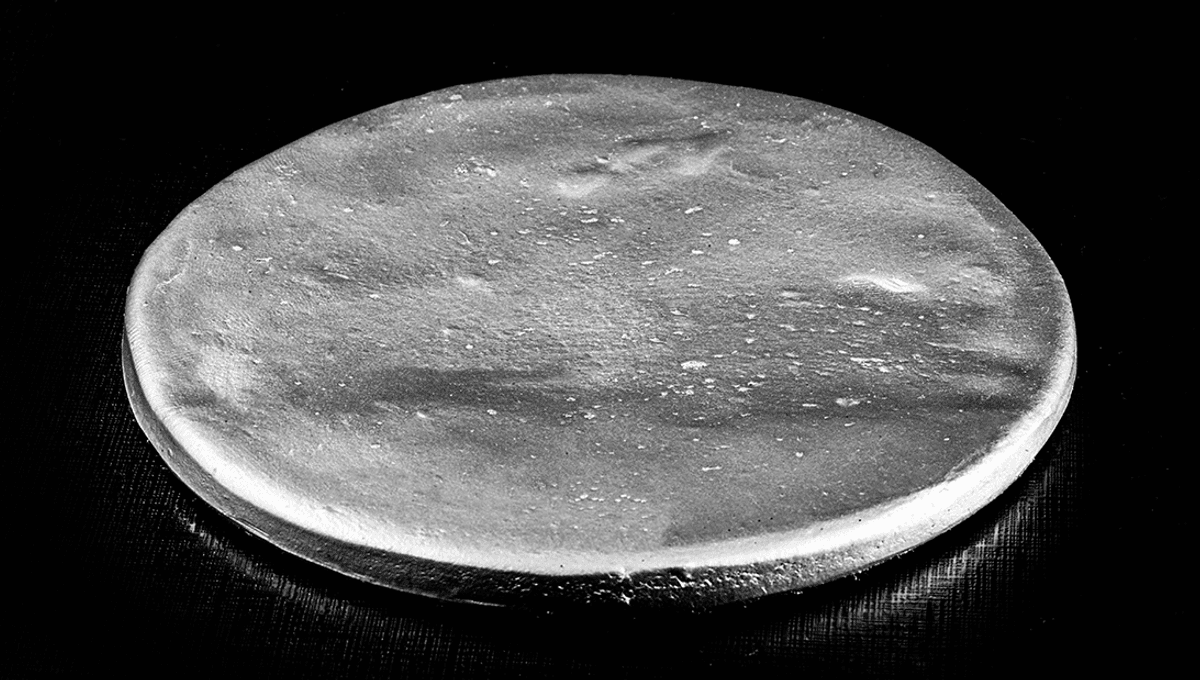
There is a fairly popular idea circulating the Internet that a single gram of uranium contains about 20 billion calories, with some joking that eating it could sustain you like a turbo-charged diet supplement. But is that calorie count right, and could you actually get energy from it?
ADVERTISEMENT
Well, the first thing we should probably get out of the way is that under no circumstances should you be eating uranium, even if you’re trying to gain weight for bodybuilding reasons.
If you fancy something spicy, try a nice curry rather than radioactive elements.
Now that that’s out of the way, how many calories are in uranium? First up:
What are calories?
“In the late 1800s, chemist W.O. Atwater and his colleagues devised a system to figure out how much energy – that is, how many calories – various foods contain. Basically, he burned up food samples and recorded how much energy they released in the form of heat,” Terezie Tolar-Peterson, Associate Professor of Food Science, Nutrition & Health Promotion at Mississippi State University explains in a piece for The Conversation.
“A calorie is a calorie is a calorie, at least from a thermodynamic standpoint. It’s defined as the amount of energy needed to raise the temperature of 1 kilogram of water by 1 degree Celsius (2.2 pounds by 1.8 degrees Fahrenheit).”
ADVERTISEMENT
Under this definition, uranium is apparently loaded to the brim with calories. If – and that’s a big “if” – you can release the energy stored in uranium, it will raise the temperature of water significantly.
How many calories are there in uranium?
A common estimate thrown about the Internet is that 1 gram of uranium contains 20 billion calories (which is actually 20 million kilocalories, listed as Calories with a capital C on food packaging). But is that right?
In usual uranium ore deposits, three main isotopes are found; uranium-238, uranium-234, and uranium-235, based on how many neutrons are contained within the nucleus. Of these isotopes, uranium-238 is the most abundant, while uranium-234 is the rarest. Uranium-235 makes up around 0.72 percent of uranium deposits, and is the most coveted – this is because if you can enrich it past 3 percent it can be used to create a sustained nuclear reaction.
Focusing on uranium-235, the average amount of energy released during fission – when a neutron strikes the nucleus and the nucleus splits into two or more smaller atoms – is about 200 megaelectron volts (MeV). A gram of uranium-235 contains 2.56 × 10²¹ atoms. Assuming that all the uranium underwent fission successfully, that would release around 5.12 x 10²³ MeV.
ADVERTISEMENT
Converting that to calories, that’s around 19,605,984,734 – or 19,605,985 Calories. However, it should be heavily noted that you do not have a mechanism for bombarding the uranium with neutrons within your stomach. Unless you’re hiding a particle accelerator somewhere in your intestines, you are not going to be able to use those calories for energy. In reality, as stated above, you will likely just die. Eating more than 50 milligrams will likely result in renal failure and death.

Source Link: How Many Calories Are There In Uranium?
