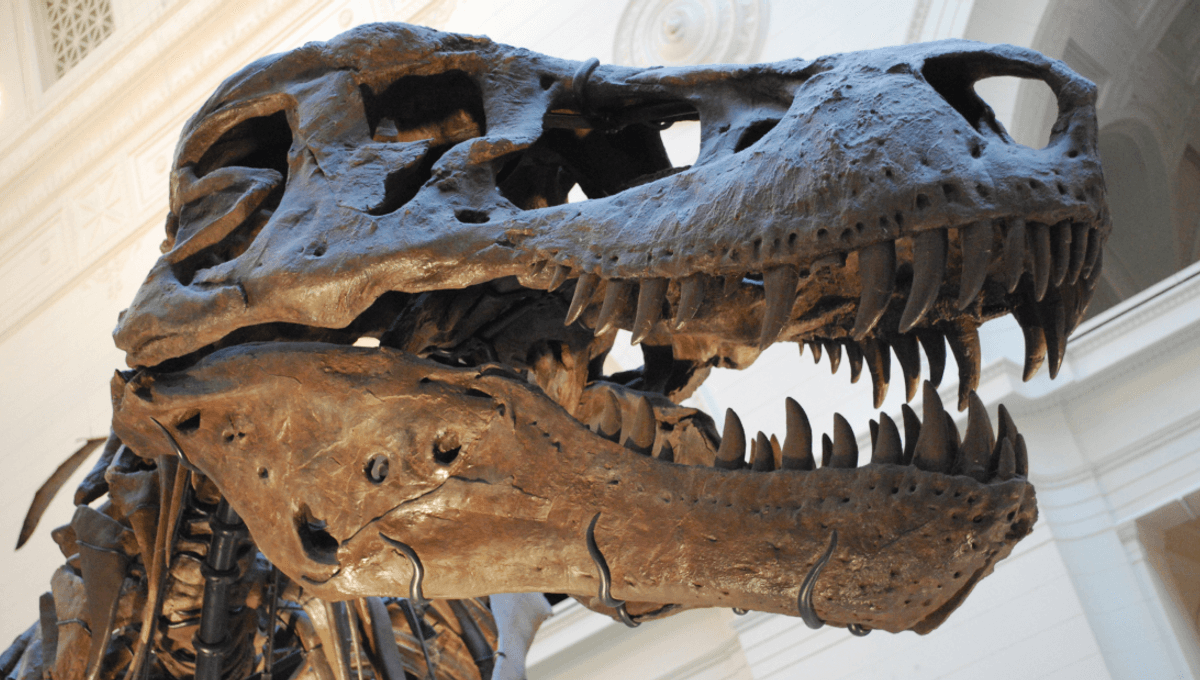
Tyrannosaurus rex got an upgrade in 2024 when a computer modeling study estimated that these dinosaurs may have been up to 70 percent heavier than we’d previously estimated based on the fossil record. It effectively supersized a predator that was already thought to be pretty damn big, highlighting how much food such a large animal would have needed to reach that size.
The rest of this article is behind a paywall. Please sign in or subscribe to access the full content.
There was plenty to sink your teeth into in the time of T. rex. They’re thought to have been active predators capable of stalking or ambushing prey, and ate whatever they could get – Triceratops, Edmontosaurus, and even other tyrannosaurs. Fossilized stomach contents have revealed T. rex ate a lot of babies, too. An easy meal, no doubt, but it could also feast on giants. It got us wondering…
How many teeth did T. rex have?
The mouth of T. rex is thought to have been lined with around 50 to 60 teeth. These teeth were huge, even longer than those of the prehistoric shark Otodus megalodon. Each tooth was banana-sized, between 19 to 30.5 centimeters (7.5 to 12 inches) long with serrated edges.
“T. rex teeth are more robust than other smaller theropods and could withstand stronger stresses,” said Associate Professor Kristin Brink, a vertebrate palaeontologist at the University of Manitoba, to IFLScience. “They were likely able to crush bone, whereas the smaller species likely used their teeth for slicing flesh.”
Did T. rex‘s tooth count change with age?
The number of teeth T. rex had throughout its life presented something of a mystery to Brink and colleagues during a study that looked at tooth counts through growth in many types of reptiles. The general trend is that the number of teeth goes up with age, but there was one exception: T. rex.
We now know that this outlier was actually a case of mistaken identity. We thought we had juvenile T. rex specimens to study until recently, when it was announced that these juveniles were actually an entirely different genus: Nanotyrannus. If that reclassification holds, it means everything we thought we knew about T. rex growth trends – including tooth count – needs to be reevaluated.
“It is possible that tooth count stayed consistent or increased and the teeth got bigger through growth in T. rex, like every other reptile, but we don’t know yet,” said Brink. “Reptiles – including dinosaurs – continuously replace their teeth throughout life, so each time they shed their teeth is an opportunity for the next tooth generation to be slightly larger.”
So, how did it get to the 60 banana-sized gnashers we see in adult T. rex? It remains to be seen, but one thing’s for certain: the T. rex tooth fairy must’ve been awful busy (and very strong).

Source Link: How Many Teeth Did T. Rex Have?
