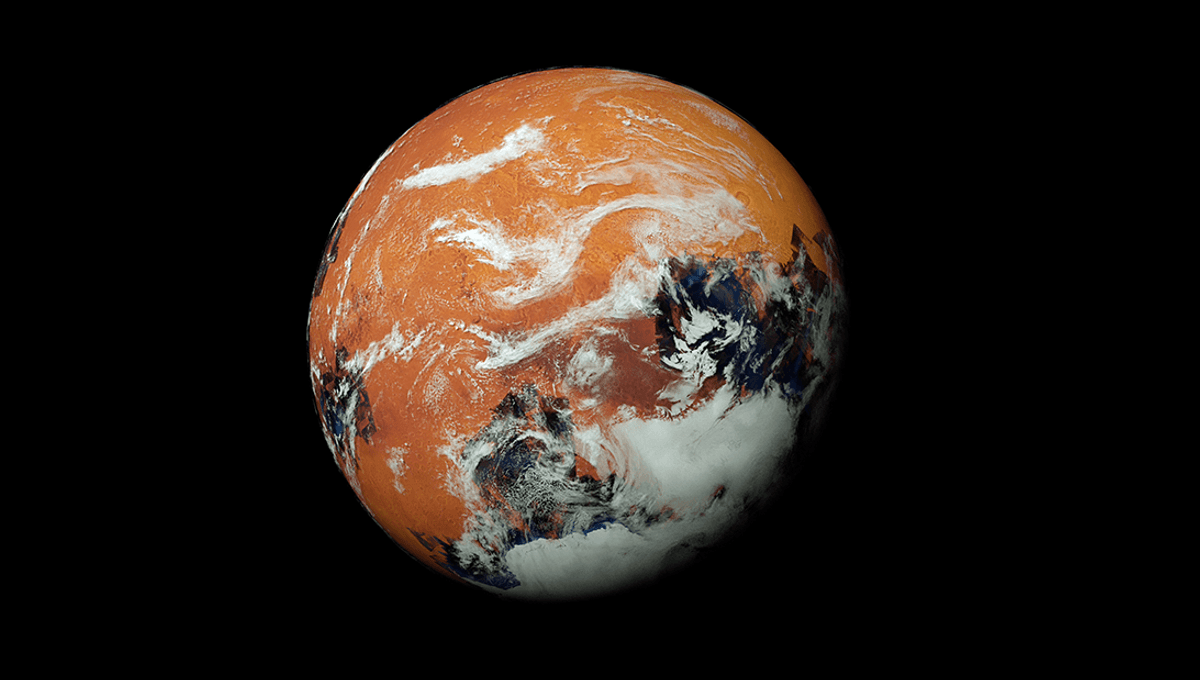
There may come a point (perhaps for humans, perhaps not) where a civilization may wish to terraform a planet in their Solar System or beyond. Perhaps an environmental disaster was looming on their planet, or they spotted a nearby neighbor planet that looked like – with a few finishing touches – it could make a nice new home.
A new study has looked at what options such a civilization wishing to warm a planet would use, and determined that these methods would likely be detectable from Earth.
The hunt for alien life, at the moment, is fairly elegant in its simplicity. As well as looking out for potential signals deliberately or unintentionally sent out into space by alien civilizations, we scan the stars for tiny dips in light that suggest an exoplanet has blocked our view of its light. Once we have located an exoplanet, we can look at factors such as where the planet is in its solar system to figure out if it is in a habitable zone.
Gases in planets’ atmospheres block specific wavelengths of light, meaning that if we measure the spectra, we can get an idea of the chemical composition of the planet. As we’ve only ever found evidence of life on one planet (you’re currently sitting on it) it makes sense to look for planets with a chemical makeup amenable to life on our own planet. But we also look for signs of technological civilizations, including hypothetical megastructures that should emit hefty amounts of infrared radiation.
In the new paper, a team from the University Of California, Riverside suggests another sign we could look for is chemical signatures that suggest a civilization is attempting to warm their planet.
Greenhouse gases on Earth are a fairly big problem. “For us, these gases are bad because we don’t want to increase warming,” UCR astrobiologist and lead study author Edward Schwieterman said in a statement. “But they’d be good for a civilization that perhaps wanted to forestall an impending ice age or terraform an otherwise-uninhabitable planet in their system, as humans have proposed for Mars.”
Chlorofluorocarbons (CFCs) have been suggested as a way a civilization could do this. However, they are not great for any civilization that enjoys the protection of ozone, nor are they very detectable.
“If another civilization had an oxygen-rich atmosphere, they’d also have an ozone layer they’d want to protect,” Schwieterman added. “CFCs would be broken apart in the ozone layer even as they catalyzed its destruction.”
Instead, the team suggests, they may wish to use fluorinated versions of methane, ethane, and propane.
“These fluorine-bearing gases were chosen in part because of their nontoxic nature and their relative inertness compared to chlorine- or bromine-containing greenhouse gases that catalytically destroy ozone,” the team explains in their paper. “On a per-molecule basis, each of these species is a far more effective greenhouse gas than CO2 or H2O due to strong and broad absorption features that overlap with the mid-infrared (MIR) window of a habitable exoplanet.”
These gases are much longer-lived than CFCs, and could remain in an Earth-like atmosphere for tens of thousands of years, meaning that you would not have to keep replenishing the supply to keep the climate how you want it.
As alien civilizations are subject to the same physics we are, it’s possible they would notice the potential of these gases, which gives us something to look for. According to the team, using telescopes like the JWST and future telescopes, we should be able to detect the signatures these chemicals give off.
“Specifically, we have shown that CF4, C2F6, C3F8, SF6, and NF3, alone and in combination, can produce MIR (5–12 μm) transit signatures comparable to or greater than the 9.65 μm O3 band at concentrations ≳ 1 ppm,” the team wrote in the study. “We calculated the number of transits required to detect C2F6, C3F8, SF6, NF3, and equal combinations of the first three gases at 1, 10, and 100 ppm on TRAPPIST-1 f with MIRI LRS and found surprisingly few transits are required, as few as five for a 5σ detection for a combination of each gas at 100 ppm, and 10 transits for the same at 10 ppm.”
This could get muddied if such civilizations use a combination of greenhouse gases, to keep costs low. For the “first pass” at finding such planets, they suggest that astronomers should look for anomalously low infrared radiation, which could then be looked at more closely to attempt to analyze their chemical signatures.
The paper is published in the Astrophysical Journal

Source Link: How We Could Detect A Terraformed Planet Using Existing Technology
