Last month, NASA announced development progress of the Pulsed Plasma Rocket, a new type of thruster that could help enable one of the coolest astronomy projects ever dreamt up.
First proposed by Einstein (somewhat reluctantly), the idea is actually fairly simple, and based on a concept we use fairly frequently in astronomy these days known as “gravitational lensing“. As implied by Einstein’s general theory of relativity, giant objects in the universe bend space-time, altering the path of light.
Astronomers use this handy feature of the universe to see light beyond stars and black holes, but we are limited by where these massive objects are placed. However, we do have a (relatively) nearby object that can produce this effect in our old, reliable Sun.
“The gravitational field of the sun acts as a spherical lens to magnify the intensity of radiation from a distant source along a semi-infinite focal line,” Von Russel Eshleman, who first expounded on this idea, wrote in a 1979 paper.
“A spacecraft anywhere on that line in principle could observe, eavesdrop, and communicate over interstellar distances, using equipment comparable in size and power with what is now used for interplanetary distances. If one neglects coronal effects, the maximum magnification factor for coherent radiation is inversely proportional to the wavelength, being 100 million at 1 millimeter.”
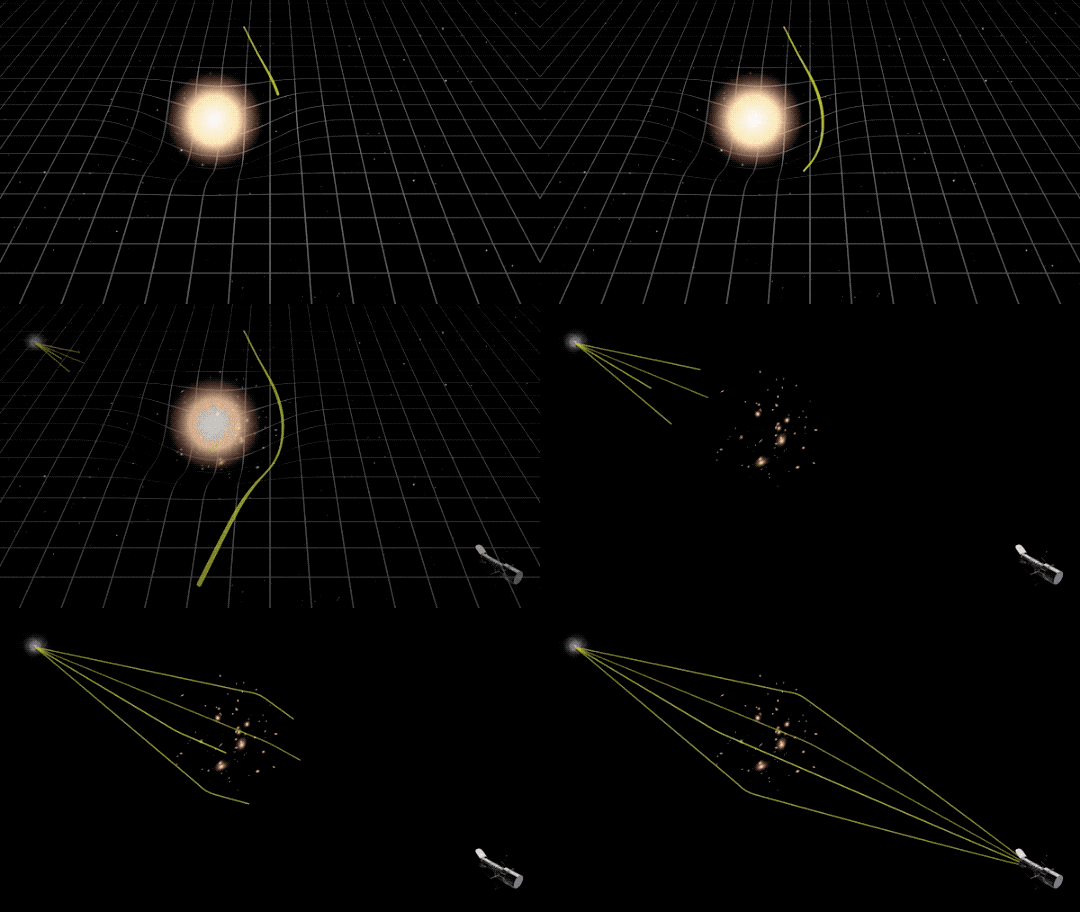
How gravitational lensing works.
Image credit: NASA, ESA, and Goddard Space Flight Center/K. Jackson
This is a pretty cool concept, and one not entirely out of the realm of achievable space projects in the not-too-distant future.
But a similar concept might be even more achievable, requiring us only to travel around 85 percent of the distance to the Moon, rather than the 550 astronomical units (AU) required by the Sun telescope idea (with one AU being the distance between the Earth and the Sun).
This is the “terrascope”, proposed by David Kipping, assistant professor of astronomy at Columbia University. In a 2019 paper, Kipping – known for his YouTube channel Cool Worlds – proposed that we could use refraction of light by the Earth’s atmosphere to achieve a similar effect.
Though you might not be aware of this refraction, you see evidence of it on a clear day. When the Sun has just dipped below the horizon, or just before it comes up in the morning, you can see it seemingly appear above the horizon due to the refraction of light.
“Imagine a distant star setting on the horizon. Light from that star enters the Earth’s atmosphere and deflects by half a degree it skims the surface and makes its way back out of the atmosphere giving another half a degree of bend, so one degree in total,” Kipping explains in a Cool Worlds video.
“Light from that same star will also shine upon the opposite hemisphere and the two rays will converge together at a distance given by the radius of the earth divided by one degree, so that’s a distance just interior to the orbit of the moon. This is a focus point.”
Kipping continues: “If the ray were any closer to the Earth, it would strike the surface and thus be lost. If the ray were a bit higher in altitude, then it would bend a little bit less, since the atmosphere is thinner as altitude increases. So this means that not only do you get a focus for surface skimming rays, you will also get a focus at every point more distant than that too. In other words, you have a focal line.”
Place a telescope along this line, and you should be able to see a lot further than you could with regular telescopes, as you are essentially using a natural telescope the size of the planet.
To account for the effects of clouds, you could use light that passes higher up in the atmosphere, though this would require traveling further out than the Moon. Using such a system, Kipping suggests that it could be possible to achieve around 10-40,000 amplifications, equivalent to having a 150-meter (492-foot) space telescope, far larger than the 6.5-meter (21.3-foot) JWST mirror.
Though a neat concept, and a great potential test run for using the Sun as a telescope, there are plenty of problems to overcome, such as airglow, thermal emission and scattering from Earth, and interference from the Sun’s light. It could be possible that we can overcome these problems, but for now, it remains a fun idea, rather than an achievable project.
The study is published in Publications of the Astronomical Society of the Pacific.

Source Link: How We Could Turn The Earth Into A Giant Telescope
