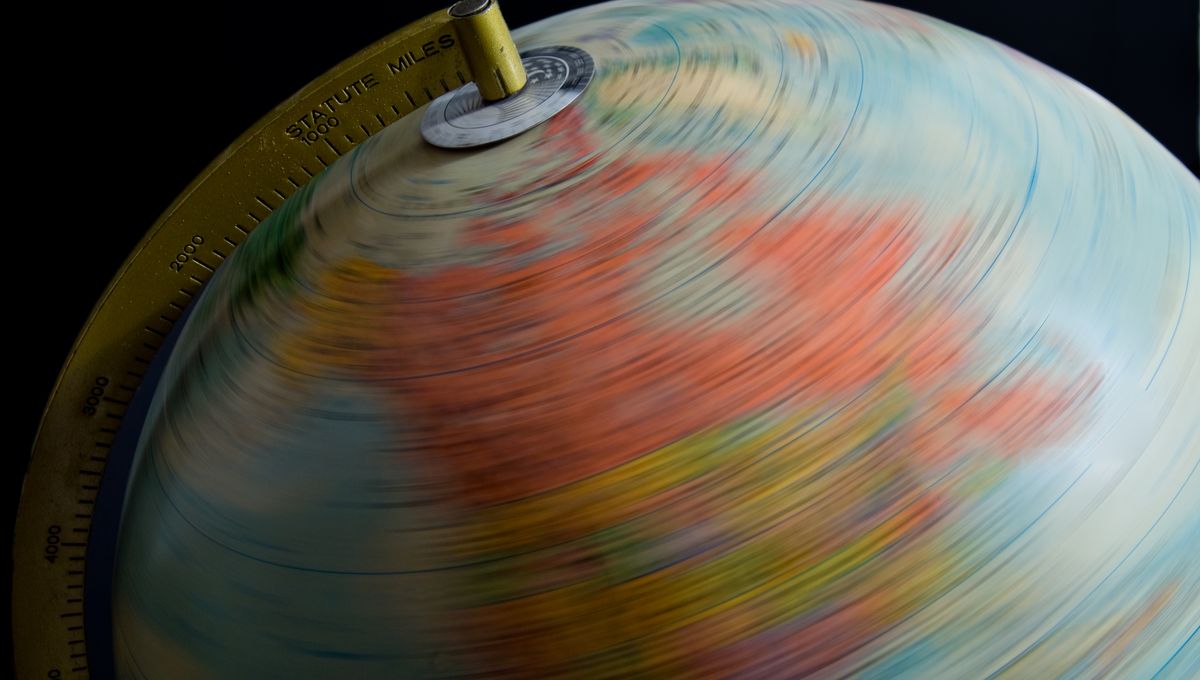
The Earth rotates towards the east, so the Sun, the Moon, and all celestial bodies we can see always appear to rise from that direction and set in the west. But there is no reason for that to be the only possible case. Our planet might just as easily spin in the opposite direction, and while the world would be different, life would still go on as usual.
For this thought experiment, let’s magic up a planet just like our own, but spinning towards the west. We cannot stop Earth and reverse it. If the world stopped spinning we would have apocalyptic tsunamis, oceans migrating to the poles, and a lack of magnetic field to deal with it (more in our deep dive on this). We don’t want to deal with all that, so let’s just pretend that we wished upon a star and tomorrow morning the Earth will be spinning the other way.
Sunrise and sunset
Well, the first thing we’d notice tomorrow morning is the sunrise in the west. So far so good, we have avoided catastrophic devastation. The major thing that it would change is the weather.
The rotation of our planet affects the winds. This phenomenon is known as the Coriolis effect and it is seen, often and erroneously, as the reason why the water in a toilet goes one way or another, depending on if you are north or south of the equator. The way a household facility is built, such as a toilet, might falsify the effect, hence you shouldn’t take the toilet experiment at face value.
Trade winds
But in the atmosphere, the effect is in full force and things will be mirrored. The trade winds at the Equator will no longer blow toward the west. And the east-blowing winds in the mid-latitudes, such as the US and Europe, but also Argentina and part of Australia, will no longer push in that direction.
Biodiversity on this planet depends on adaptations that took a long time to develop, and we are suddenly placing everything in a mirror world. Certainly many species, us included, will be affected by this. One simple example is that the trade winds at the equator bring nutrients from the Sahara to the Amazon, helping the incredible biodiversity of the region. Without those winds, that important process couldn’t take place.
Ocean currents
Currents too are affected by the rotation and, in coastal areas, by winds. The established flow of hot or cold water in the oceans would change completely, with peculiar effects across the planet. The immediate impact that this would have is hard to quantify.
Deserts and no deserts
Let us take a walk into a scenario where the magical change in spin took place several thousand years ago (so we can ignore all the biodiversity decimation). The world today would look quite different.
A paper from 2018 actually modeled an Earth-analog spinning in the opposite direction. A clear difference would be in the Sahara. The desert would simply not be there. Africa and the Middle East would be a lot greener than they are today. The southern United States, the Caribbean, Central America, southern Brazil, and Argentina would instead be deserts. And so would Japan and the eastern coast of China.
The shift in winds and currents would also affect temperatures and precipitation. The regions that are now deserts would be a lot hotter and drier of course, but there would also be changes in other areas. Europe would be a lot colder and wetter, as well as the Maghreb and the Middle East, bits of Australia, and New Zealand.
Planets’ spins are not all the same
All the planets in the Solar System orbit the Sun in the same direction. Thanks to the conservation of angular momentum of the gas cloud from which the Sun formed, we are all on this synchronized merry-go-round. But making a planet spin the opposite way is not impossible. Uranus experienced a major collision that sent it spinning on its side, so during its 84-year-long trip around the Sun, its poles point directly at it during their respective summers.
More interestingly, let’s look at Venus. Earth’s deadly hot twin has an extremely slow day (roughly 224 times longer than Earth’s) and it spins in the opposite direction. So on Venus, the Sun would set in the east. Too bad that there’s constant cloud cover and it would take over 100 days to do so! The reason for this is uncertain.
Possibilities include that the planet flipped 180 degrees due to the Sun’s gravitational pull and the behavior of its interior. Another option is that the effect mentioned already, plus the pull from other planets on Venus’s atmosphere, slowed down its rotation to a standstill and then reversed it.
The jury is still out for Venus; but clearly, an Earth with an opposite spin could be possible. Maybe in the multiverse, there is an Earth like ours with a verdant Sahara and sand dunes where the Argentine Pampas ought to be.

Source Link: How Would Earth Be Different If It Spun In The Other Direction?
