• Email Us: [email protected]
  • Contact Us: +1 718 874 1545
  • Skip to main content
  • Skip to primary sidebar

Medical Market Report

  • Home
  • All Reports
  • About Us
  • Contact Us

Hubble Spots Unexpected Twin Tails In New DART Asteroid Impact Image

October 20, 2022 by Deborah Bloomfield

A follow-up observation from NASA’s Hubble Space Telescope has shown a curious new development from the asteroid system a spacecraft smashed into last month: a newly developed second tail of ejecta.

On September 26, the first-of-its-kind DART mission saw an uncrewed spacecraft collide with asteroid moonlet Dimorphos, a small body just 160 meters (530 feet) in diameter, that orbits a larger, 780-meter (2,560-foot) asteroid called Didymos. All of this took place some 11 million kilometers ( 7 million miles) away from Earth. 

Advertisement

NASA declared the DART mission managed to successfully alter the orbit of Dimorphos. It looks like the crash shortened Dimorphos’ original 11-hour, 55-minute orbit around Didymos by about 32 minutes. This suggests that humanity might stand a chance at averting a future catastrophic collision with an asteroid by using this technique one day. 
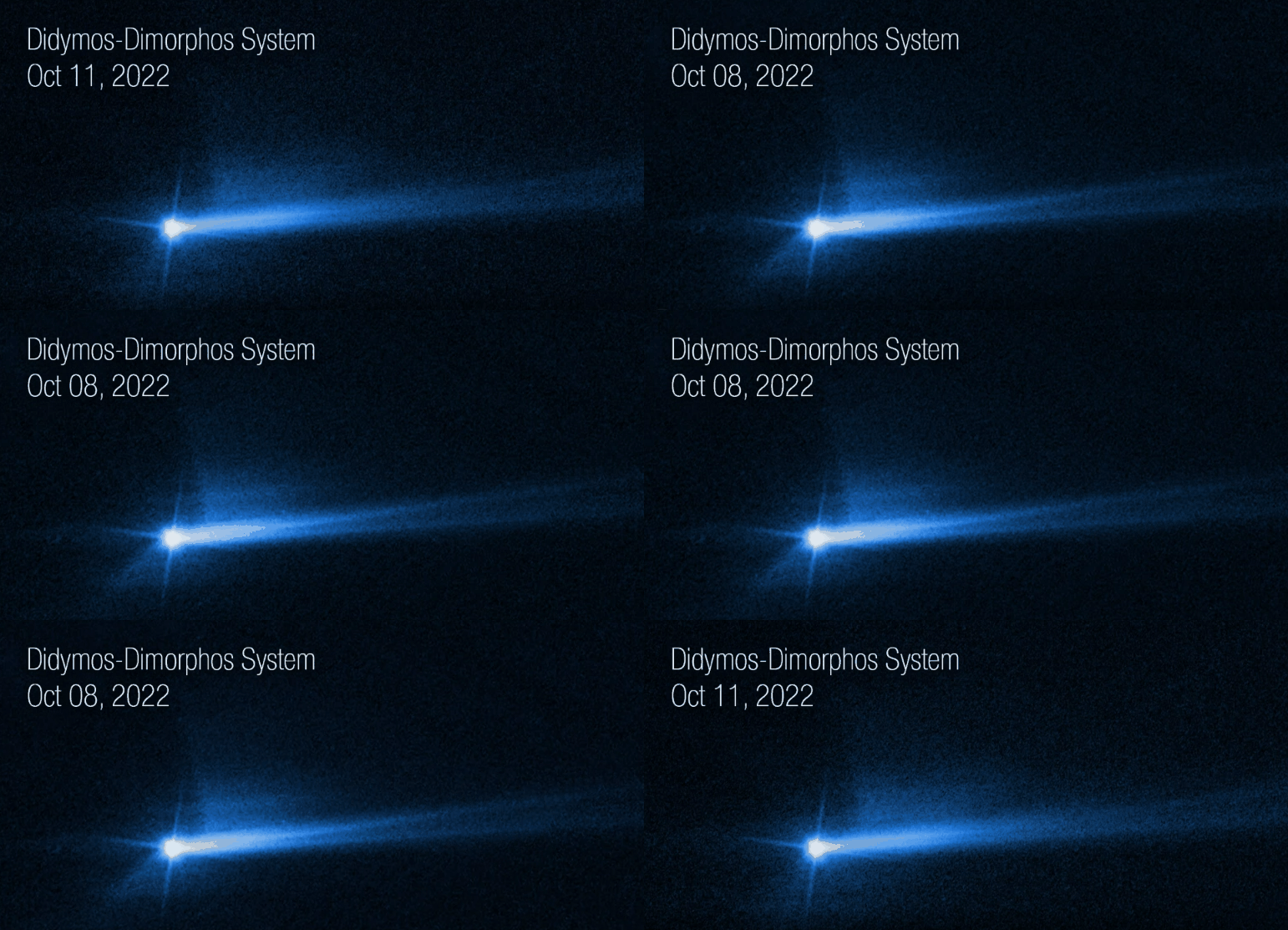
Two tails of dust ejected from the Didymos-Dimorphos asteroid system

The newly developed second tail is easier to spot in this gif. Image credit: NASA, ESA, STScI, Jian-Yang Li (PSI)/ Processed by Joseph DePasquale

On top of orbits, astronomers are also keeping a close on how the asteroid’s ejected material, or “ejecta,” is changing over time. In these latest images from Hubble, two tails of dust ejecta can be seen flying out of the Didymos-Dimorphos asteroid system

While researchers were expecting to see the formation of one tail, although perhaps not to the extent they did, the second was not anticipated. Their observations suggest it formed between October 2 and October 8, but they’re still uncertain how it developed. The team says they’re a number of possible scenarios which they’re keen to investigate.

Deborah Bloomfield
Deborah Bloomfield

Related posts:

  1. Union at Albemarle Atacama plant rejects new contract offer, strike continues
  2. Advocates see ‘chaos’ if U.S. Supreme Court guts abortion rights
  3. Promising Treatment For Sleep Apnea Opens Up New Therapeutic Possibilities
  4. Oregon Police Ask Beachgoers Not To Play With Hand Grenades

Source Link: Hubble Spots Unexpected Twin Tails In New DART Asteroid Impact Image

Filed Under: News

Primary Sidebar

  • Astronomers Catch Incredible First Direct Images Of Objects Colliding In Another Star System
  • Billionaire Jared Isaacman Finally Confirmed As Head Of NASA, As Agency Faces Uncertain Future
  • Something Just Crashed Into The Moon – And Astronomers Captured The Whole Event
  • These “Living Rocks” Are Among The Oldest Surviving Life And Are Champion Carbon Dioxide Absorbers
  • Ambitious Iguana “Love Island” For Near-Extinct Reptiles Becomes Epic Conservation Success Story
  • Sol 1,540: NASA Releases Video Of Perseverance Rover’s Record-Breaking Drive On Mars
  • Why Carl Sagan Was Way Ahead Of His Time And The Legacy He Left Behind
  • Why Were Pompeii Victims All Wearing Thick Woolly Cloaks In August?
  • We May Finally Know What Causes These Bizarre Bright Blue Cosmic Flashes
  • What’s The Biggest Rock In The World?
  • There Is A Very Simple Test To See If You Have Aphantasia
  • Bringing Extinct Animals To Life: Is Artificial Intelligence Helping Or Harming Palaeoart?
  • This Brilliant Map Has 3D Models Of Nearly Every Single Building In The World – All 2.75 Billion Of Them
  • These Hognose Snakes Have The Most Dramatic Defense Technique You’ve Ever Seen
  • Titan, Saturn’s Biggest Moon, Might Not Have A Secret Ocean After All
  • The World’s Oldest Individual Animal Was Born In 1499 CE. In 2006, Humans Accidentally Killed It.
  • What Is Glaze Ice? The Strange (And Deadly) Frozen Phenomenon That Locks Plants Inside Icicles
  • Has Anyone Ever Actually Been Swallowed By A Whale?
  • First-Known Instance Of Bees Laying Eggs In Fossilized Tooth Sockets Discovered In 20,000-Year-Old Bones
  • Polar Bear Mom Adopts Cub – Only The 13th Known Case Of Adoption In 45 Years Of Study At Hudson Bay
  • Business
  • Health
  • News
  • Science
  • Technology
  • +1 718 874 1545
  • +91 78878 22626
  • [email protected]
Office Address
Prudour Pvt. Ltd. 420 Lexington Avenue Suite 300 New York City, NY 10170.

Powered by Prudour Network

Copyrights © 2025 · Medical Market Report. All Rights Reserved.

Go to mobile version