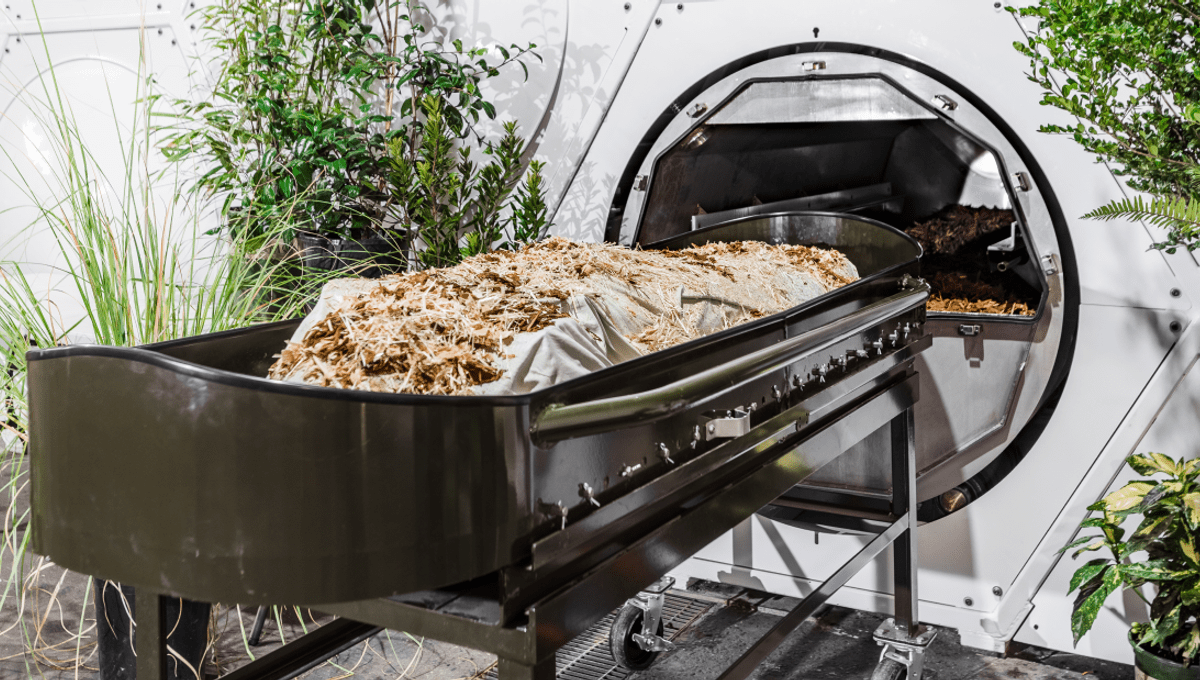
Human composting is catching on as New York joins other US states in approving an eco-friendly funerary practice as a legitimate way to dispose of the dead. The approach takes a corpse and gives it a “natural organic reduction” treatment that sees the soft tissues decompose into a compost-like substance.
The treatment’s recipe includes a mixture of wood chips, alfalfa, and straw to form a cocoon. Bodies are placed into an above-ground chamber with the organic blend and it takes microbes in the mixture around 30 days to break down the body, which will eventually be transformed into a rich, nourishing soil.
The approach is considered safe and can destroy most pathogens, though certain causes of death may exclude a person from being able to be processed with natural organic reduction. This is because some pathogens, like the prions that cause Creutzfeldt-Jakob disease, could potentially still be infectious even after the organic processing.
Washington became the first US state to approve human composting back in 2019 but it’s catching on as an eco-friendly alternative to burial and cremation. As the sixth US state, New York follows California, Colorado, Oregon, and Vermont in approving the funerary practice.
America is estimated to contain around 1 million acres (404,685 hectares) of land currently dedicated to human burial, representing a significant chunk of the land that has been stripped of its natural plant and wildlife composition. On top of this, the production of coffins and caskets (which aren’t the same thing) sees around 4 million acres (1.6 million hectares) of forest lost each year, the loss of which is likely worse when the planks needed to facilitate burials are taken into account.
Embalming also commits around 800,000 gallons of embalming fluid to the ground, which can leach into the soil as a contaminant. It’s easy to see why, then, eco-friendly solutions to traditional funeral practices are becoming more popular.
Another approach that was in the press following the death of Desmond Tutu was aquamation, which uses alkaline hydrolysis to break a body down. While an increasingly climate-conscious Earth catches up with less harmful ways to deal with the dead, communities in Tibet and Mongolia have long being using sky burials, a practice observed by Buddhists in which corpses are offered up to carnivorous birds. The burials are believed to facilitate the soul’s passage after death, as well as benefiting local wildlife.
Some have even suggested that sky burials could be a solution to the plight of California condors that are currently under threat from lead contamination. While the US may be some way from considering the latter, that human composting is now on the cards shows that there are a lot of people out there interested in greener funerals.
[H/T: BBC]

Source Link: Human Composting Now An Approved Funerary Practice In New York
