We know full well that our species has the capacity to effect phenomenal change, even accidentally, for better or for worse. We see it in the climate crisis but also in the eradication of smallpox. When the DART mission hit asteroid Dimorphos, our species gained the ability to move celestial bodies. It turns out we can also move vast bands of radiation and make them into a barrier around our planet, even though we had no idea we were doing it.
The rest of this article is behind a paywall. Please sign in or subscribe to access the full content.
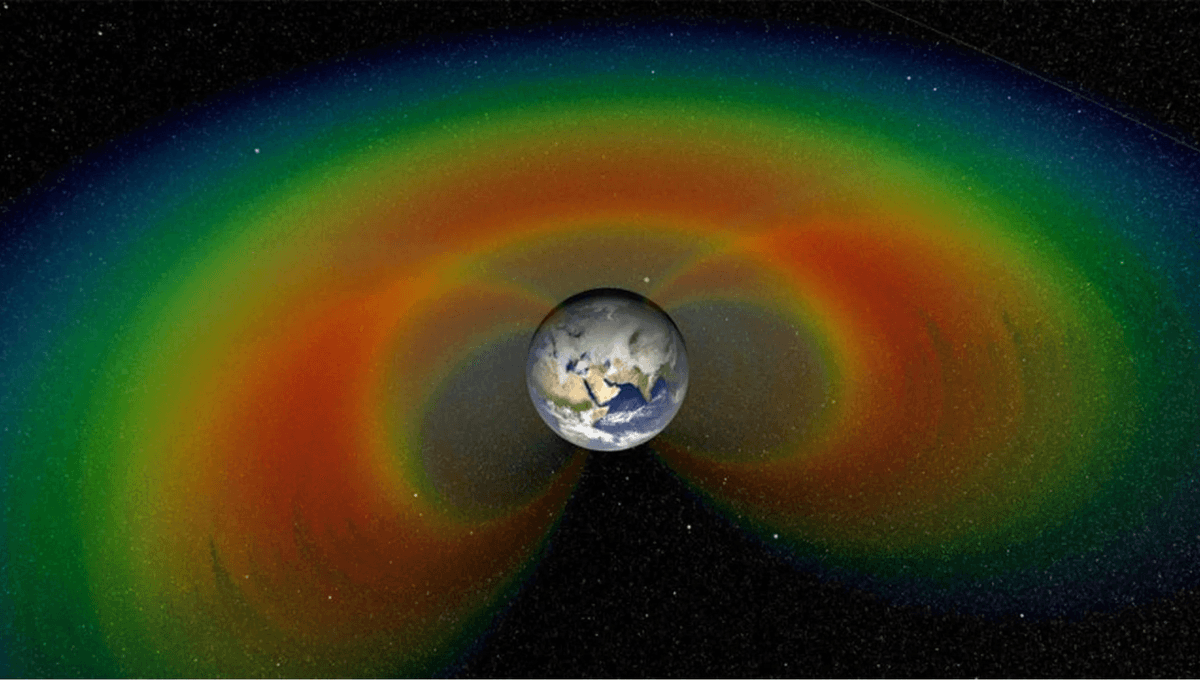
The Earth’s magnetic field acts as a shield against dangerous cosmic rays and powerful solar winds. Electrically charged particles can reach the planet by following field lines towards the poles. As they slam into the atmosphere, they create the Southern and Northern Lights. The magnetic field also traps swarms of those particles into bands of radiation around the Earth.
These are known as the Van Allen belts, and they were discovered in the 1950s. The shape of the belts varies in response to the interactions between the Sun and the Earth, but they are often pictured as two concentric donuts. There is a small stable one between 1,000 and 6,000 kilometers (600 and 3,700 miles) above the Earth’s surface and a larger, less constant one between 13,000 and 60,000 kilometers (8,100 and 37,300 miles) up.
A NASA mission called the Van Allen Probes, deactivated in 2019, studied the belt in spectacular detail. One thing that they discovered was the fact that, depending on the energy of the particles, the belt looks radically different, so the donut picture is limited at best. Another extremely cool thing was the discovery that we have been messing with the belts without realizing.
You might think it’s satellites that affect them. They are in space after all. However, what’s actually affecting the radiation belts is radio waves, in the very low frequency (VLF) range used in radio communications by submarines, for example. These can affect the motion and position of the particles in space.
“A number of experiments and observations have figured out that, under the right conditions, radio communications signals in the VLF frequency range can in fact affect the properties of the high-energy radiation environment around the Earth,” explained Phil Erickson, assistant director at the MIT Haystack Observatory and co-author of a study that revealed this in 2017.
So the VLF ends up creating a bubble around the Earth, pushing particles away, and its outward extent corresponds almost exactly to the inner edge of the Van Allen radiation belts. The inner belt actually appears to have shifted farther away from the early 1960s measurements, suggesting that VLF might have pushed the radiation belt outwards as this barrier was created.
The barrier is not really a force field, but it might have some uses; for example, it could deflect some of the cosmic radiation that comes towards Earth. Tests are even underway to see if VLF emitters can be used to protect different areas of the planet from the particles from solar storms.

Source Link: Humans Have Accidentally Created A Barrier Around The Earth
