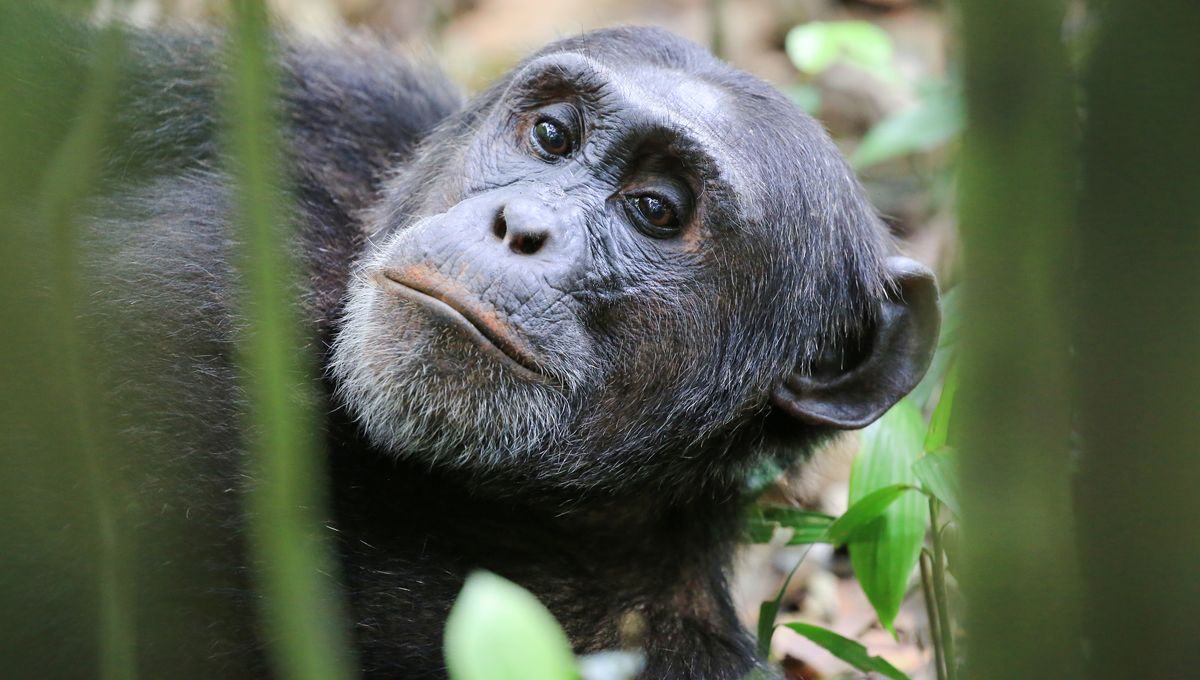
Travel across a country and you’ll come across a vast array of dialects in humans – but what about one of our closest-living relatives, chimpanzees? A new study appears to show that they too have different “dialects” across groups, but we might also be triggering them to change.
ADVERTISEMENT GO AD FREE
To find this out, a group of researchers spent years collecting observational data on the four wild western chimpanzee (Pan troglodytes verus) communities neighboring each other in Taï National Park, Côte d’Ivoire, watching them morning to night and noting anything that seemed important.
What they discovered was related to sex – specifically, the different ways in which the different groups of chimpanzees attempted to get some.
While humans might attempt to rizz someone up with a terrible chat-up line, male chimpanzees have other ways to attract the attention of females. This includes auditory gestures, which means making a sound to communicate something – in this case, their desire to get jiggy with it.
“We identified four types of communicative gestures, ‘heel kick’, ‘knuckle knock’, ‘leaf clip’ and ‘branch shake’, used by male chimpanzees to attract females to mate with them,” said first author Mathieu Malherbe in a statement.
The team also discovered that these four gestures weren’t used consistently between the different chimp groups in the national park – they each had their own dialect. “Between 2013 and 2024, we found differences in the frequency of use of these communicative gestures between neighbouring chimpanzee communities, but also between populations across Africa,” explained Malherbe.
Analyzing further data that spanned the course of 45 years revealed that the gestures used could change over time too. Given that female chimpanzees move between groups, this led the researchers to conclude in their paper that these different gestural dialects “are likely to be socially influenced”, providing evidence of culture.
ADVERTISEMENT GO AD FREE
“The consistent use of the same mating request signal forms within communities, but different signal forms between neighbouring communities that experience regular gene flow through female migration, suggests socially learned dialects in chimpanzees, evidence that has rarely been demonstrated before,” said Catherine Crockford, one of the study’s senior authors.
However, the team also found that in one of the groups, a gesture appears to have completely disappeared. “These days, males in the North group, one of the four communities, have not been observed to use the ‘knuckle knock’ for 20 years, although all males in the North group used this gesture before 2004,” said senior author Liran Samuni.
They linked this to human activity in the area. “Since 1999, the North community lost many members including all adult males due to human pressure, with the last adult male killed by a poacher in 2008. Over an eight-year period (2004–2011), no two adult males were together in the group, limiting male–male competition and the availability of adult males to model signal use,” wrote the researchers. “This demographic decline coincided with the apparent loss of the knuckle-knock gesture in the North group.”
Given the importance of social learning and that “horizontal transmission of cultural knowledge is a powerful mechanism of evolutionary change”, the researchers said that their findings highlight the need to prevent further loss of chimpanzee culture by human action.
ADVERTISEMENT GO AD FREE
“There is an urgent need to integrate the preservation of chimpanzee culture into conservation strategies,” said senior author Roman Wittig, with Malherbe adding: “This initiative is crucial not only for the survival of the species, but also for understanding our own evolutionary history”.
The study is published in Current Biology.

Source Link: Humans May Have Triggered An Entire Gesture To Disappear From Wild Chimpanzee Culture
