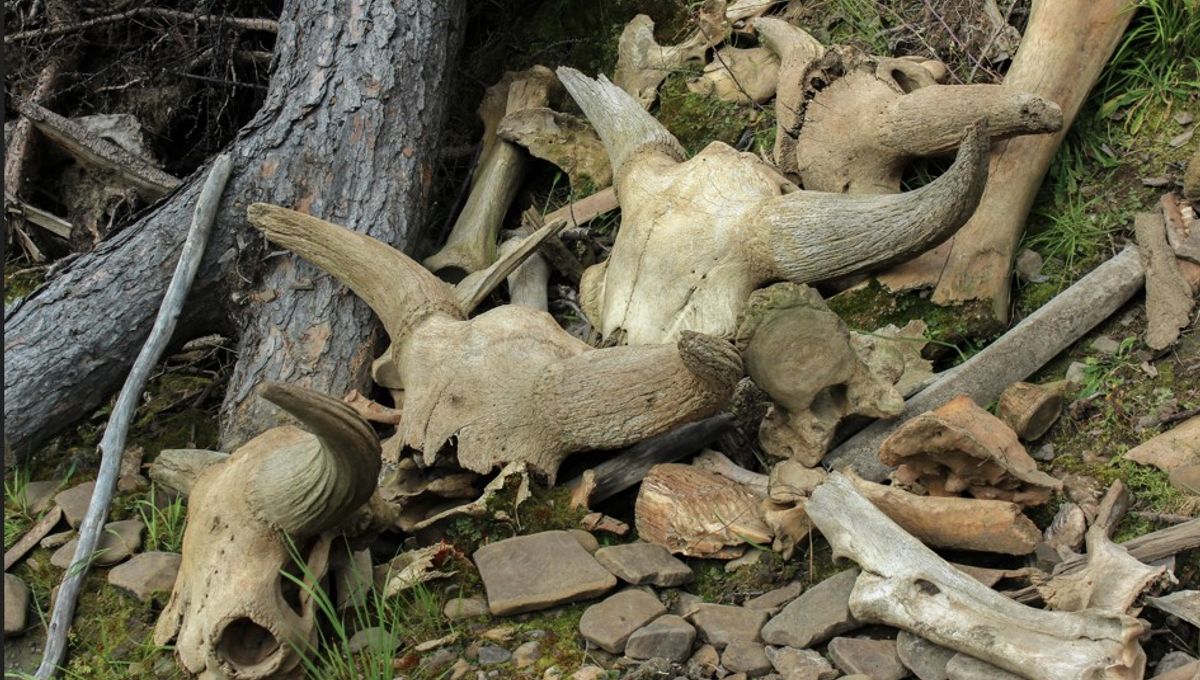
Hunting an entire herd of aurochs was no mean feat, and would have required sophisticated levels of cooperation and communication between multiple groups of ancient humans. According to a new study, the organizational skills required to pull off such a massacre were only developed around 50,000 years ago and may have helped Homo sapiens outlive their Neanderthal neighbours.
The last 50 millennia of human history have been completely unique. For some unknown reason, humans all over the world suddenly underwent a cognitive upgrade about 50,000 years ago, resulting in an explosion of artistic expression and ritual behavior. Known as the Great Leap Forward, this cultural breakthrough still lacks a decent explanation, although anthropologists think it may have been related to Homo sapiens’ unique talent for communicating, networking, and collaborating.
To gain a more precise idea of how and when these abilities emerged, the authors of a new study sought out signs of mass hunting prior to 50,000 years ago. “Mass hunting, pertaining to the simultaneous killing and subsequent processing of several herd animals… may involve high levels of cooperation and communication among numerous people from different bands over several days, sometimes longer,” they write. “As such, it is an important archaeological proxy of large-scale cooperation.”
The researchers focused on a site in Israel called Nesher Ramla, where huge numbers of aurochs bones have been discovered bearing signs of butchery by humans. Dated to around 120,000 years ago, the site was inhabited by Neanderthal-like hominins who co-existed with anatomically modern humans, and could potentially have learned how to execute a mass hunt by observing these more advanced groups.
However, an analysis of the aurochs remains at Nesher Ramla suggests that this was not the case, as the slaughtered animals clearly did not belong to the same herd. Rather than working together to kill multiple animals simultaneously, then, it seems that these prehistoric hunters targeted individual aurochs during multiple small-scale hunting events.
For instance, the study authors found that all of the aurochs present at the site were adult females, which simply doesn’t match the mortality profile that would be expected if an intact herd had been killed. Furthermore, isotopic analyses of the bones revealed that these enormous cows didn’t all live together, ruling out the possibility that the hunters daringly brought down an entire stampeding herd.
“Our analyses and data do not support the hypothesis that [Nesher Ramla] hosted mass hunting events, speaking for multiple small-scale hunting events instead,” write the study authors. This conclusion is bolstered by the presence of one particular animal that shows signs of surviving being shot with an arrow during one hunt, only to be killed by the same human group at a later date.
Having dismissed the possibility of a mass hunt, the researchers ultimately propose that the hominids at Nesher Ramla were incapable of the kind of intergroup communication and cooperation necessary for such a massacre, despite living alongside the more adept Homo sapiens. They therefore suggest that this inability to work together may have “amounted to an evolutionary disadvantage when faced with the more numerous or better interconnected modern human groups.”
Researchers widely agree that H. sapiens engaged in mass hunting from around 50,000 years ago, though some suggest they could have begun as early as 400,000 years ago. This new study adds to the idea that archaic humans could not compete with modern humans’ ability to cooperate and organize events like mass hunting that sustained larger populations, which may have contributed to modern humans’ long-term survival.
The study is published in the journal Scientific Reports.

Source Link: Humans Weren’t Capable Of “Mass Hunting” Until 50,000 Years Ago – What Changed?
