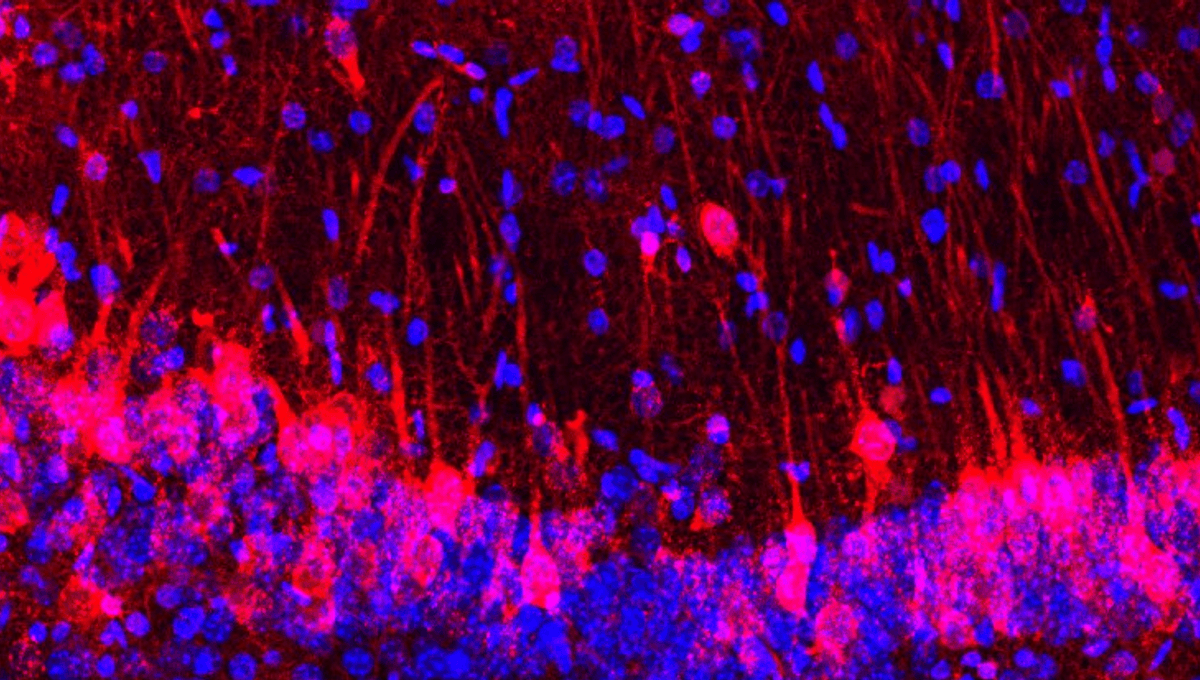
In a world first, two teams of scientists have independently created hybrid brain tissue with cells from two species: mice and rats. These two fuzzy rodents might look similar on the outside, but evolutionarily speaking they’re about 20 million years apart, so some sophisticated genetic engineering was needed to make this feat possible.
The scientists behind this work have an important goal in mind. Animal hybrid brain models could be a vital tool for research into new treatments for neurological diseases in humans.
“We have beautiful models of cells in dishes and 3D cultures called organoids and they both have their advantages,” said Kristin Baldwin, a professor at Columbia University and senior author of one of the studies, in a statement. “But none of them allow you to determine if the cells are really functioning at the highest level.”
But how do you go about combining cells from two such diverse animals?
Previous experiments have shown it is possible to replace a lost pancreas in a mouse using rat stem cells, thanks to a method called blastocyst complementation. Stem cells from one species are injected into a blastocyst – a very early-stage embryo – from another, where they develop and take on a missing function.
In the pancreas experiments, the mouse blastocyst contained a genetic mutation that meant it would develop without a pancreas. The rat stem cells were able to slot into that gap and develop into the missing organ. Could the same thing work with areas of missing brain tissue?
Over in Dallas, at the University of Texas Southwestern Medical Center, a team led by assistant professor Jun Wu developed a CRISPR-based system to identify the specific genes responsible for the development of different tissue types. They found that a gene called Hesx1 is needed for proper forebrain development in mice, and generated blastocysts that were lacking this gene. Then, they injected rat stem cells into the blastocysts and, sure enough, the rat cells were able to fill the gap and the mouse brains developed normally.
Even though rat brains are bigger than mouse brains, this didn’t seem to be an issue. The hybrid brains grew at the same pace and to the same size as wild-type mouse brains, and the rat and mouse-derived neurons were able to interface and pass signals to each other as if they were both from the same species.
At the same time, Baldwin’s team were using blastocyst complementation to restore lost neural circuits in the mouse olfactory system.
Once again, the mouse brains developed at the usual pace, even with rat hitchhikers on board. “You could see rat cells throughout almost the entire mouse brain, which was fairly surprising to us,” Baldwin said. “It tells us that there are few barriers to insertion, suggesting that many kinds of mouse neurons can be replaced by a similar rat neuron.”
The team created two different models, one where the mouse’s own neurons had been completely killed off, and one where they had just been silenced. The hybrid mice had to show off their sense of smell by trying to find a cookie that the scientists had hidden in their cage. It became clear that the rat neuron replacements worked best when there was no silenced mouse tissue in the way.
Baldwin explained, “This suggests that adding replacement neurons isn’t plug and play. If you want a functional replacement, you may need to empty out dysfunctional neurons that are just sitting there, which could be the case in some neurodegenerative diseases and also in some neurodevelopmental disorders like autism and schizophrenia.”
Blastocyst complementation is a long way from being ready for use in humans, but some of the early experiments bring cause for optimism, especially for those waiting for a transplant.
“Our aspiration is to enrich pig organs with a certain percentage of human cells, with the aim of improving outcomes for organ recipients. But currently there are still many technical and ethical challenges that we need to overcome before we can test this in clinical trials,” said Wu in another statement.
Until then, there’s much we could still learn from these types of hybrids – and to be fair, things have been a bit mouse- and rat-heavy up to now.
“There are over 2,000 living rodent species in the world. Many of them behave differently from the rodents we commonly study in the lab,” Wu said. “Interspecies neural blastocyst complementation can potentially open the door to study how the brains from those species develop, evolve, and function.”
The studies are both published in Cell, here and here.

Source Link: Hybrid Brains With Both Rat And Mouse Cells Created In Landmark Double First
