• Email Us: [email protected]
  • Contact Us: +1 718 874 1545
  • Skip to main content
  • Skip to primary sidebar

Medical Market Report

  • Home
  • All Reports
  • About Us
  • Contact Us

If The Sun Heats The Earth, Why Is Space Cold?

December 19, 2023 by Deborah Bloomfield

As a science website, it’s easy to get bogged down in questions like is there life on Enceladus and where are all the aliens, when people are struggling with more basic (but fun!) questions like why can’t we power our cars with magnets and could people breathe the air on Mars.

One such question it appears people have is “if the sun is in the sky, why is there heat on earth but not in the sky?” asked in the Facebook group Physics is Fun (which it IS). 

Advertisement

First off, space is cold, with the background temperature being an average of 2.7 Kelvin (−270.45°C or −454.8°F). And the Sun is indeed hot, in confusing ways. The core reaches temperatures over 15 million °C (27 million °F) while the surface (the photosphere) drops off to around 5,500 °C (10,000 °F), while the Sun’s corona (outer atmosphere) gets hotter further away from the photosphere, reaching temperatures of  3.5 million °C (2 million °F).


So why isn’t space hot? Well, this seeming paradox probably comes from people thinking about the Sun intuitively as a hot fire, heating the planets like a toasty marshmallow near a bonfire. This isn’t how planets are warmed. The heat we feel on Earth is not direct heat energy from the Sun, but the result of solar radiation emitted from the Sun (wavelengths across the electromagnetic spectrum, including visible light) interacting with particles on Earth.

With fewer particles to interact with in the (almost) vacuum of space, there is not enough matter to heat via radiation. However, this doesn’t mean that you can send a spaceship close to the Sun and expect to experience very cold temperatures. When you put matter in the way of the Sun’s radiation, it is going to heat up. 

Advertisement

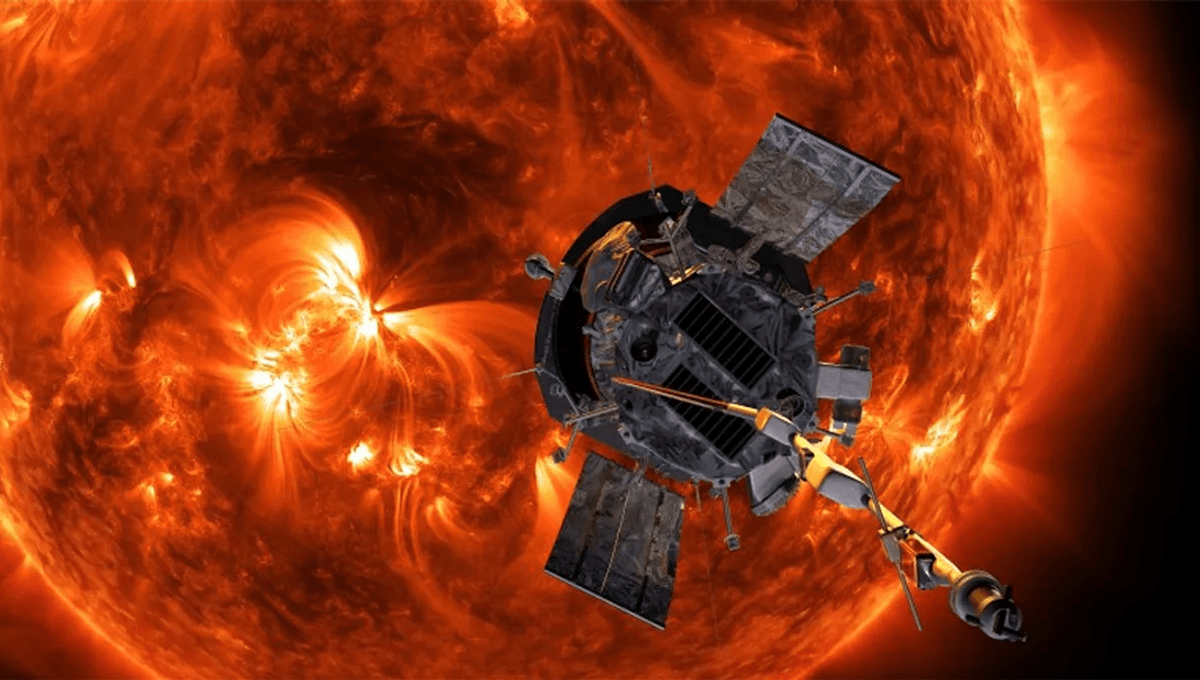
On its closest approach, NASA’s Parker Solar Probe’s solar shields for obvious example, will face temperatures of 1,400°C (2,600°F) as it tries to keep its payload at around room temperature. This is as it passes through the Sun’s corona at speeds human-made objects have never previously achieved.

Deborah Bloomfield
Deborah Bloomfield

Related posts:

  1. Facebook questions British watchdog’s authority to order Giphy sale
  2. S.Africa’s Zuma seeks to replace prosecutor in arms trial
  3. Indonesia’s new carbon tax signals higher power costs amid calls for clarity
  4. Hot As The Sun? People Are Still Confused About The Titan Implosion

Source Link: If The Sun Heats The Earth, Why Is Space Cold?

Filed Under: News

Primary Sidebar

  • There Is A Very Simple Test To See If You Have Aphantasia
  • Bringing Extinct Animals To Life: Is Artificial Intelligence Helping Or Harming Palaeoart?
  • This Brilliant Map Has 3D Models Of Nearly Every Single Building In The World – All 2.75 Billion Of Them
  • These Hognose Snakes Have The Most Dramatic Defense Technique You’ve Ever Seen
  • Titan, Saturn’s Biggest Moon, Might Not Have A Secret Ocean After All
  • The World’s Oldest Individual Animal Was Born In 1499 CE. In 2006, Humans Accidentally Killed It.
  • What Is Glaze Ice? The Strange (And Deadly) Frozen Phenomenon That Locks Plants Inside Icicles
  • Has Anyone Ever Actually Been Swallowed By A Whale?
  • First-Known Instance Of Bees Laying Eggs In Fossilized Tooth Sockets Discovered In 20,000-Year-Old Bones
  • Polar Bear Mom Adopts Cub – Only The 13th Known Case Of Adoption In 45 Years Of Study At Hudson Bay
  • The Longest-Running Evolution Experiment Has Been Going For 80,000 Generations
  • From Shrink Rays And Simulated Universes To Medical Mishaps And More: The Stories That Made The Vault In 2025
  • Fastest Cretaceous Theropod Yet Discovered In 120-Million-Year-Old Dinosaur Trackway
  • What’s The Moon Made Of?
  • First Hubble View Of The Crab Nebula In 24 Years Is A Thing Of Beauty… With Mysterious “Knots”
  • “Orbital House Of Cards”: One Solar Storm And 2.8 Days Could End In Disaster For Earth And Its Satellites
  • Astronomical Winter Vs. Meteorological Winter: What’s The Difference?
  • Do Any Animal Species Actively Hunt Humans As Prey?
  • “What The Heck Is This?”: JWST Reveals Bizarre Exoplanet With Inexplicable Composition
  • The Animal With The Strongest Bite Chomps Down With A Force Of Over 16,000 Newtons
  • Business
  • Health
  • News
  • Science
  • Technology
  • +1 718 874 1545
  • +91 78878 22626
  • [email protected]
Office Address
Prudour Pvt. Ltd. 420 Lexington Avenue Suite 300 New York City, NY 10170.

Powered by Prudour Network

Copyrights © 2025 · Medical Market Report. All Rights Reserved.

Go to mobile version