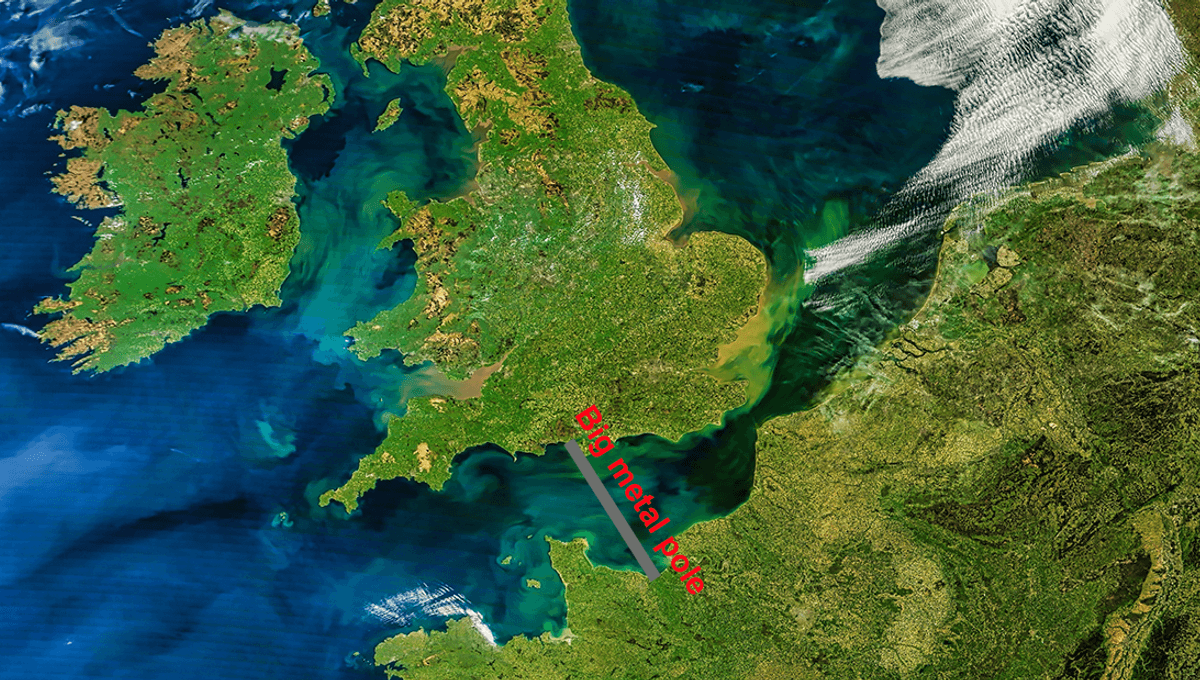
Over on Reddit, people are once again asking some interesting physics questions with equally intriguing answers. Today is the turn of Redditor gothreepwood101, who asks “if I had a metal pole long enough to reach from the English coast to the French coast. And a person holding it at each end. If one person pulls it would the other end move instantly?”
That’s a fun question, and it might seem pretty simple. It’s made of metal, right, so if you push or pull on one end the other end must move instantaneously? An instant yank for the French person on the other end? But it’s not as simple as you might imagine. If you answered “yes”, then congratulations; you have broken a fundamental rule of the universe, affecting another part of the universe (in this case, the French) faster than the speed of light.
The speed of light, 299,792,458 meters (983,571,056 feet) per second, is the speed limit of the universe. No matter, electromagnetic wave, or “guy with a theory” can travel faster than it. We could go into why breaking the speed of light is a problem, but the question is about poles, so let’s leave that to David Kipping of the always great Cool Worlds YouTube channel below.
Another (reasonable! It’s not that intuitive!) guess you might have is that when you yank on one end of the pole, the other end would move at the speed of light. Or more precisely, it would take the same amount of time for the other end to move as it would for light to travel the length of the pole. While more plausible than faster than light travel involved in the other end moving instantly, this is also incorrect.
The problem is our intuition of how solids work. At our scale, when you look at a solid metal pole it looks pretty continuous and, for lack of a better word, solid. But shrink yourself down to the microscopic level and you would see that the metal bar is a crystalline structure arranged from nucleons (protons and neutrons – no we are not getting into the madness of quarks right now either) and their electrons, held together by electromagnetic forces between the charged particles in the lattice. What looks unbroken to our big, great ape eyes is actually a microscopic network of particles tugging on each other.
When you push or pull on the metal pole, the first layer of atoms pushes on the next, which pushes on the next, spreading through the bar as a wave, at the speed of sound in that medium. If you would like to see that in action, the video below from material scientist Brian Haidet on his YouTube channel AlphaPhoenix.
Haidet tested this delay by hitting a pole at one end and detecting when the signal passed down through the pole to the other end. He found that the delay matched what you would expect if it took place at the speed of sound in steel, in a neat tabletop experiment.
So how quickly would you yank on your French friend/English enemy?
Still pretty fast. Sound moves at different speeds through different mediums. On Earth, sound moves at 1,500 meters (4,921 feet) per second in water, and in air around 340 meters (1,115 feet) per second. In solids, sound can move much faster, though how fast depends on the solid, and all these depend on factors such as temperature and pressure, and the “bulk modulus”.
“A little ripple in the density of a piece of steel creates much bigger forces than a similar percentage ripple in the density of some air. So those bigger forces speed up the sound,” the University of Illinois Urbana-Champaign explains in its Ask The Physics Van feature.
“Another way of saying that is that the sound speed goes up for bigger bulk modulus. (That’s the compressive longitudinal sound. Transverse sound depends on the shear modulus.) For ideal gases, the two factors just cancel and the speed of sound doesn’t depend on the density. In typical solids the bulk modulus goes up by a bigger factor than the density does, compared to gases, so solids typically have faster sound waves.”
Let’s imagine it was an iron pole, and assume that the speed of sound is 5,130 meters per second for simplicity. The shortest point between England and France is 33 kilometers (20 miles), and again for simplicity we will imagine your pole is exactly this long. Now we merely need to divide 33,000 by 5,130 in order to find out how long it will take for the other end of the pole to move, with the answer being 6.43 seconds.
That’s still an acceptable wait, but light would have made the journey in 0.00011 seconds, really rubbing it in how ridiculously fast it is.

Source Link: If You Had A Pole Stretching From England To France And Yanked It, Would The Other End Move Instantly?
