A few months ago, astronomers using JWST reported that they had observed massive galaxies from just a few hundred million years after the Big Bang. The problem is that using their starlight, the team came to an impossible conclusion: these galaxies had more mass than what would have been available in the universe to make them. Now, we may have an answer for what was actually going on.
The original team was well aware that there was something odd with their findings but wasn’t sure what the problem was. “These are the first images of a brand-new telescope and we see things that don’t make a lot of sense. Or if we use our standard techniques we get an answer that is almost impossible,” lead author Professor Ivo Labbé, from the Swinburne University of Technology, told IFLScience at the time.
Now a team from Northwestern University believes they have worked out how the confusion could have happened. The mass of galaxies is estimated from the amount of light they release, and somehow, these young, low-mass galaxies are glowing like objects with a lot more stars.
“The discovery of these galaxies was a big surprise because they were substantially brighter than anticipated,” senior author Claude-André Faucher-Giguère explained in a statement.
“Typically, a galaxy is bright because it’s big. But because these galaxies formed at cosmic dawn, not enough time has passed since the Big Bang. How could these massive galaxies assemble so quickly? Our simulations show that galaxies have no problem forming this brightness by cosmic dawn.”
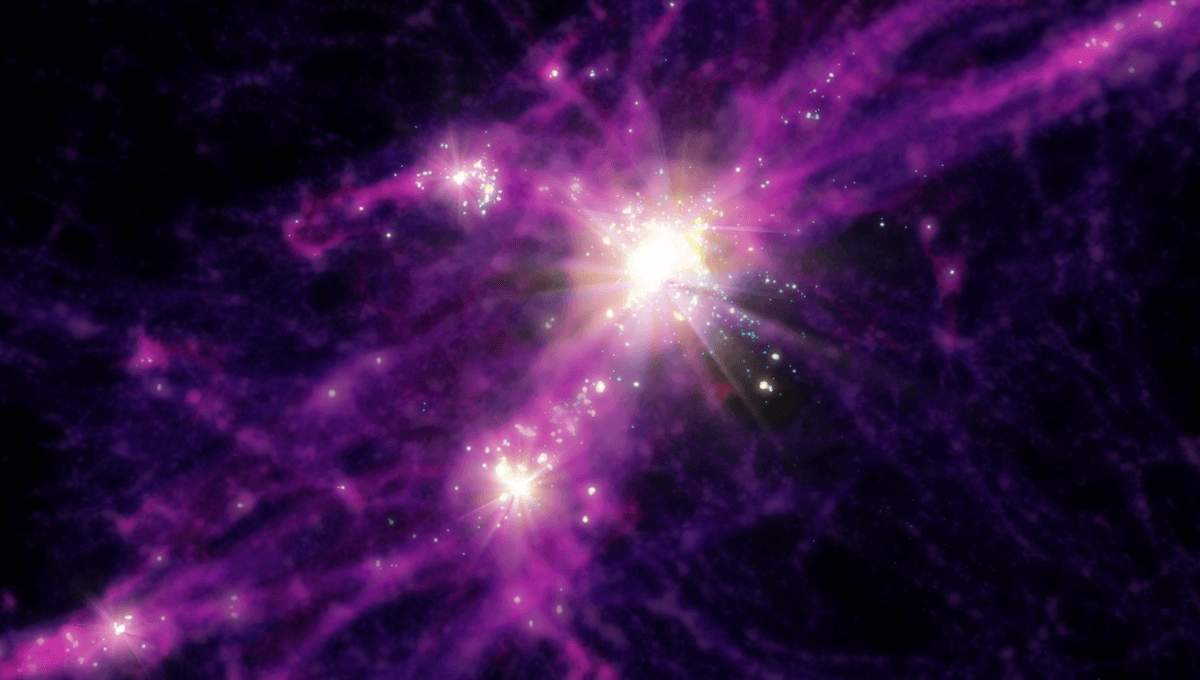
The simulation shows that much smaller galaxies can undergo irregular and luminous bursts of star formation, making them look much brighter than they ought to be for a galaxy of their size at cosmic dawn. The simulation explains what was seen in the JWST observations without having to challenge the standard model of cosmology.
“The key is to reproduce a sufficient amount of light in a system within a short amount of time,” added Guochao Sun, who led the study. “That can happen either because the system is really massive or because it has the ability to produce a lot of light quickly. In the latter case, a system doesn’t need to be that massive. If star formation happens in bursts, it will emit flashes of light. That is why we see several very bright galaxies.”
JWST has such a sharp eye that allows researchers to see galaxies as they existed during cosmic dawn. This is a period that extends from 100 million to 1 billion years after the Big Bang. Previous telescopes were more limited, but JWST is pushing the envelope on these observations.
“The JWST brought us a lot of knowledge about cosmic dawn,” Sun continued. “Prior to JWST, most of our knowledge about the early universe was speculation based on data from very few sources. With the huge increase in observing power, we can see physical details about the galaxies and use that solid observational evidence to study the physics to understand what’s happening.”
The research was published in The Astrophysical Journal Letters.

Source Link: "Impossibly" Big Galaxies From Dawn Of The Universe May Just Be Extra-Glowy
