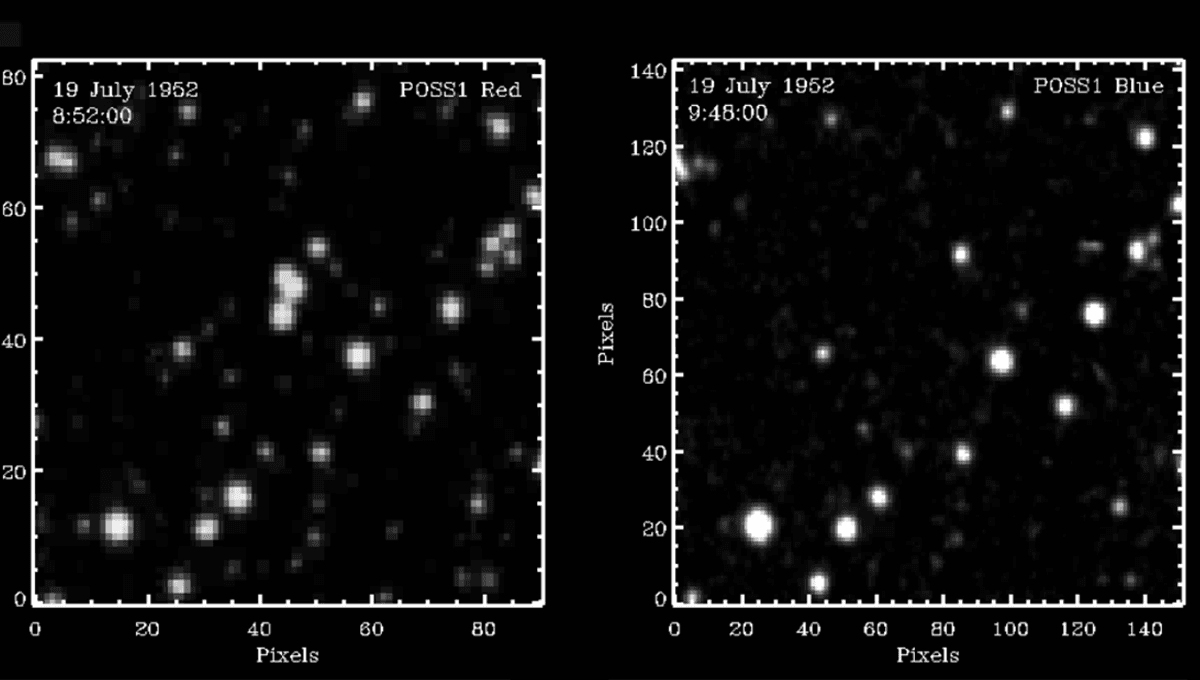
On 19 July 1952, the Palomar Observatory near San Diego, California, undertook a survey of the night sky, focusing on a particular region and photographing it multiple times, in an attempt to spot bodies in the Solar System such as asteroids as they pass in front of stars, dimming them ever so slightly.
At 8:52 that evening, they captured an image containing three stars close to each other. At 9:45 pm, a second image was captured of the same area. This time, the objects were nowhere to be seen.
This is pretty unusual. Stars may dim like Betelgeuse or explode leaving an afterglow for hours or days, but these were simply there at 8:52 pm and had vanished less than an hour later. So what happened to them?
A new team, interested in such “transients”, looked into it and came up with several possible explanations. First, they looked to see if the objects had been seen since.
“We took advantage of the Virtual Observatory capabilities to look for the triple transient in more recent images and catalogues,” the team wrote in their pre-print paper, which has not yet been peer reviewed. “The result of this search concluded that the transient does not appear in any later image of that region during the subsequent 69 years.”
Next, the team compared the transients with other stars captured in the same region. If there were significant differences, particularly towards the edges of the objects, it could indicate flaws in photographic plates or even elementary particles hitting those plates. However, they found the shapes to be remarkably similar, despite being of different size.
“In summary, we find no evidence that the transient is anything other than a bona fide unresolved, point source of light,” the team wrote. “In particular, the profiles show no evidence of a moving source such as an aircraft, asteroid, or elementary particle nor of a defect in the photographic plate.”
The team ruled out the stars dimming independently, given the rarity of stars disappearing like this at all. Whatever caused one object to disappear from our view caused them all to. The same goes if these were dim objects that were caused to brighten briefly by a common event.
If the object is indeed three separate objects in space, this means that they must be close together in order for the light (and then lack of it) to arrive all within that hour’s time frame. If this is the correct explanation, it places the objects a lot closer to our Solar System than other explanations do.
“To be causally connected, the three light sources must reside physically within 6 au of each other and are no more than 2 light-year[s] away. This distance is less than the nearest star, the alpha Cen system, bringing the venue of the three transients to a distance within our Sun’s vicinity, if not the inner Solar System, or even Earth’s orbit”.
This would make it more likely the objects were asteroids or other objects in our solar system, perhaps the Oort cloud, explaining why they were not seen in subsequent surveys.
Another possibility proposed by the team is that the objects were caused by gravitational lensing, where space-time is warped by immensely heavy objects, sometimes magnifying objects far into the distance to astronomers. While a neat idea, the team said it was difficult to imagine as it would throw up another mystery.
“Models involving background objects that are optically luminous for less than one hour coupled with foreground gravitational lensing seem plausible,” the team wrote. “If so, a significant population of massive objects with structure serving as the lenses, to produce three images, are required to explain the sub-hour transients.”
Unfortunately, there is no definitive answer as of yet, and the team called for further follow-up searches for similar transients.
The study is published to the pre-print server arXiv.
[H/T: Universe Today]

Source Link: In 1952, 3 Stars Vanished From The Night Sky. What Happened To Them?
