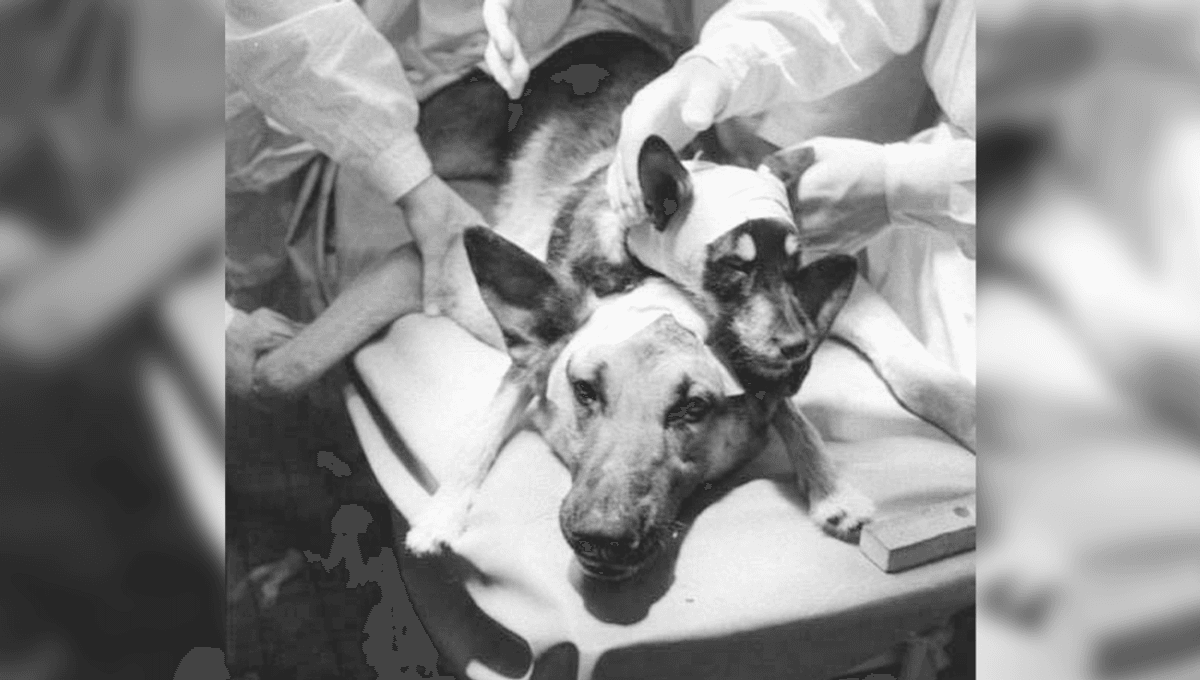
If you’ve never looked at a dog and wondered if there’s “room for a second head on there”, congratulations on not being Soviet scientist Vladimir Demikhov, a pioneer of organ transplantation who might be better remembered for his groundbreaking work in heart and lung transplants were it not for the “two-headed dog” experiments.
Demikhov was born on July 18, 1916, to a peasant family living in Yarizenskaia, a village in Russia’s Voronezh region. He was raised by his mother following the death of his father during the Russian civil war, and she saw that he and his two siblings gained a good education. Though we should be skeptical of such stories when they spring up around, uh, “interesting” characters such as Demikhov, there may have been signs of interest in unusual biology from an early age.
“Legend has it that as a 13-year-old boy Volodya (Vladimir) Demikhov was surprised by the words of the driver changing a tyre after his car had driven over a nail – he said that a car can be fixed simply by replacing a broken detail,” a paper on Demikhov explains.
“Perhaps it was exactly then that Volodya thought, animals can also be cured by changing body parts. Soon after his mother caught him with a knife in his hand trying to open the family puppy’s chest to see how the heart works.”
In 1934, he headed to the Voronezh State University to study biology, where it wasn’t long before he excelled. In 1937, he designed the first-ever total artificial heart prototype. The device was too large to place in the chest cavity of a dog, the animal on which he performed most of his cutting-edge (and often highly unethical) work, but the device was capable of keeping his subjects alive for around five hours.
“The device consisted of two adjacent diaphragm pumps working as two cardiac ventricles and its size was almost identical to that of the native dog’s heart,” the paper continues. “Two venous cannulae were connected to the atria and two arterial cannulae were connected to the aorta and the pulmonary artery.”
Demikhov saw great potential in the devices, and believed they could one day be used to keep patients alive while they awaited organ donations for transplantation. But his work was interrupted by the war, where he worked as a pathologist and forensics expert, despite holding no medical degree.
After the war, he took his work up once more, notably performing the first successful heart-lung transplant in any mammal. On July 29, 1953, he then became the first person to perform a successful coronary bypass operation, with the dog surviving for two years post-surgery.
With the good stuff out of the way, we now move on to his far more controversial, unethical, and memorable experiment. On February 24, 1954, Demikhov performed his first head transplant, taking the upper half of a small dog and transplanting it onto the top of a second, larger dog.
“The operation took three hours. After another three hours, with a gradual increase in the number of reflexes displayed, the transplanted head began to blink, open its mouth, move its tongue, bite the experimenter’s finger, the ear of the host dog, and the sheet with which it was covered,” a translation of a Russian-language paper explains.
“When the corners of its mouth were moistened with water, the head began to lick itself; when a wet napkin was placed in its mouth, it began to suck on it, and then it began to drink water brought to its muzzle, move its paws, become restless, and even eat meat. Its sleep occurred regardless of the wakefulness of the host dog.”
Demikhov’s surgeries were not very successful at first, but he continued for five whole years, upping the survival time of the dogs to 29 days. Rather than a pat on the back from his colleagues for the technical achievement, even at the time the reaction tended to focus on the “you’re doing WHAT to dogs??” aspect.
“The head transplantation by Demikhov was arguably the most controversial experimental operation of the 20th century. It fomented waves of indignation in medical circles, and Demikhov – whose experiments were always an easy target for criticism – was accused of being a charlatan,” a paper on the topic explains. “Why did he perform head transplantation? There will never be a clinical application of this procedure in any modification.”
The Soviet scientist may not be the only person to have performed such an operation. When news of the transplant made its way out of the Soviet Union in 1962, South African cardiac surgeon Christiaan Barnard allegedly stormed out and said “anything those Russians can do, we can do, too” before grabbing two dogs and combining them into one abomination dog, which survived for two days.
In later life, though he remained poor, Demikhov received recognition for his truly pioneering work in transplantation and heart surgery, winning several awards. If only he hadn’t developed a taste for combining dogs, perhaps he would have received praise not shortly followed by “but we’re here to talk about dog heads”.

Source Link: In 1954, Soviet Scientist Vladimir Demikhov Performed "The Most Controversial Experimental Operation Of The 20th Century"
