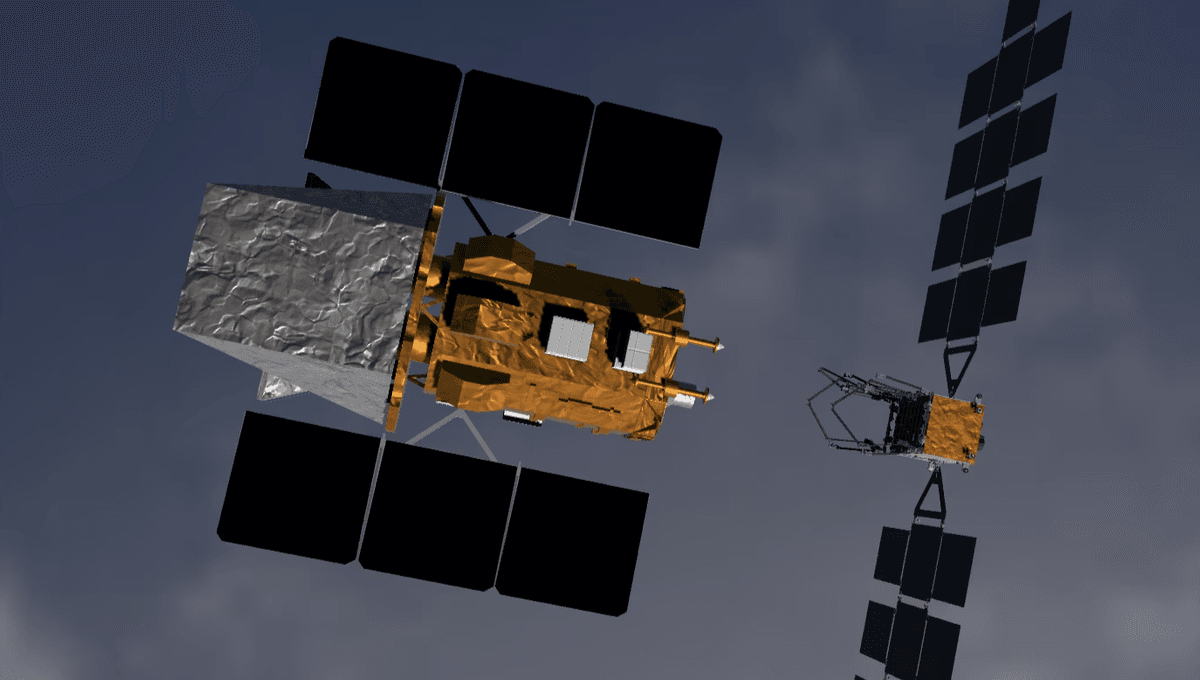
A two-decade-old NASA telescope is on an unstable orbit, and there is a 90 percent chance that it might come burning down in an uncontrolled reentry by the end of 2026. NASA has awarded a private contract to space technology company Katalyst to perform a never-before operation to save this orbiting observatory.
The rest of this article is behind a paywall. Please sign in or subscribe to access the full content.
The telescope in question is the Neil Gehrels Swift Observatory, which was launched on November 20, 2004. In its 21 years, the telescope has studied the most powerful explosions in the universe, gamma-ray bursts, as well as other events, including interstellar comet 3I/ATLAS. The orbit of satellites and spacecraft near Earth naturally decay over time, due to the extremely tenuous atmosphere in low-Earth orbit. You can’t breathe it, but over time, it slows you down. Lower velocity means a lower orbit.
NASA reported in September that due to the increase in Solar activity, Swift’s orbit is decaying faster. The Sun’s peak of activity happened last October, and when the Sun is very active, it heats up the outer atmosphere, making it puff up. NASA estimates that there is a 50 percent chance that Swift will fall back to Earth by June 2026, and a 90 percent chance that it will happen before 2027.
Enter Katalyst. The company was awarded $30 million to build a robotic spacecraft that can lift Swift to a more stable orbit. The craft will be launched on a Pegasus XL rocket developed by Northrop Grumman and launched not from the ground but from a plane. This setup allows the rocket to reach the peculiar orbit of Swift easily, something that would be more complicated from the ground, as none of the US spaceports have the right setup for that trajectory.
If that goes well, then things will get interesting. Something like this has never been attempted before. Hubble was serviced by astronauts on the Space Shuttle and was designed for those kinds of approaches. Swift was not designed for it, so Katalyst’s servicer will use a custom-built robotic capture mechanism that will connect to the telescope without disrupting its delicate suite of instruments. And all of this is being done against the clock.
“This is about saving a world-class science asset while proving the United States can execute rapid, on-orbit response,” Ghonhee Lee, CEO of Katalyst, said in a statement. “We’re demonstrating that when the need arises, we can go from identifying the problem to executing a robotic docking mission in less than a year.”
If the do-not-harm servicing mission is a success, it might provide a lease of life for many more space observatories, including even Hubble one day. That telescope is on a higher orbit compared to Swift, and it is expected to last for years to come, but they do share the same fate.

Source Link: In 2026, Unique Mission Will Try To Save A NASA Telescope Set To Uncontrollably Crash To Earth
