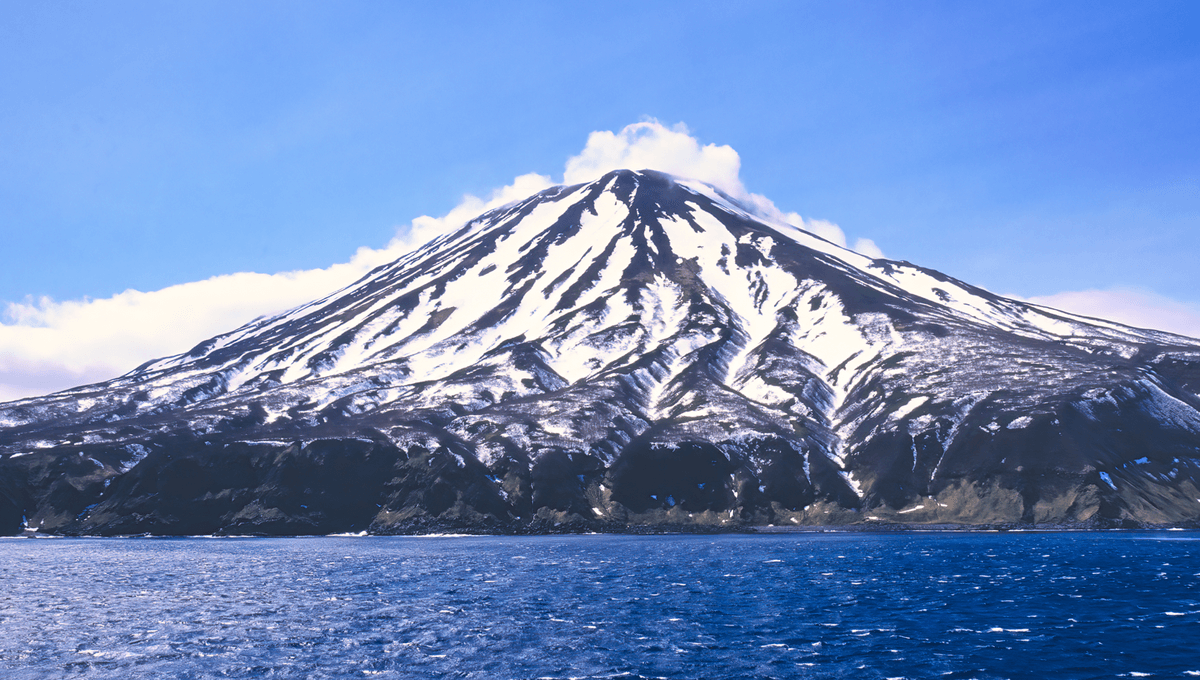
Almost 200 years ago, the Sun looked as if it had turned a strange color, ushering in two years of freakishly cool weather across the globe. Scientists have long believed that the strange effect was caused by an eruption, but they’ve never been able to pinpoint the responsible volcano – until now.
It’s known the “mystery eruption” resulted in a short, sharp cooling event that occurred between 1831 and 1833 CE, lowering average temperature by approximately 1°C (1.8°F). The German composer Felix Mendelssohn wrote this while traveling through the Alps in the summer of 1831: “Desolate weather, it has rained again all night and all morning, it is as cold as in winter, there is already deep snow on the nearest hills.”
In August 1831, reports also emerged from around the world – including China, Europe, the US, and the Caribbean – of the Sun appearing “blue, purple, and green.” This phenomenon was likely caused by volcanic dust and gases scattering sunlight in an unusual way.
There was some speculation that the eruption occurred at the Babuyan Claro volcano in the Philippines or the Ferdinandea eruption near Sicily, but new research has uncovered a new culprit.
Scientists at the University of St Andrews in Scotland have gathered sturdy evidence that the volcanic eruption came from the Zavaritskii caldera on the uninhabited island of Simushir, part of the Kuril Islands in the Russian Far East, not too far from Japan.
They reached this conclusion through geochemical analysis of ice-core samples, which revealed a “perfect fingerprint match” of the ash deposits.
“We analyzed the chemistry of the ice at a very high temporal resolution. This allowed us to pinpoint the precise timing of the eruption to spring-summer 1831, confirm that it was highly explosive, and then extract the tiny shards of ash. Finding the match took a long time and required extensive collaboration with colleagues from Japan and Russia, who sent us samples collected from these remote volcanoes decades ago,” Dr Will Hutchison, lead study author from the School of Earth and Environmental Science at the University of St Andrews, said in a statement.
“The moment in the lab when we analyzed the two ashes together, one from the volcano and one from the ice core, was a genuine eureka moment. I couldn’t believe the numbers were identical. After this, I spent a lot of time delving into the age and size of the eruption in Kuril records to truly convince myself that the match was real,” added Hutchison.
The researchers say their work highlights the power of volcanic eruptions and their potential to influence life on Earth. Volcanoes can significantly impact the climate by releasing gases and particulates into the atmosphere, leading to short-term cooling effects and, in some cases, contributing to long-term warming.
For example, the 1991 eruption of Mount Pinatubo in the Philippines pumped out the largest cloud of sulfur dioxide ever measured, causing global temperatures to drop by about 0.5°C (0.9°F) for one to three years.
If another eruption like 1831 occurred today, it would cause quite an upset.
“There are so many volcanoes like this, which highlights how difficult it will be to predict when or where the next large-magnitude eruption might occur,” Dr Hutchison added.
“As scientists and as a society, we need to consider how to coordinate an international response when the next large eruption, like the one in 1831, happens,” he concluded.
The new study is published in the journal Proceedings of the National Academy of Sciences.

Source Link: In August 1831, The Sun Appeared Blue – And We Now Know Why
