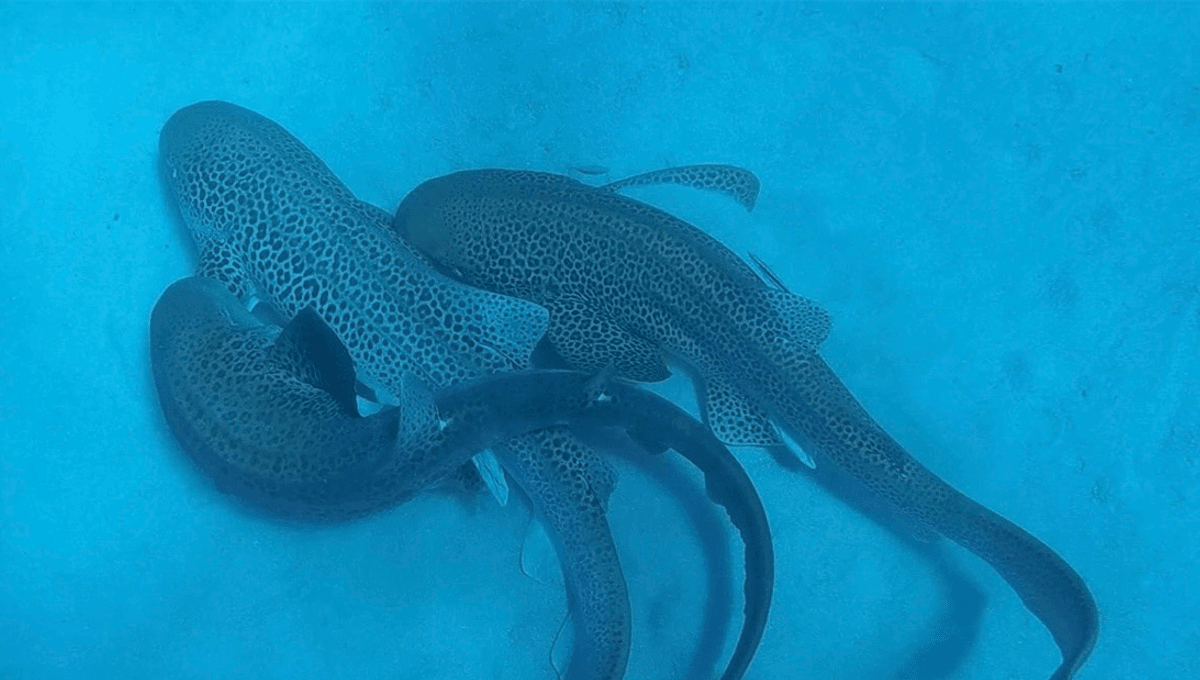
Inaccessible environments and secretive species make discovering certain aspects of animal biology challenging. However, new research has revealed something surprising about the mating habits of leopard sharks. Never-before-seen behavior filmed in the wild has shown that in the leopard shark world, it takes more than two to tango.
The rest of this article is behind a paywall. Please sign in or subscribe to access the full content.
Indo-Pacific leopard sharks (Stegostoma tigrinum) were seen at Abore Reef, around 15 kilometers (9.3 miles) off the coast of New Caledonia. This is a regular survey spot for the species and premating behavior has been seen here on multiple occasions. However, this was the first time the team observed a sequential mating event in which the female was followed by two males and subsequently mated with both of them.
“It’s rare to witness sharks mating in the wild, but to see it with an endangered species – and film the event – was so exciting that we just started cheering,” said marine biologist and study author Dr Hugo Lassauce in a statement.
Until now, observations of mating behavior in these sharks has been limited to captivity, where a single male has been observed following a female and biting her pectoral fins.
“While I was surveying this particular aggregation of leopard sharks, I spotted a female with two males grasping her pectoral fins on the sand below me,” continued Lassauce. “I told my colleague to take the boat away to avoid disturbance and I started waiting on the surface, looking down at the sharks almost motionless on the sea floor.”
The team were able to split the behaviors they saw into pre copulation, copulation, and post copulation, which fit with other observations of this species in captive settings and other shark species. What was unusual, however, was that the female mated with both males.
Initially, she mated with male one while male two remained holding her fin with his mouth. After copulation with male one, he released his hold on her fin and she and male two swam away and copulated. The female was left with visible wounds on each of her pectoral fins from both of the male’s biting and holding onto her as she swam and during mating.
“I waited an hour, freezing in the water, but finally they started swimming up. It was over quickly for both males, one after the other. The first took 63 seconds, the other 47. Then the males lost all their energy and lay immobile on the bottom while the female swam away actively,” added Lassauce.
There is still more to learn about the reasons for this kind of behavior and whether any offspring could have different fathers. Crucially, learning more about the breeding behavior of these sharks can help inform conservation actions for this endangered species.
With the rise of smart phones and drone footage, more and more species have been witnessed making more sharks than ever before.
The paper is published in the Journal of Ethology.

Source Link: In World First Sighting, Saucy Leopard Sharks Caught Having "Threesome" On Seafloor
