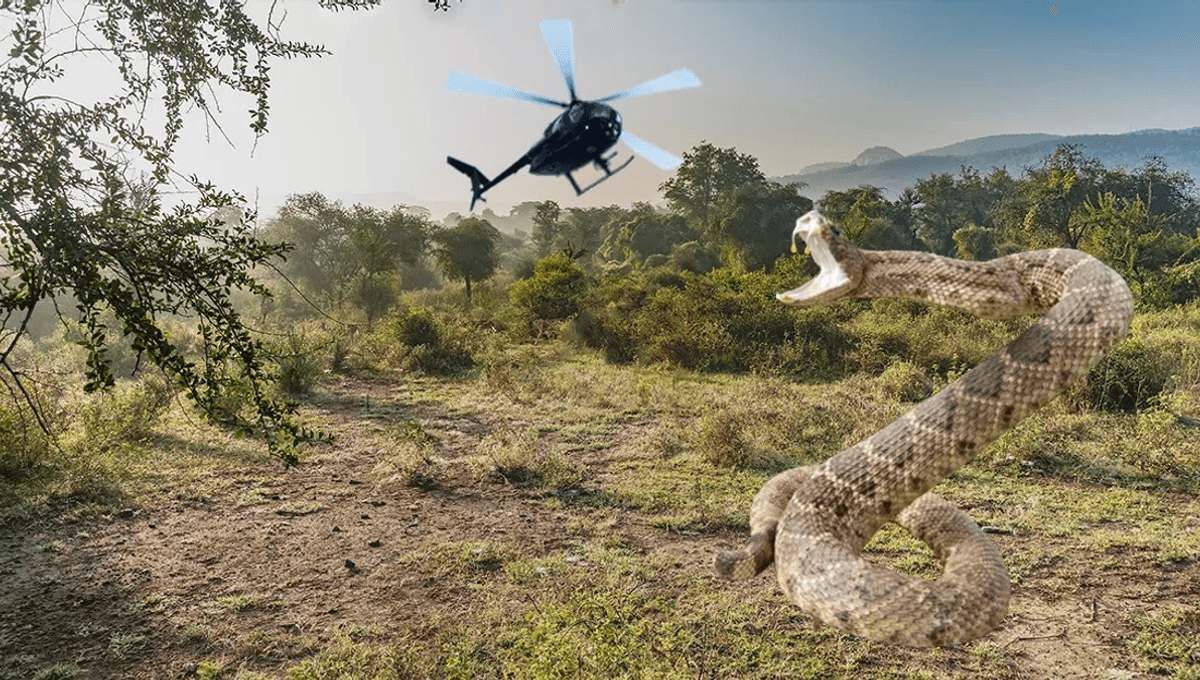
There’s a curious tale that often circulates on internet forums and podcasts, a legend of a 15-meter (50-foot) snake said to lurk in the depths of Central Africa, known to lunge from the jungle and strike at passing helicopters when disturbed. Like most stories in cryptozoology, it’s almost certainly nonsense – but it’s one hell of a tale.
Remy Van Lierde, a Belgian Air Force Colonel who served in World War Two, made the claim in 1980 during an interview with the British TV show Mysterious World, hosted by renowned sci-fi writer Arthur C Clarke.
Van Lierde claimed that in 1959 he encountered a giant greenish-brown snake while flying over the Katanga Province of the Belgian-occupied Congo (now Democratic Republic of Congo) by helicopter. As an experienced pilot, Van Lierde argued that he was extremely skilled at gauging the size of things on the ground from the sky.
“I would say the snake I saw there was close to 50 foot,” he told the program.
He said the helicopter dipped down within 9 meters (30 feet) of the snake below, at which point it “raised up” its neck by around 3 meters (10 feet) and eyed-up the chopper for a bite.
“I could very clearly see the head,” which he said looked like a “very large horse” with a huge triangle jaw.
“I feel – and I’m convinced – that if I had been in its range, it would have struck at me. The head, I would say was certainly 2 foot wide and 3 foot long. It could have easily eaten a man,” said Van Lierde.
Along with this first-hand account, Van Lierde also managed to snap a photograph of the sight. However, the image was taken in black and white, plus it’s a little on the grainy side.
As a well-respected air force veteran, Van Lierde is often considered to be a reliable source who has no apparent motive to make up such a claim. However, it does look extremely doubtful that this mythical snake is secretly living in the Congo Basin.
The largest species of snake known to live in the area is the African Rock Python (Python sebae). They typically grow to well over 3 meters (10 feet), although there are reliable accounts of specimens measuring up to 6 meters (20 feet).
If anyone were to make the claim of a 15-meter (50-foot) snake, then they’d have to provide some extremely robust evidence, which Van Lierde’s account is not.
However, his story of the train-sized snake is not the only colossal cryptid reported in the depths of the Congo Basin. One of the most famous is mokele-mbembe, a swamp-dwelling monster that’s said to resemble a long-necked sauropod dinosaur. In fact, in the minds of some, this mysterious creature might be a survivor of the asteroid that wiped out non-avian dinosaurs around 66 million years ago.
Most scientists believe that sightings of mokele-mbembe are likely to be elephants or black rhinos, large-bodied mammals that could be mistaken for prehistoric beasts if obscured by thick rainforests.
With the advances in AI, will we see new and increasingly sophisticated monster hoaxes, similar to the classic ones of the Loch Ness Monster or Bigfoot, slither into the spotlight?
As for Van Lierde’s giant python, we can assume that he came across an African Rock Python – or, who knows, perhaps the serpent-like neck of an angry sauropod.
An earlier version of this article first appeared in 2023.

Source Link: Inside The Myth Of The 15-Meter Congo Snake, Cryptozoology’s Most Outlandish Claim
