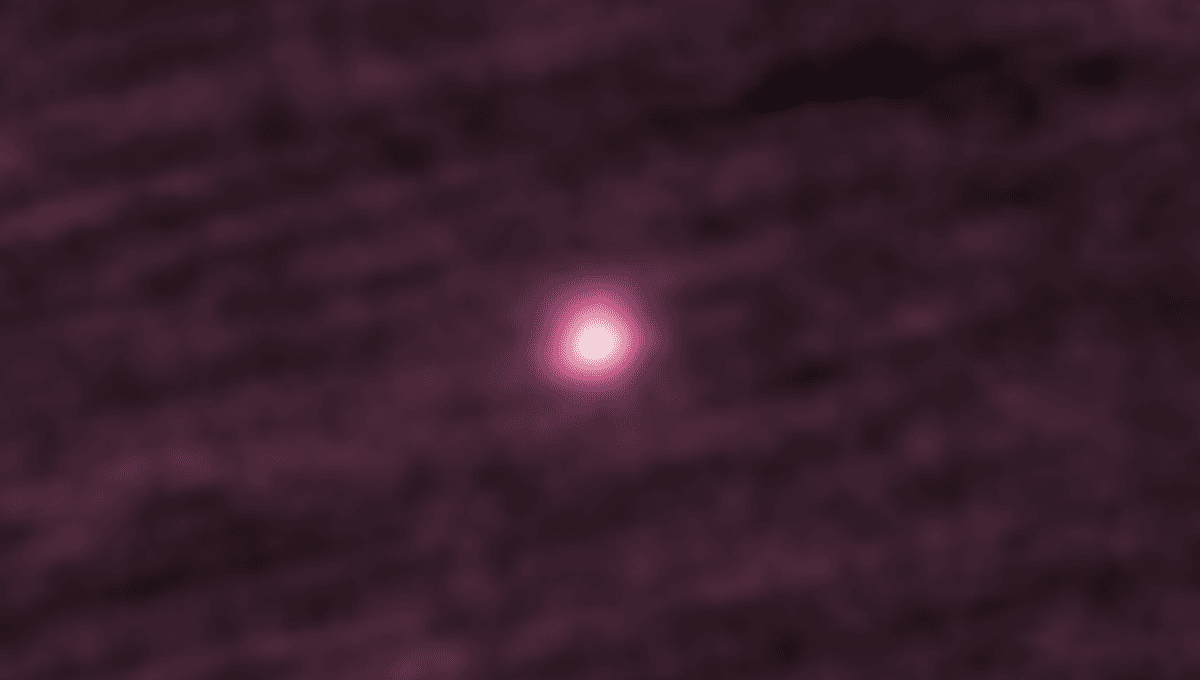
Interstellar comet 3I/ATLAS may be a primitive carbonaceous object, according to a new preprint study comparing the object’s spectra with pristine NASA samples from Antarctica. As well as this, our third interstellar visitor also appears to be undergoing cryovolcanic activity during its first close encounter in (possibly) 10 million years.
While much recent analysis has been focused on the potential for 3I/ATLAS to break up during its close encounter with our star, the international team of scientists were particularly interested in the idea of 3I/ATLAS as an “ancient survivor”. Previous studies have shown that the object, our third interstellar visitor that we know of, has likely traveled through the interstellar medium (ISM), being exposed to cosmic rays potentially for billions of years.
“From cosmogonic grounds, a body surviving for so long in the harsh ISM should have a significant mechanical strength. Observationally, 3I is also large: estimates place its diameter between 0.3 and 5.6 km, and its ~16 h rotation period is sufficient to distribute solar heating relatively uniformly across its surface,” the team writes in their paper.
“Its high incoming velocity suggests ejection through a close encounter in its parent planetary system, and although no stellar encounters are found within the last 500 pc, earlier close passages cannot be excluded. These considerations lead us to hypothesize that 3I/ATLAS may be a metal-bearing carbonaceous body.”
By looking at the light reflected off small bodies in the Solar System and splitting it into its spectra, scientists can learn about the object’s composition.
“Each element in the periodic table can appear in gaseous form and will produce a series of bright lines unique to that element. Hydrogen will not look like helium which will not look like carbon which will not look like iron… and so on,” NASA explains. “Thus, astronomers can identify what kinds of stuff are in stars from the lines they find in the star’s spectrum. This type of study is called spectroscopy.”
In the study, which has not yet been peer reviewed, the team used photometric observations of 3I/ATLAS, and compared them to pristine carbonaceous chondrites from the NASA Antarctic meteorite collection. These are samples of meteorites which have been discovered in Antarctica since 1976, as part of NASA’s Antarctic Search for Meteorites (ANSMET). Comparing the spectra from 3I/ATLAS and pristine samples of the team believes they have found a close match with trans-Neptunian objects (TNOs) – objects and minor planets beyond the orbit of Neptune.
“The spectral similarities indicate that 3I/ATLAS may be a primitive carbonaceous object, likely enriched in native metal and undergoing significant aqueous alteration during its approach to the Sun,” the team writes, adding that it is “experiencing cryovolcanism as we could expect for a pristine Trans-Neptunian Object.”
“We propose that the combination of elevated metal abundance and abundant water ice can account for the unusual coma morphology and chemical products reported to date.”
While “cryovolcanism” may sound exotic, it is by not unexpected for TNOs. They are essentially where subsurface materials erupt from beneath the surface of an object, or to put it a little more dramatically; ice volcanoes. Most of the work on cryovolcanoes has been on Moons of the Solar System’s gas giants, as well as TNOs like Pluto.
“Models of the interiors of TNOs indicate that cryovolcanism, which is considered to be the most probable form of geological activity on some satellites of the outer planets, may be possible on the larger Trans-Neptunian objects (diameter > 800 km),” one paper explains.
While 3I/ATLAS is believed to be between 0.3 kilometers (0.186 miles) and 5.6 kilometers (3.48 miles), the team believes it is an expected behavior for a smaller TNO approaching the Sun.
“The corresponding ∼2-mag brightness increase at 2.5 au, followed by the rapid development of a diffuse coma, confirms the activation of near-surface volatile components, even when water-ice sublimation probably was not fully achieved, except perhaps in the near subsurface as consequence of reaching a more localized pressure and temperature,” the team writes.
“Cryovolcanism is known to occur on pristine ice-rich and C-rich bodies in the outer solar system, and 3I behaviour has an overall similitude to what we should expect for a pristine TNO during a close approach to the Sun.”
“To do so, corrosion of fine‑grained metal grains can originate energetic Fischer–Tropsch reactions,” they added, “generating specific chemical products into the coma that are not so common in other comets because most of them formed in the outer solar system and didn’t inherit so much metal.”
As well as being cool – it’s nice enough to see an interstellar visitor, and this one is packing space volcanoes – the discovery is interesting for learning about the environments around other stars.
“Despite its unknown extrasolar formation environment, 3I shows its closest spectral affinity with CR and CH chondrites, both of which exhibit featureless red spectra – likely due to the presence of metal grains, sulphides, and other opaque phases,” the team explains. “It means that early stages of planetary formation could produce similar types of materials, even in really remote locations of our galaxy.”
Spectrographic studies of these objects are great, but the team urges that projects like ESA’s Comet Interceptor become a top priority, with the ultimate goal of sampling a future interstellar visitor directly.
“Interstellar visitors like 3I/ATLAS continue to challenge and refine our understanding of planetary-system formation and the chemical evolution of small bodies. Each newly discovered object reveals unexpected properties that test and expand current models,” the team concludes. “Future intercept missions will be essential for visiting, and directly sampling these rare messengers and unlocking the record they carry from distant planetary systems.”
The study is posted to preprint server arXiv.

Source Link: Interstellar Comet 3I/ATLAS Appears To Be Experiencing "Cryovolcanism", And Is Eerily Similar To Objects In The Outer Solar System
