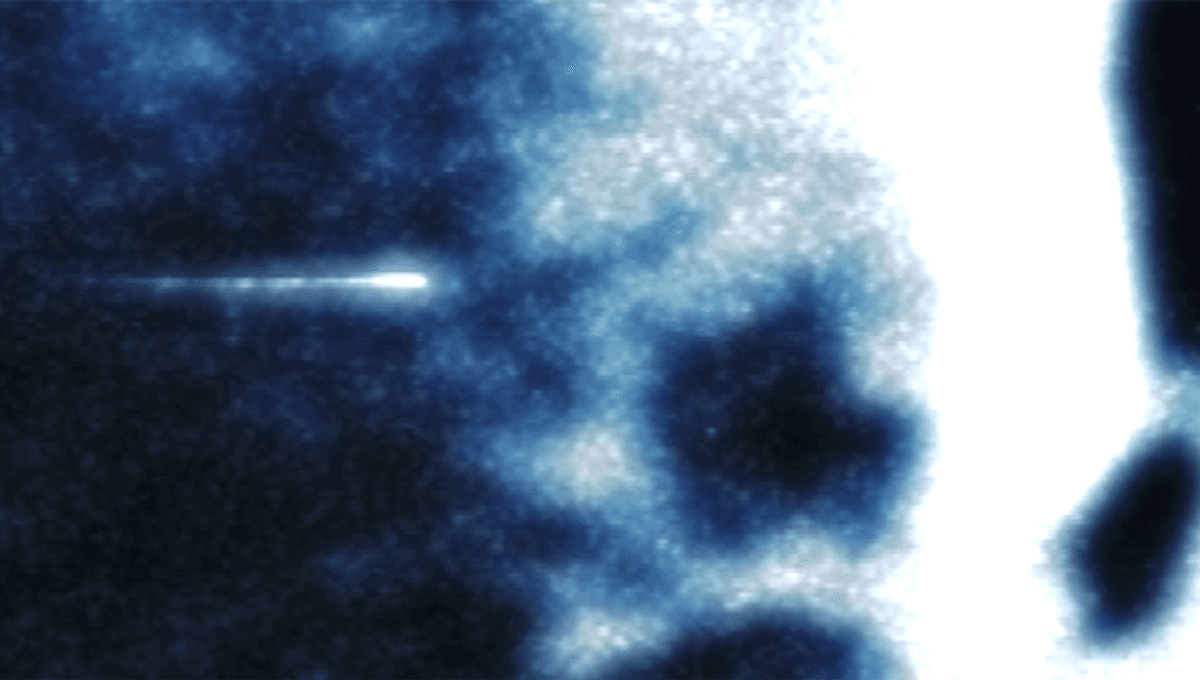
In spectacularly good timing a coronal mass ejection (CME) from the Sun is about to collide with an object which came from outside of the Solar System.
On July 1, 2025, astronomers spotted an object moving through the Solar System at nearly twice the velocity of previous interstellar visitors ‘Oumuamua and Comet Borisov. The object, which was confirmed to be an interstellar comet with its own dusty coma, and suspected to be far larger than the previous two, with a estimated nucleus (the rocky part of the comet, excluding its coma) of around 5.6 kilometers (3.5 miles), and a possible “anomalous” mass of over 33 billion tons.
The astronomical community continues to track the object, known to be a comet due to outgassing as it has approached closer to the Sun.
Its path looked to be pretty unimpeded. On its closest approach to any planet, it will come within about 0.35854 astronomical units (AU) of Jupiter, with one AU being the distance between the Earth and the Sun, and on the opposite side of the Sun to Earth.
But the comet’s short trip won’t be entirely drama-free. Despite being predicted to decrease in activity, NASA has found that the Sun is “slowly waking up” and continues to be pretty active at this stage of the Solar Cycle. As spaceweather.com reports, a new NASA forecast model predicts that a CME will collide with 3I/Atlas on 25 September 2025, if it hasn’t collided with it already yesterday.
That would be pretty spectacular. It’s not often we get an interstellar visitor, this being only the third that we know of, and it would be interesting to see the effect it would have on the comet.
While we haven’t seen an interstellar comet being struck by a coronal mass ejection before, we have seen it happen to others. This happened on April 20, 2007, when NASA’s STEREO A spacecraft saw Comet Encke collide with a CME.
“Comet Encke is a short-period comet that circles the Sun every 3.3 years. As the icy rock hurtles through the inner solar system, it produces two tails: one made of dust and another made of gases. The gas tail, known as an ion tail, points directly away from the Sun, aligning along magnetic field lines within the solar wind,” NASA explains.
“But these field lines can be put into complete disarray by a coronal mass ejection (CME), powerful eruptions of plasma and magnetism from the sun. When a CME blew past comet Encke, the wave of solar material disturbed the magnetic field surrounding the comet and snapped its tail off. The effect, however, was only temporary—within minutes a new tail formed.”
Astronomers would not expect any significant change in trajectory because of the CME, especially if the comet is 33 billion tons as recently measured. But it will still be interesting to see what happens to its tail, if anything, as a CME hits it.
Unfortunately, they will only have a very short window to do so. 3I/Atlas will soon go into “solar conjunction”, a fancy-pants way of saying that the Sun will block our view from Earth. Fingers crossed, astronomers can get some good observations of it before it does so.

Source Link: Interstellar Comet 3I/Atlas Is About To Be Hit By A Coronal Mass Ejection. What Will Happen Next?
