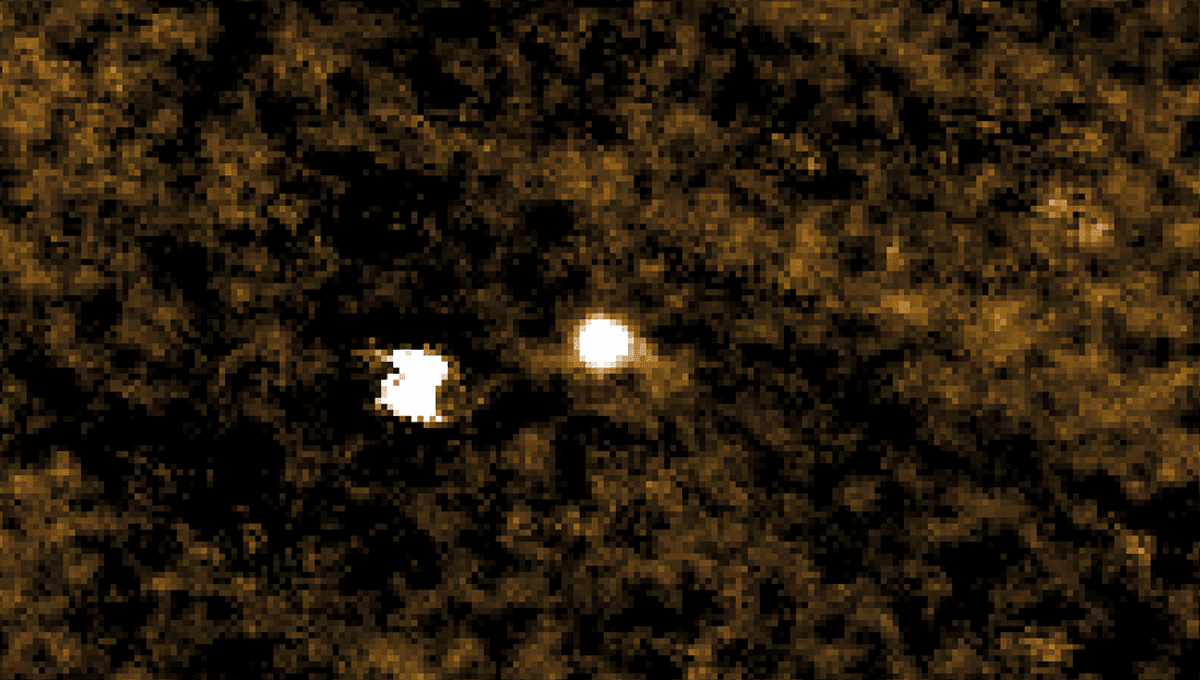
A new pre-print paper suggests that our latest interstellar visitor, comet 3I/ATLAS, may be headed for one final close encounter before it departs our Solar System in 2026. The paper, which focuses on dynamical simulations of the object, also attempts to look at the course 3I/ATLAS will take on departure, and the path that brought it to us.
If you’re up to speed with science news, you likely know the story of our third confirmed interstellar object. But mention “the interstellar visitor” to anybody else, and you’ll likely be met with a baffled expression and a soothing tone. Trust us. So those of you who aren’t aware, let’s (briefly, this time) recap.
On July 1, 2025, the Asteroid Terrestrial-impact Last Alert System spotted an object hurtling through our Solar System at an unusually high velocity (around 58 kilometers per second, or 36 miles per second) and eccentricity. Looking at the object, it was soon confirmed to be an interstellar object, the third we have confirmed so far, after 1I/’Oumuamua and 2I/Borisov.
While much has been made of (highly dubious and unnecessary) claims that 3I/ATLAS is an interstellar spacecraft, that is not the case. But that doesn’t make it uninteresting; we are still talking about a visitor from another star, which could give us clues about the environment in another part of the Milky Way.
In the new paper, which has not yet been peer reviewed, the team attempts to model the path of our fastest interstellar visitor so far, both into the past and the future. Let’s do this, as is traditional, in chronological order.
As yet, astronomers are not entirely sure what part of our galaxy the object came from. There have been suggestions that it may have come from the Milky Way’s “thick disk”.
“This thing’s coming in much faster than the other two, but it is actually within the range of velocities that we would predict in objects. So we don’t think that’s notable, but it’s moving fast up and down relative to the plane of the galaxy in a vertical velocity, so it gives us a clue about where it’s from,” Chris Lintott, Professor of Astrophysics and Citizen Science Lead at the University of Oxford, explained to IFLScience. “Our model predicts that it’s from a star in the thick disc of the galaxy.”
“[Comet 3I/ATLAS] is probably from an old star in the thick disc, and we think that it’s likely that this thing’s been out there for longer than the age of the Solar System,” he added.
However, these things are pretty uncertain given the complexity of the task at hand. Another study that attempted to identify its origin found that it had likely not had a close encounter in 10 million years before it reached our Solar System, and may have even traveled alone for 10 billion years before we spotted it in our neighborhood.
“Together, all data indicate that while 3I/ATLAS follows a thin-disk orbit in the solar neighborhood, it may nonetheless be an old object, consistent with ejection from a primordial planetesimal disk in an early-formed system, or from an exo-Oort cloud, and is most likely associated with the transition region between the thin and thick disk, although its origin remains undisclosed,” that team concluded.
The new paper attempted to model the direction that 3I/ATLAS came from and where it is headed. Though the team stresses there are uncertainties involved in the model (welcome to astrophysics), they suggest a rough path.
“The long-term orbital integration of 500 statistical clones of comet 3I for hundred years in the past and future shows that the comet is coming from the Sagittarius constellation with a mean radial velocity of -57.995 ± 0.011 kms−1 and leaving towards the Gemini constellation with a mean radial velocity of 58.01 ± 0.01 kms−1,” the team writes in their paper, adding. “The possible location of the comet 3I is found to be in the transition zone from the thin to the thick disk. [But] it is uncertain to confirm the region of origin using kinematic information.”
The team looked at close encounters that the interstellar object will have before it heads out of our Solar System.
“The comet 3I will definitely suffer the perturbation from both Mars and Jupiter at their respective close approach epochs. The effect of Jupiter will be larger due to the fact that the comet is passing very close to the Hill radius of Jupiter,” the team writes, adding: “The distance of the comet 3I from Jupiter is very close to the Hill radius (0.355 au) of Jupiter. Therefore, there could be a stronger perturbation from Jupiter compared to Mars.”
In short, on March 16, 2026, 3I/ATLAS could have a course-altering encounter with our largest gas giant, Jupiter. However, the non-gravitational acceleration of the object (or the acceleration it is undergoing, which is not due to gravity alone, but other factors like outgassing and radiation pressure from our Sun) is still uncertain.
Modeling the effects of outgassing, the team found that accelerations below 10−7 auday−2 would have “negligible” effect on its path, while accelerations of order 10−6 to 10−5 au day−2 could significantly alter the object’s future trajectory. We will have to wait for more observations to know more about the acceleration of the object.
Though more observations are needed, the team suggests the best time to look at the object is as it gets close to Jupiter.
“Taking the maximum distance from Juno to be 0.4 au for optimal observation, and the time at which the distance between comet 3I and the Juno spacecraft is less than the distance between comet 3I and Jupiter, we suggest that the optimal period for observation is from 09th to 22nd March 2026,” the team concludes.
The study is posted to the pre-print server arXiv.

Source Link: Interstellar Comet 3I/ATLAS May Have A Course-Altering Encounter Before It Heads Towards The Gemini Constellation
