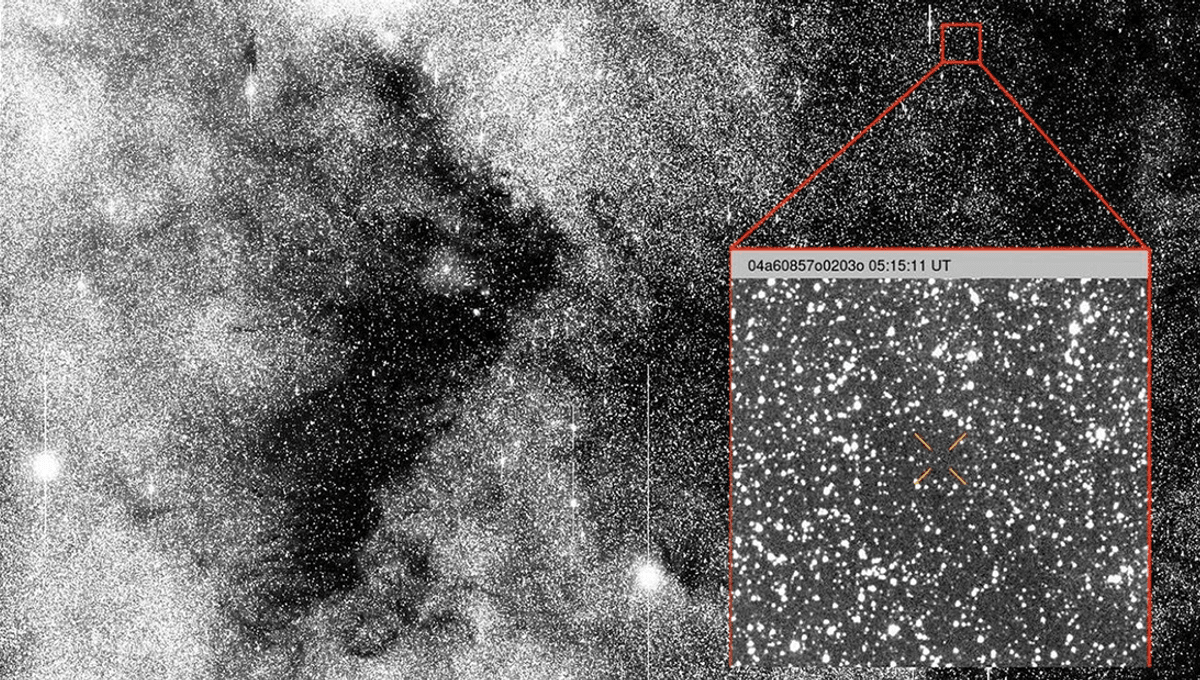
A team of astronomers has attempted to track the path of interstellar object 3I/ATLAS back into the past, tracing its path through the galaxy in simulations involving over 13 million stars.
On July 1, astronomers spotted an unusual object speeding through the Solar System at nearly twice the velocity of previous interstellar visitors ‘Oumuamua and Comet Borisov. The object was soon confirmed to be an interstellar comet, and is suspected to have a nucleus (the rocky center of the comet, excluding its coma) of around 5.6 kilometers (3.5 miles), and a potential mass of over 33 billion tons.
The astronomical community continued to track the object as it moved through the Solar System and behind the Sun from our perspective. We may even have seen it using NASA’s Perseverance rover on Mars.
But where did it come from? Luckily for us, gravity is time-reversal symmetric, and if we know an object’s trajectory, we can work backwards and trace its path. In a new paper submitted to the Astrophysical Journal, but not yet peer reviewed, a team from the University of A Coruña attempted to do just this.
The team used data from the European Space Agency’s Gaia mission, which produces a three-dimensional map of stars and other objects in the Milky Way and beyond. Tracing the object’s path backwards through 10 million years, the team tried to identify where it had close encounters in the past, coming within 2 parsecs (6.5 light-years) of another star.
“We identify 93 nominal encounters, 62 of which are significant at the 2σ level. However, none of these encounters produced any meaningful perturbation,” the team writes in their paper. “The strongest perturber Gaia DR3 6863591389529611264 at 0.30 pc and with a relative velocity of 35 km s−1, imparted only a velocity change of |∆v| ≃ 5 × 10⁻⁴ km s−1 to the orbit of 3I/ATLAS. Our results indicate that no stellar flybys within the past 10 Myr and 500 pc contained in Gaia DR3 can account for the present trajectory of 3I/ATLAS or be associated with its origin.”
In short, none of these potential close(ish) encounters could explain 3I/ATLAS’s origin, and barely altered its trajectory. But mapping it back into the past, the team believes it likely originated from the galaxy’s thin disk, in contrast to an earlier study, which suggested it may be from the thick disk, given how little it wandered from the galactic plane.
“Together, all data indicate that while 3I/ATLAS follows a thin-disk orbit in the solar neighborhood, it may nonetheless be an old object, consistent with ejection from a primordial planetesimal disk in an early-formed system, or from an exo-Oort cloud, and is most likely associated with the transition region between the thin and thick disk, although its origin remains undisclosed,” the team concludes.
Further study of 3I/ATLAS and other interstellar objects is needed to draw further conclusions, but this preliminary study suggests it could be a very old object, that may have been traveling alone for billions of years until we spotted it near our star. The team suggests the object is around 10 billion years old, making it a time capsule of the formation of the earliest planetary systems in the galaxy and universe, though we will likely never know its true origin.
“What makes 3I/ATLAS unique is that it allows us to study the evolution of objects originating from other stellar systems – something we had only theorised about until now,” Pérez Couto, Centre for Research in Information and Communication Technologies researcher and team leader, added in a statement. “Each observation is like opening a window into the Universe’s past.”
The study is posted to the pre-print server arXiv.

Source Link: Interstellar Object 3I/ATLAS May Be A 10-Billion-Year-Old Time Capsule From An Earlier Age Of The Universe
