An amateur astronomer looking through data from NASA’s Perseverance rover may have spotted interstellar comet 3I/ATLAS as it passed overhead.
3I/ATLAS was discovered on July 1, this year, moving through the Solar System at nearly twice the velocity of previous interstellar visitors ‘Oumuamua and Comet Borisov. The object was confirmed to be an interstellar comet and is suspected to be far larger than the previous two, with an estimated nucleus (the rocky part of the comet, excluding its coma) of around 5.6 kilometers (3.5 miles), and a possible “anomalous” mass of over 33 billion tons.
The astronomical community continued to track the object, known to be a comet due to outgassing as it gets closer to the Sun on its way through the Solar System. Now, it has vanished from Earth’s view and won’t be back in it until later this year. But Earth is not the only place in the Solar System where humanity has cameras and scientific instruments.
On October 3, Comet 3I/ATLAS had its closest approach to Mars, passing by it at a distance of around 29 million kilometers (18 million miles). NASA and the European Space Agency (ESA) both planned to observe the sky during this timeframe using space robots such as Mars Express and the ExoMars Trace Gas Orbiter, and we’ll find out soon enough if they observed it from Mars’ orbit. And possibly, as the case may be, by the Perseverance rover on the Red Planet’s surface.
Here’s where it gets a little murky. As the US space agency explains on its website, “NASA Operating Status: NASA is currently CLOSED due to a lapse in Government funding”. While NASA is unable to post information on any data that may have been captured by its robots, Perseverance continues to send its raw images, which are available to the public to view. Looking through those images, some believe they have identified the interstellar object. While one has been picked up by the press and the Internet alike, this one is unlikely to be an image of 3I/ATLAS. However, another that has gone unnoticed by most media may be worthy of some further attention.
Let’s begin with the stupider claims. NASA runs an “image of the week” feature on its website, highlighting the images that the public has voted to be the best that week. Unsurprisingly, this week it was an image of what people think looks suspiciously like 3I/ATLAS.

NASA’s image of the week shows an object some claim is 3I/ATLAS.
Image credit: NASA/JPL-Caltech
“NASA’s Mars Perseverance rover acquired this image using its onboard Right Navigation Camera (Navcam). The camera is located high on the rover’s mast and aids in driving,” NASA explains of the image, adding “this image was acquired on Oct. 4, 2025 (Sol 1643) at the local mean solar time of 21:33:39.”
While more conspiracy-minded folk have declared “it’s not a comet… it’s perfectly cylindrical,” they are likely at least 50 percent correct, if not 100 percent. First off, the cylindrical shape is an artifact of the camera’s shutter speed and the fact that the object was moving overhead. If you instead track the object, it is the other objects around it that begin to look cylindrical, as seen in this Hubble image below.

3I/ATLAS seen by Hubble.
Image credit: NASA, ESA, D. Jewitt (UCLA), J. DePasquale (STScI)
According to IFLScience’s own resident astronomy expert, Dr Alfredo Carpineti, the object is more likely to be one of the Mars orbiters. It is difficult to pin these things down based on a smudge.
So IFLScience went through the raw Perseverance data following a Reddit post claiming to have the first images. While there is definitely something moving across the several minutes of this time-lapse, the object is too fast to be the comet. This might have been one of the orbiters that fly around Mars.
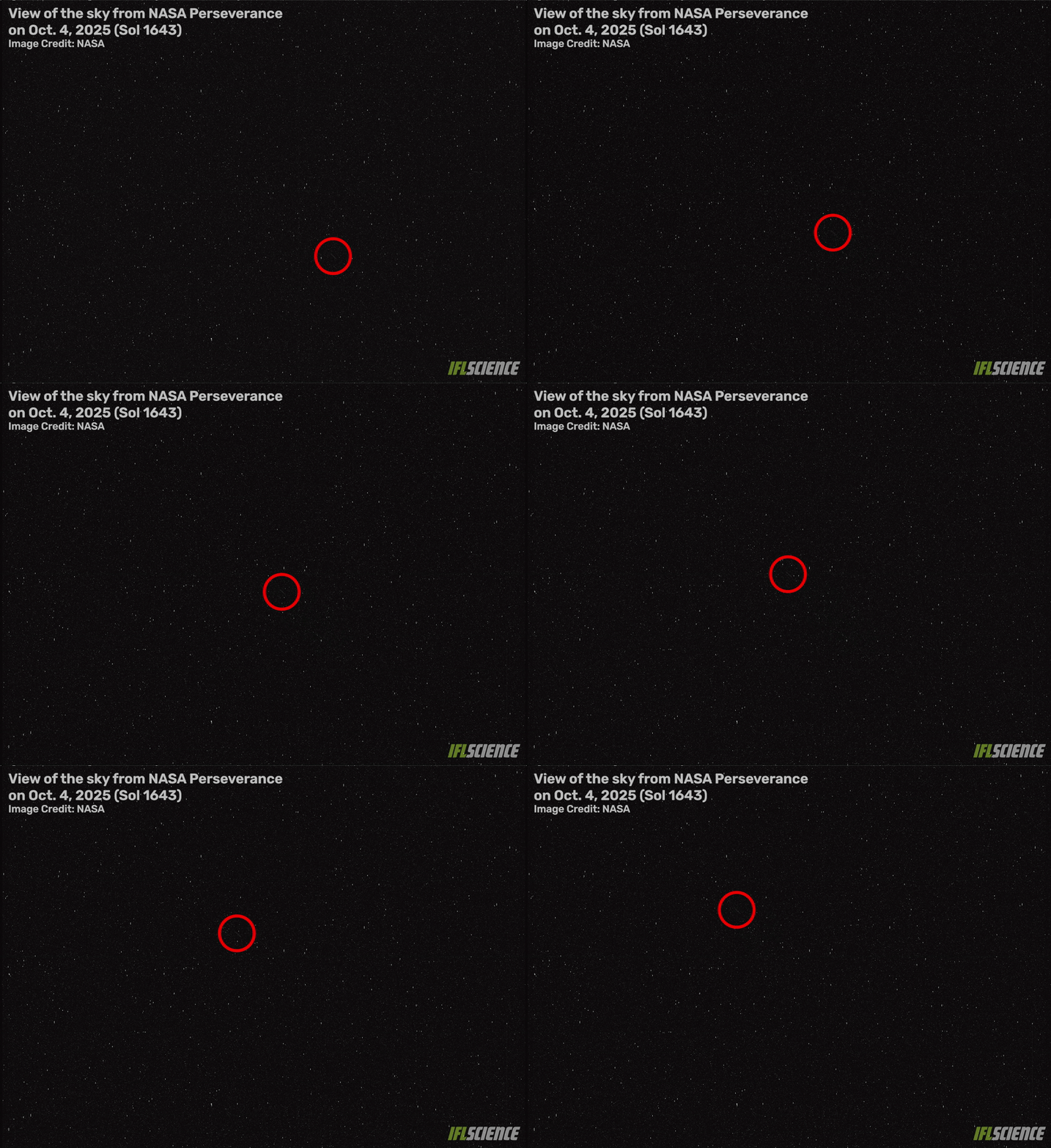
Perseverance’s view of the sky, October 4, 2025, most likely not seeing 3I/ATLAS. Time-lapse created by IFLScience from NASA data
Image credit: NASA, modified by IFLScience
But there is a better candidate, which appears to have been first spotted by Simeon Schmauß.
“I think Perseverance may have spotted interstellar comet 3I/ATLAS last night from Mars!” Schmauß wrote on Bluesky. “After stacking 20 images from Mastcam-Z, I found a faint smudge of light in the constellation Corona Borealis close to the location where the comet was expected.”
While the object appears in the right area of the sky, and looks more like what you might expect if NASA trained its cameras on an object in an attempt to take a long exposure of this distant source, we’re afraid that it is a waiting game to find out exactly what we’re looking at.
In short, we may have seen an Interstellar object from the surface of another world for the first time, but we will need to wait further for confirmation. Fingers crossed the shutdown does not last much longer.

Source Link: Interstellar Object 3I/ATLAS May Have Been Caught In Perseverance Rover Photo
