


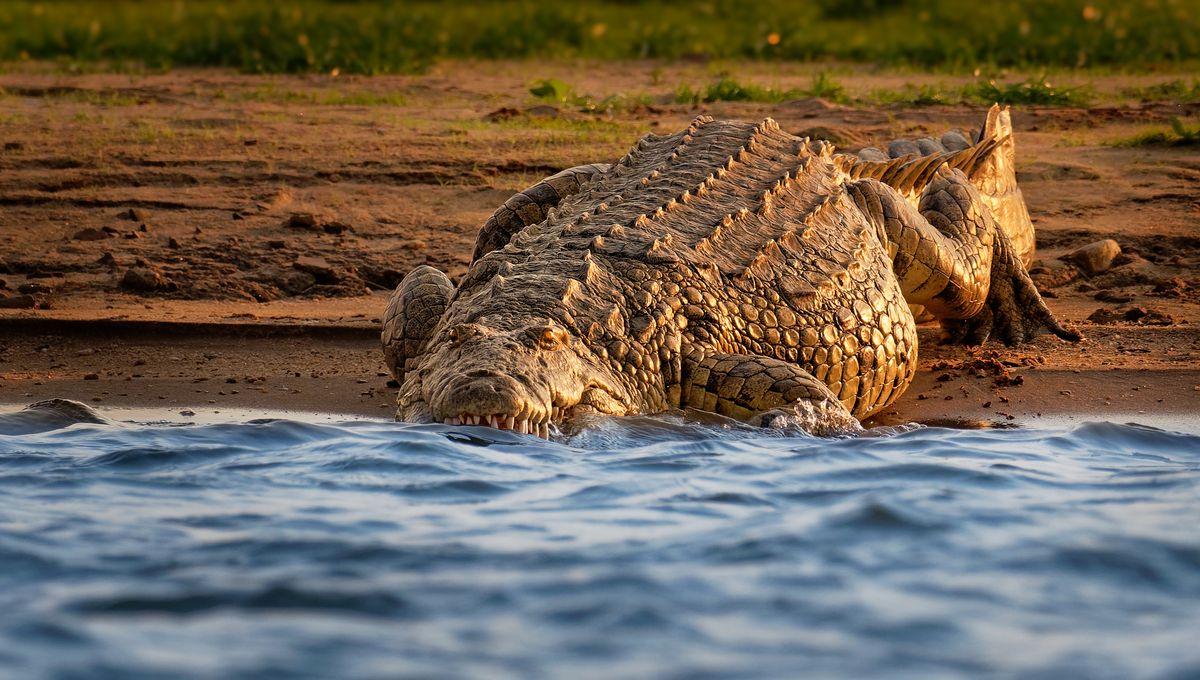
We strongly advise you never go swimming in Burundi’s Rusizi River, but if fate deals you a cruel hand and you’re left with no other option, beware of Gustave.
Gustave is a legend in this part of East Africa, surrounded by decades of folklore, fear, and fragmented accounts. Most of what we know about this crocodile comes from a spate of media reports that came out around 20 years ago, including a documentary, Capturing the Killer Croc, which aired in 2004 on PBS and the 2007 monster movie Primeval, inspired by the documentary’s attempts to capture the croc, including trying to lure Gustave into a trap using a live goat. Watch the movie to see how that goes.
Lurking in the Rusizi River and the northern shores of Lake Tanganyika, he’s said to be sometimes mistaken for a large boat. Estimates of his size vary wildly, as with any beast steeped in legend, but one widely cited measurement puts him at 6.1 meters (over 20 feet) from snout to tail and around 900 kilograms (2,000 pounds). For comparison, the average male Nile crocodile is 4-5 meters (13-16 feet) and weighs 410 kilograms (900 pounds).
By some accounts, Gustav is responsible for the deaths of over 300 people, namely children and adolescents who dare to go near his waterways, dating as far back as 1987, and peaking in the late 1990s and early 2000s. Most experts believe this unverified figure is almost certainly overblown, but there is some evidence that links Gustave to dozens of attacks.
In 2005, National Geographic headed to Burundi to investigate the legend and spoke to Patrice Faye, a self-described “man of the bush” who became the de facto expert on the killer croc. The eccentric Frenchman explained that a suspicious number of crocodile fatality reports in the area closely lined up with the known whereabouts of Gustave, who he estimated to be around 60 years old at the time.
In many instances, government officials and police authorities blamed an unusually large crocodile. Witnesses have reported that the giant crocodile has three distinctive dark scars on top of its head, likely caused by bullets from previous attempts to kill it.
“He travels all the way to the areas of Rumonge and Minago and eats fishermen and bathers en route,” Faye, the French-born herpetologist, told the BBC in 2002.
“He can eat 10, 15 or 20 people along the bank. One year, I followed the path he took on one of his forays and 17 people had been eaten between Kanyosha and Minago, and Kabezi and Magara.”
The attacks reportedly happened in bouts, with a series of victims being taken in rapid succession between October and February. Things would then go quiet for around three years, until the death cycle started up again. Nile crocs usually drag their prey away from the attack site to consume either in the water or to stash away for consumption later. Unusually, Gustave reportedly would attack and sometimes leave his victims where they were, opening up the question of why he was attacking if not for food.
Faye remarked that most crocodile attacks in the area go unreported, primarily because they tend to impact younger people from poor, remote communities. However, he and National Geographic reporters did manage to interview some people who had narrowly escaped a run-in with Gustave.
One of these victims was a young barber named Hatungimana Audifax, who lost his leg to a crocodile, believed to be the legendary large croc.
“It was seven years ago, when I was 13,” he told National Geographic. “Around 11:30 in the morning, my friends and I went for a swim. They say people on shore were shouting ‘crocodile!’ but I didn’t hear them. The croc grabbed me by the leg. At first, I thought it was one of my friends. I looked back and saw this thing that was huge and old. Then I felt the pain. It was unbelievable.”
“It was like he was escorting me,” the barber continues. “He didn’t attack, maybe because the fishermen were beating on the water. I turned to look at him and our eyes met. My leg was crushed and some of the calf muscle was torn off. I was almost losing my mind because of the pain.”
Sightings of Gustave have grown increasingly rare in recent times. Aside from a reported sighting in 2009 and an unconfirmed encounter in 2015, news of the crocodile has faded, as have the sensational headlines that once followed.
There were rumours that Gustave’s reign of terror may even be over. In March 2019, Nicky Dunnington-Jefferson wrote in Travel Africa Magazine: “According to reports I’d read and a television programme I’d seen, Gustave had eaten people — some say 300, others 60, and some only three. I had wanted to meet Patrice Faye, who knew more about Gustave than anyone else. I learnt, though, that, sadly, Gustave has been killed and Patrice Faye is no longer in the country.”
This claim about Gustave’s demise remains unverified and no body has been found, but the lack of reports does suggest he may be a goner. Alternatively, perhaps he was never a single monster, but a collection of crocodiles stitched together in folklore and fear.
Or maybe, just maybe, he is still out there, wisely laying low for his next outburst.


Source Link: Is Gustave The Killer Croc Dead? Notorious Crocodile Accused Of 300 Deaths Is Surrounded By Legend