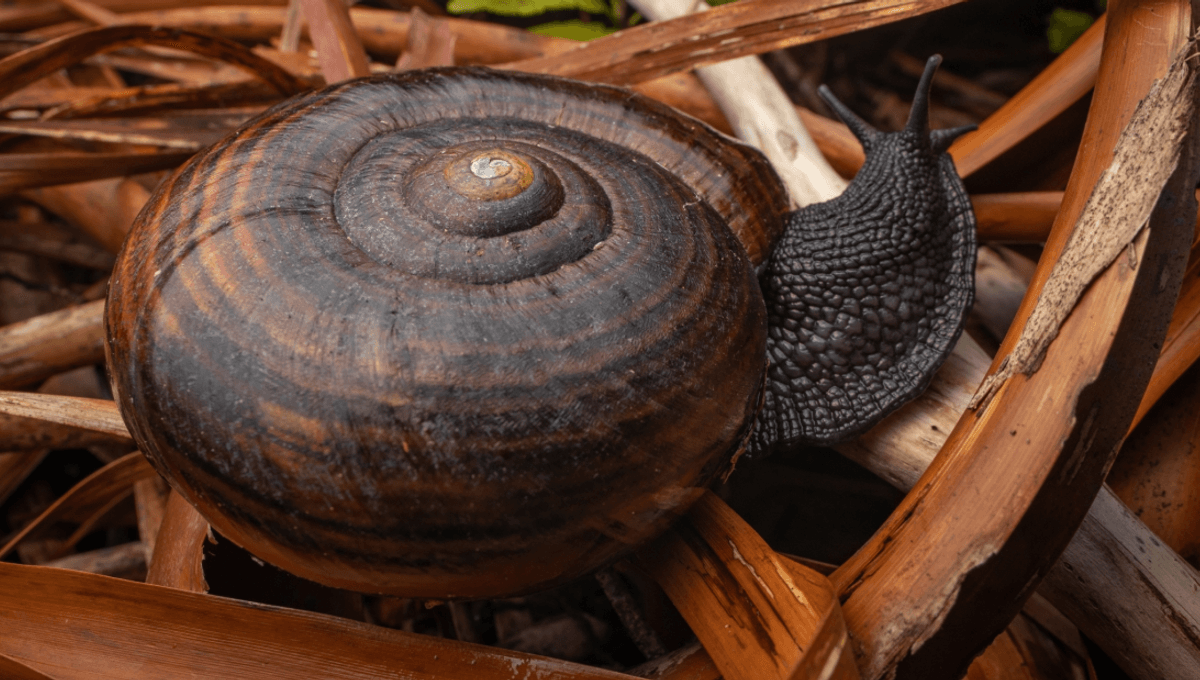
It’s hard not to feel jealous of New Zealand, home to some of the planet’s most spectacular organisms. They’ve got blue mushrooms and the world’s rarest and most eccentric birds (that aren’t easy to get sperm from, FYI). The most recent specimen to catch our eye? A snail whose worm slurping skills makes that spaghetti scene in Lady And The Tramp look amateur.
If this is your first time hearing about the snail Powelliphanta hochstetteri, prepare to be impressed. For starters, these babies are massive. About the size of a lemon, they have beautiful brown shells and big black bodies. Becoming such a unit takes calories, which is why these snails have developed a taste for meat.
“These snails are quite special because they’re carnivorous,” said science advisor and director of operations for Project Janszoon Ruth Bollongino to Justine Hausheer for The Nature Conservancy. “They’re not after the lettuce in your garden. They’re out hunting worms and other snails, and they can suck down earthworms like spaghetti.”
It’s incredible to watch, but unfortunately it’s a sight few will get to see in the modern era. There was a time these snails were so plentiful they were jamming up the roads. Now, we wish that was the problem.
Powelliphanta snails, including P. hochstetteri and the other ~19 species in the genus (one of which you may have recently spotted laying eggs from its neck), are now among the most endangered invertebrates in the world. Like much of New Zealand’s native wildlife, they’ve suffered from the introduction of invasive predators like rats and stoats. However, research using tagged snails has revealed that in some places, it’s actually a native animal that’s behind most snails’ demise.
Weka, a brown flightless bird, have enjoyed the reverse of what we’ve seen for Powelliphanta, having once been a rare sighting that’s now so common there are signs up warning campers to zip their tents unless they want to be robbed. The weka boom is probably connected to the loss of other native birds that means they now have few predators or competition. Great for the weka, but bad news for our worm-slurping snail.
“What we see is that the decline of the Powelliphanta coincides exactly with the arrival of weka records up in the uplands. And we also have the shells that prove it,” said Bollongino. “They are just being hammered from all sides, not to mention the effect of global warming. The older snails can deal with it to some degree, but drought can kill the young snails.”
This is why Project Janszoon have established weka-proof areas within Abel Tasman National Park to try and give the snails a bit of respite. The fenced-off areas are around 70 by 70 meters (230 by 230 feet) wide, allowing a bounce-back of biodiversity that keeps large predators out while letting the snails roam free. So far, it’s been a success.
“There’s wētā everywhere, and earthworms and flatworms… It’s just crawling with life,” said Bollongino.
For now, Powelliphanta live to slurp another day.
[H/T: Predator Free NZ]

Source Link: “It Can Suck Down Earthworms Like Spaghetti”: The Mission To Save A Really Big Snail
