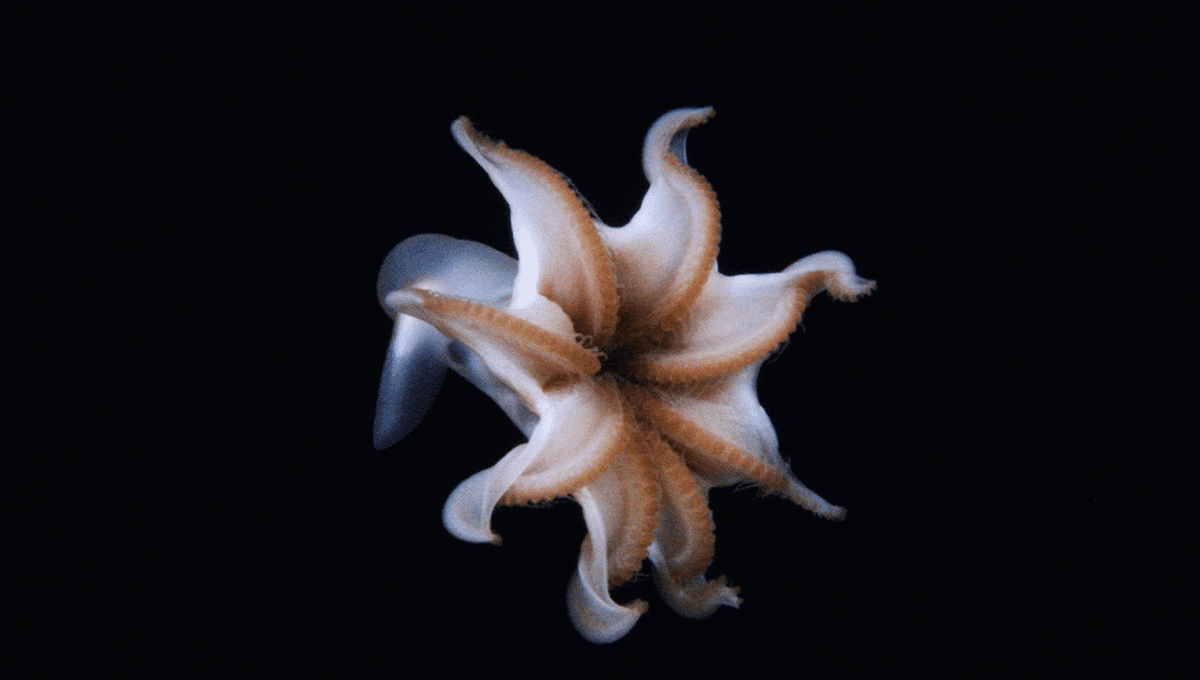
Exploring the deep ocean comes with the chance to encounter all kinds of weird and wonderful species. You could come face to face (ish) with a faceless cusk eel, Chewbacca corals, dancing sea pigs – or if you’re lucky, an otherworldly-looking octopus, as scientists exploring the abyssal plains of the South Pacific recently discovered.
The rest of this article is behind a paywall. Please sign in or subscribe to access the full content.
The team, part of the Ocean Exploration Trust, was on board the E/V Nautilus and roughly 160 kilometers (100 miles) from Aituaki Island, part of the Cook Islands, when they spotted the octopus at a depth of around 5,000 meters (16,400 feet).
“It felt wild to see this cephalopod! I was awed by the way that it seemingly put on an otherworldly show – beginning its dance along the seafloor, drifting into the water column, opening its mouth to our camera and eventually skimming off into the dark abyssal distance,” Madison Dapcevich, Communication Lead for the Ocean Exploration Trust, who was onboard the E/V Nautilus at the time, told IFLScience.
“The deep-sea, eight-armed animal came into our camera view just as we were doing our watch change. This is when the previous watch, in this case 1200-1600, hands over the control van to the relieving watch, which in this case was 1600-2000. We had nicknamed the ‘four to eight’ team the ‘octo-watch’ because they had been spotting most of the octopuses in this deep-sea abyssal plain environment – and there was an ongoing joke onboard that as soon as I gave up my seat in the control van, the octopuses came out to visit!” added Dapcevich.
Originally thought to be a dumbo octopus, the species spotted is now believed to be a member of the Cirroteuthidae octopus family, possibly in the Cirrothauma genus, which often shows a large web that is connected to each arm. These octopuses can either swim with their fins or drift along in the water column with their arms and webs outstretched.
Little is known about the life cycles of these creatures, given the difficulties in studying them, but it is suggested that they have slow metabolic rates and the life cycle could take many years owing to the deep cold waters in which they live.
“Life in the abyssal plains of the South Pacific is quite unique,“ said Dapcevich. “Organisms that live here have evolved distinctive adaptations to their habitat’s extreme environments – an enormous amount of pressure, near-freezing temperatures, and absolute darkness.“
The octopus was spotted as part of a 21-day expedition exploring the deep sea around the Cook Islands. This region contains abyssal plains, seamounts, and volcanic ridges, making it important biologically for a range of species, and it is also part of a marine-managed area.

Source Link: “It Seemingly Put On An Otherworldly Show”: Watch As This Beautiful Deep-Sea Octopus Glides Gracefully Through The Ocean
