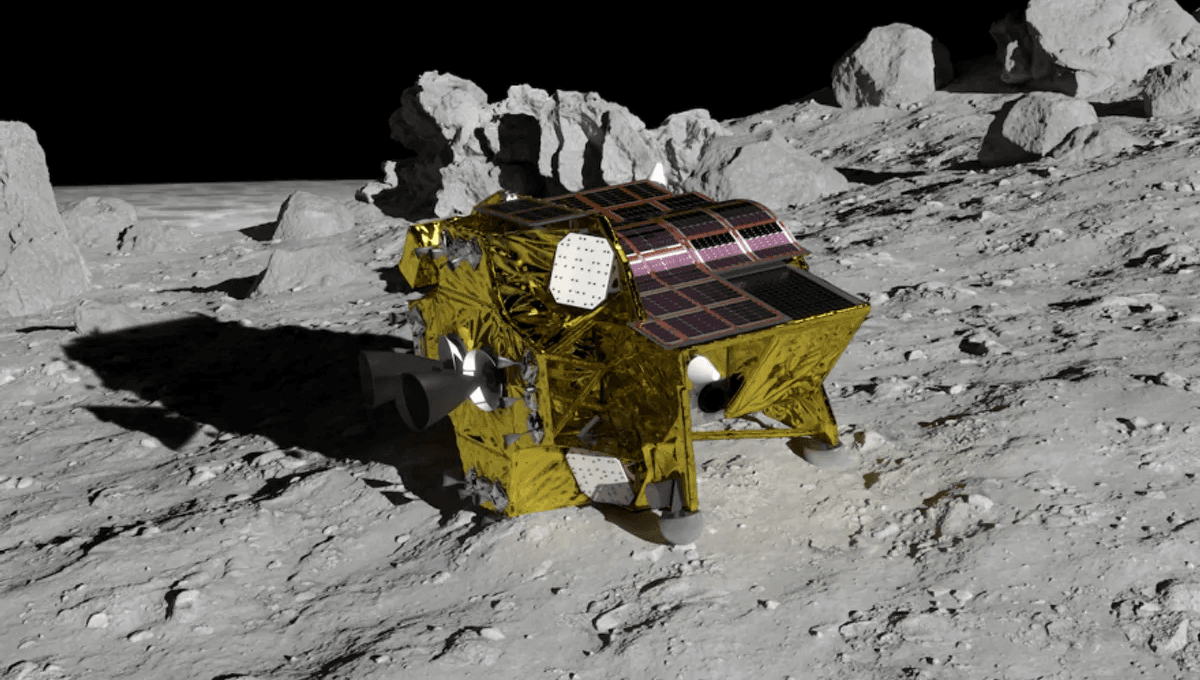
Today, January 19, at 3:20 pm UTC, the Japan Aerospace Exploration Agency (JAXA) has made history – not just for Japan, but for the whole world. Its Smart Lander for Investigating Moon (SLIM) successfully soft-landed on the Moon. The goal was to be able to do so within just 100 meters (330 feet) of a specific target area. Never before have humans attempted such precision in landing a spacecraft on another world. It looks like it achieved this but confirmation of the precision is expected next week.
With SLIM, Japan becomes the fifth nation ever to soft-land on the Moon, and the third this century. Two other Asian countries – China and India – also performed the not-so-easy feat, joining the previous success of the United States and former Soviet Union from the 1960s and ’70s.
SLIM is a technology demonstration for high-precision landing. It used observations from another JAXA mission, SELENE (also known as Kaguya), to know precisely where it was on the surface of the Moon and move precisely to the target area. In comparison, the expected landing site for Apollo 11 was an ellipse 20 kilometers by 5 kilometers (12 by 3.1 miles). Achieving a landing “where we want” rather than “where we can” is a truly incredible feat.
However, not everything has gone perfectly. After a much-anticipated press conference, JAXA confirmed SLIM’s solar cells are not charging and generating electricity so it is currently using only its batteries. If SLIM can’t charge, its mission life could be just a few hours. There is a chance that when the Sun’s direction changes it may hit the solar cells and they could start charging, but for now JAXA has shut down part of the spacecraft to save power and is prioritizing downloading the landing data and photographs taken. Still, the mission has achieved much already, including the precision landing and the release of its two rovers, which are both communicating with Earth.
Both rovers have some interesting experimental designs: the first will move using a hopping mechanism and is equipped with cameras and a few science payloads. The second, an extremely light rover weighing just 250 grams (9 ounces), is a shapeshifter that can change shape to best adapt to various conditions it might encounter on the Moon’s surface.
Despite the human Moon landings and the several soviet missions from decades past, reaching and landing on our natural satellite is fraught with complications – and we are not just talking about the precision reached by SLIM today. Japan has failed before. Back in November 2022, JAXA’s OMOTENASHI lander was lost before it reached the Moon while a similar fate was suffered in April 2023 by a Japanese startup attempting to become the first private company to land on the Moon.
In August last year, Russia attempted its promised return to the Moon. This also ended poorly, with the spacecraft crashing on the surface, creating a brand new crater that was imaged by NASA. Just yesterday, the private US mission Peregrine One also failed to reach the Moon, instead burning up as it fell back into Earth’s atmosphere.
With many more Moon missions scheduled for this year, success is not guaranteed, even 50 years after humans walked on the lunar surface. For now, Japan has achieved a major milestone today, taking us another step forward in Moon exploration.

Source Link: Japan Becomes Fifth Country To Land On The Moon Successfully
