Interstellar comet 3I/ATLAS is about to be studied from not one but two locations in deep space. The comet has just gone through perihelion, the closest approach to the Sun, but unfortunately, it is on the opposite side of our star. Over the last few days, it has become visible again, but it can’t be studied in detail from observatories on and around Earth due to the glare of the Sun. That’s how JUICE comes into the fray.
The rest of this article is behind a paywall. Please sign in or subscribe to access the full content.
The European Space Agency’s JUICE is a groundbreaking mission to study the icy moons of Jupiter: Ganymede, Callisto, and Europa. We believe that there are liquid oceans inside those moons, and the mission will study their properties, including the possibility of life. It will also become the first spacecraft to enter orbit around a moon that is not the Moon: Ganymede, the largest moon in the Solar System and the only one with a magnetic field.
But to do all that, the spacecraft is on a fuel-saving, slow-and-steady trajectory to Jupiter – it will get there in the early 2030s. So, the probe is just traveling in deep space, which means it is in a fortuitously good position to catch comet 3I/ATLAS in these exciting days post-perihelion.
“All this campaign was unexpected for everybody!” Olivier Witasse, ESA Project Scientist, told IFLScience. “For JUICE, indeed, we are in a cruise phase during which there are thermal constraints, being relatively close to the Sun (with respect to the science phase around Jupiter). Therefore, no payload activities were expected to take place at this moment. However, given the uniqueness of these observations, it was decided to prepare this extra observation planning.”
The spacecraft will observe the comet twice, even though it will never get very close. The close passage will be on November 4, when the comet will be 64 million kilometers (39.8 million miles) from JUICE. That is about 0.428 astronomical units, with 1 AU being the average Earth-Sun distance. Despite the distance, JUICE has a camera and instruments ready to study the comet.
“JUICE will observe 3I/ATLAS between 2 and 25 November. We will be using five instruments: the camera, the near-infrared imaging instrument, the UV spectrometer, the sub-millimetre instrument, and a sensor to image neutral atoms. We are far away (0.5 Astronomical units), therefore, only remote sensing,” Witasse explained.
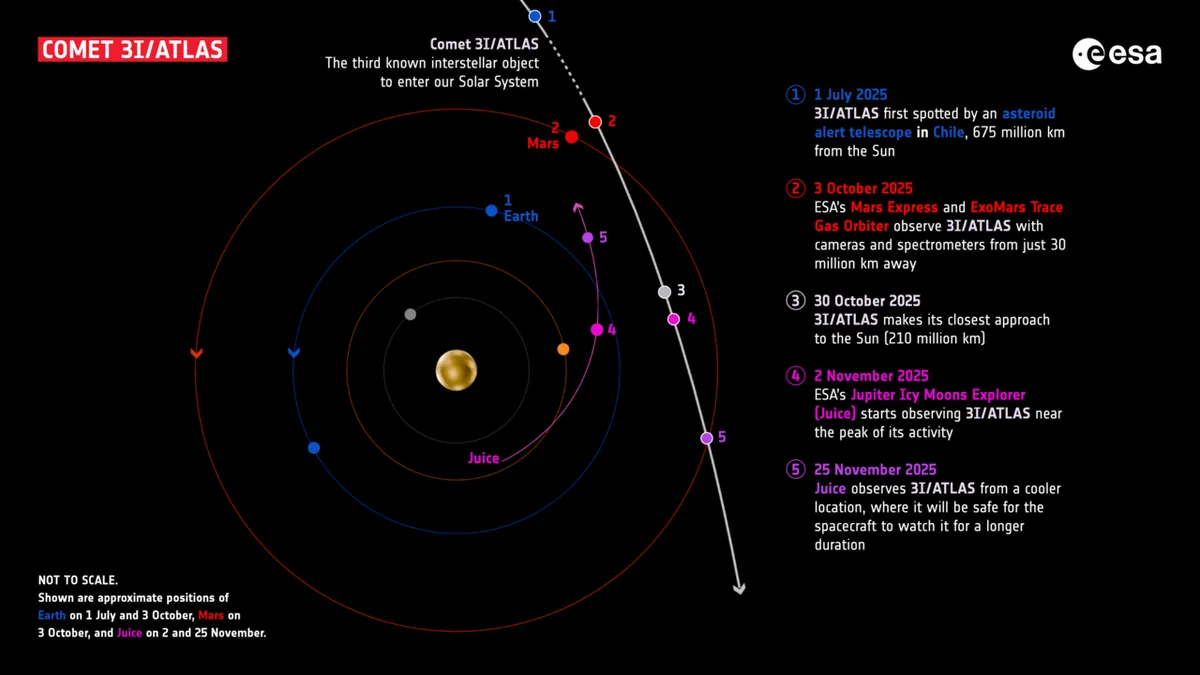
Some important dates for the comet and JUICE are coming up.
Image Credit: ESA
ESA missions not on Earth have already observed the comet, such as the space agency’s orbiters around Mars. Using JUICE is a great opportunity to study the comet at its period of maximum activity, even though it will take some time to collect all this data.
“Due to the position of JUICE with respect to Earth, the data rate is very low. We expect the data to be downloaded only in February 2026, so we need to be a bit patient,” Witasse explained.
While we wait for these insights, more will be coming. The comet is now coming away from the Sun, and the Earth is moving towards it, so we will have better chances to see it from our own backyard.

Source Link: Jupiter-Bound Mission To Study Interstellar Comet 3I/ATLAS From Deep Space This Weekend
