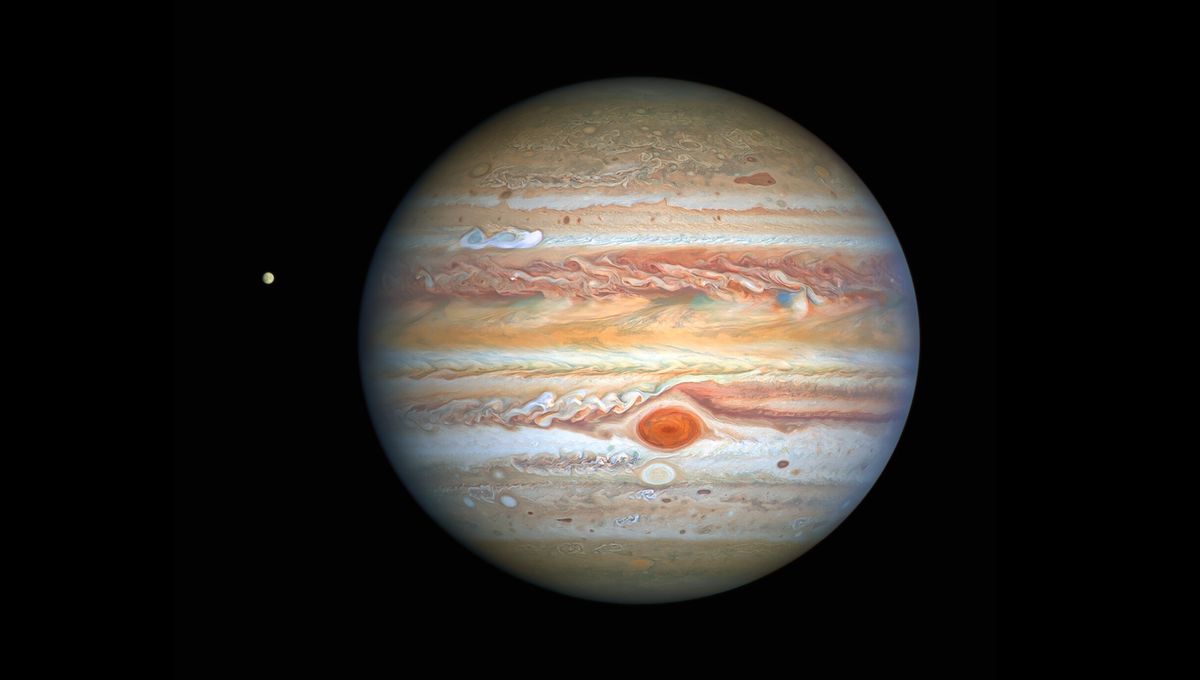
Jupiter is a very pretty planet. Whether seen with a small telescope or up close by spacecraft, the planet’s colorful stripes and storms are a stunning defining feature. They are the product of a complex atmosphere always churning, which can regularly lead to stripes changing color.
The reason for it has been quite the cosmic conundrum but researchers believe they have found a possible solution. The changes are linked to infrared variations seen 50 kilometers (31 miles) deep within the atmosphere. And that variation appears to be linked to the planet’s magnetic field.
“If you look at Jupiter through a telescope, you see the stripes, which go round the equator along lines of latitude. There are dark and light belts that occur, and if you look a little bit more closely, you can see clouds zipping around carried by extraordinarily strong easterly and westerly winds,” Professor Chris Jones, from the University of Leeds, said in a statement. “Near the equator, the wind blows eastward but as you change latitude a bit, either north or south, it goes westward. And then if you move a little bit further away it goes eastward again. This alternating pattern of eastward and westward winds is quite different from weather on Earth.”
“Every four or five years, things change. The colors of the belts can change and sometimes you see global upheavals when the whole weather pattern goes slightly crazy for a bit, and it has been a mystery as to why that happens.”
Jupiter’s magnetic field is extremely intense, about 20,000 times stronger than Earth’s own. Researchers tracked the magnetic field over several years thanks to NASA’s Juno mission, gaining insights into how it changes.
“It is possible to get wavelike motions in a planetary magnetic field which are called torsional oscillations. The exciting thing is that when we calculated the periods of these torsional oscillations, they corresponded to the periods that you see in the infrared radiation on Jupiter,” Professor Jones added.
One interesting feature in the magnetic field is called the Great Blue Spot (unrelated to the Great Red Spot in the atmosphere). This feature has been moving eastward for a while, but it has been slowing. The Juno team believes that it might soon reverse and begin moving toward the west, causing upheaval inside Jupiter.
“There remain uncertainties and questions, particularly how exactly the torsional oscillation produces the observed infrared variation, which likely reflects the complex dynamics and cloud/aerosol reactions,” lead author Dr Kumiko Hori explained. “Those need more research. Nonetheless, I hope our paper could also open a window to probe the hidden deep interior of Jupiter, just like seismology does for the Earth and helioseismology does for the sun.”
Juno continues to survive the incredible radiation around Jupiter. Its mission has now been extended to September 2025.
The study is published in Nature Astronomy.

Source Link: Jupiter’s Color-Changing Mystery Might Finally Have An Answer
