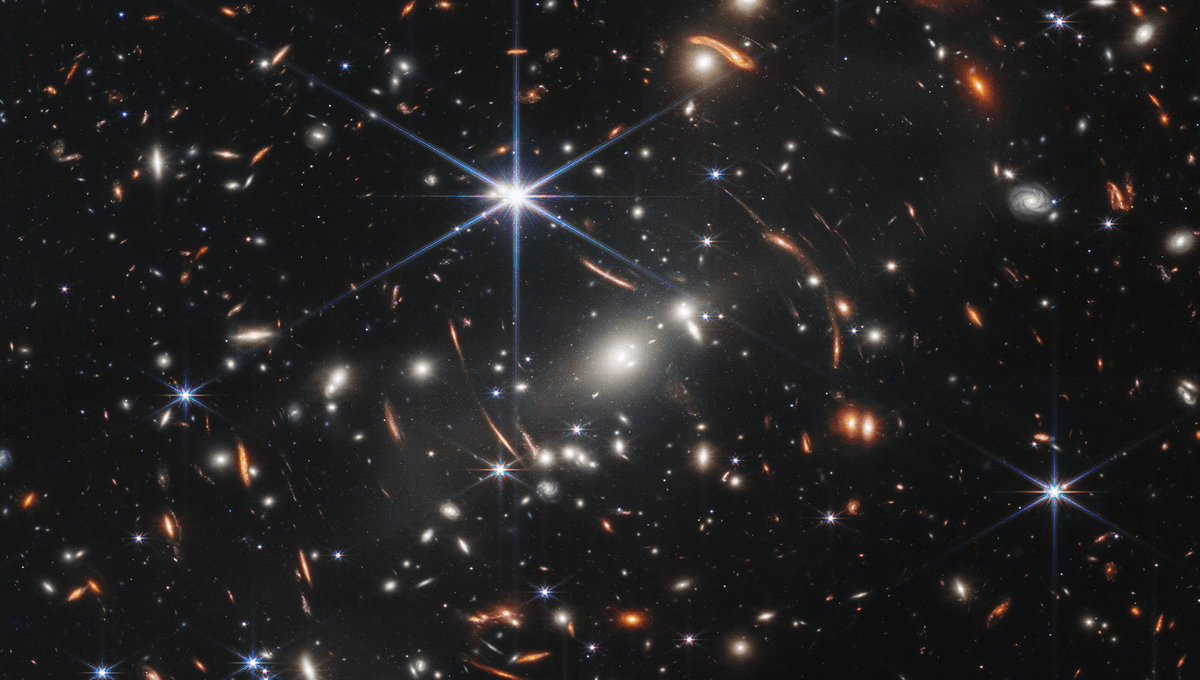
Astronomers have announced new evidence on a bit of a controversial topic in the field: the number of bright galaxies that existed in the early universe, specifically within the first 600 million years following the Big Bang. Hubble had shown that the number was higher than expected but ground observations disagreed with this assessment. Now, new JWST observations suggest that the Hubble analysis was right.
The galaxies were selected from the largest Hubble Brightest of Reionizing Galaxies (BoRG) pure-parallel survey. They came from 200 different lines of sight to ensure the sample was universal rather than just from a lucky spot. Their distance was based on their colors, which JWST calculates by measuring the spectrum of light of these galaxies, confirming that over 50 percent of the BoRG were indeed from the distant universe.
“The highlight of what I find in this recent study is that we’re truly having this many bright galaxies, and this is important to see how reionization happens,” Dr Sofía Rojas Ruiz of UCLA, who presented this work at the 32nd General Assembly of the International Astronomical Union that took place in South Africa this week, told IFLScience.
Reionization is a not completely understood early epoch of the universe. Once the cosmos cooled down enough, about 400,000 years after the Big Bang, hydrogen atoms were able to hold on to their electrons. They were no longer ionized as they had been since the first proton popped into existence.
This neutral hydrogen gas made the universe opaque, not that there was much to see then. The first stars were yet to begin to shine. It took many tens of millions of years for the first stars and then the first galaxies to form. Those stars emitted a lot of ultraviolet light and that light ionized hydrogen once again, hence reionization.
This is why the BoRGs are important. Just like the Borgs of Star Trek, for the neutral hydrogen, resistance was futile. Their light ripped the electrons from the hydrogen nucleus. The new research showed that while bright as a whole, the population has a lot of diversity. These objects are not just forming stars at a constant high rate, but they are also experiencing bursts of star formation. More bright galaxies with different star-formation histories paint a specific picture of the early universe.
If the early bright galaxies are few then they had to do a lot of work to reionize the whole universe. That means that they are powerhouses that dramatically changed the cosmos. But with a lot more objects taking turns becoming bright as their star-formation rate picked up, the whole process can be more gentle.
“When you look at the abundance of these galaxies, you can precisely say [whether] reionization is happening fast or more smoothly. What we see now with the higher abundance is that it’s going more smoothly,” Dr Rojas Ruiz told IFLScience.
So, JWST appears to back up Hubble’s initial analysis that there were more bright galaxies in the early universe. It is not clear why these galaxies were not seen by ground-based observatories, but as Rojas Ruiz points out, “Doing infrared astronomy from the ground is very difficult. It might be that it’s really hard to find this specific population of galaxies. Or perhaps they were more aggressive in their contamination assessment, which is fair because we do have a lot of contaminants in the infrared.”
Dr Rojas Ruiz also runs the Bringing Astronomy to Rural Communities of Colombia (BARCo) project, as part of the International Astronomical Union – Office for Office of Astronomy for Development.

Source Link: JWST Confirms More Bright Galaxies Found In The Early Universe Than Expected
